|
 Yingluck, who attended a trade show in Saraburi province, 100 km
(60 miles) north of Bangkok, called for dialogue to resolve a crisis
that has dragged on for months, with key intersections in the
capital blocked by protest camps. Yingluck, who attended a trade show in Saraburi province, 100 km
(60 miles) north of Bangkok, called for dialogue to resolve a crisis
that has dragged on for months, with key intersections in the
capital blocked by protest camps.
"It's time all sides turned to talk to each other," Yingluck told
reporters. "Many people have asked me to resign but I ask: is
resignation the answer? What if it creates a power vacuum?"
The protests have been punctuated by gunfire and bomb blasts,
including one on Sunday that killed a woman and a young brother and
sister.
They are aimed at unseating Yingluck and erasing the influence of
her brother, former premier Thaksin Shinawatra, who is seen by many
as the power behind the government.
Yingluck's office would not confirm how many days Yingluck had been
working outside the capital.
She was last seen in public in Bangkok nearly a week ago, last
Tuesday, when both anti-government protesters and farmers angry
about not being paid under a rice subsidy scheme were trailing her
and some of her ministers.
She is due to attend a corruption hearing in Bangkok on Thursday.

Foreign Minister Surapong Tovichakchaikul said Yingluck would hold a
cabinet meeting on Tuesday.
"It is highly likely that we will hold the cabinet meeting outside
of Bangkok," Surapong told reporters.
The political crisis, which pits the mainly middle-class
anti-government demonstrators from Bangkok and the south against
supporters of Yingluck from the populous rural north and northeast,
shows no sign of ending soon.
But the army, which toppled Thaksin in 2006 in the latest of 18
coups or attempted coups since Thailand became a constitutional
monarchy in 1932, said it would not interfere.
"Somebody has to take responsibility but that doesn't mean soldiers
can intervene without working under the framework (of the law),"
army chief Prayuth Chan-ocha said in a rare televised address, also
calling for dialogue.
"How can we be sure that if we use soldiers, the situation will
return to peace?" POLITICAL LIMBO
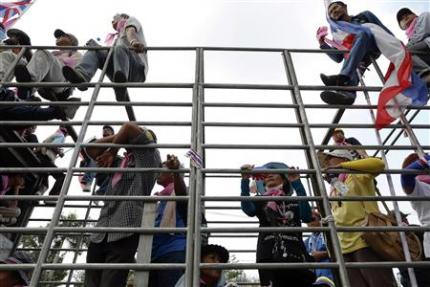
Protesters, who disrupted and boycotted this month's general
election, have been urged by their leader to target businesses
linked to Thaksin and gathered outside a television station on
Monday managed by Thaksin's son.
[to top of second column] |

The Election Commission had said it would try to complete the
election process in late April, but has since suspended that date
pending a court decision, leaving the country in limbo under a
caretaker government with limited powers.
It was not immediately clear who was responsible for Sunday's bomb
blast in a busy central shopping district, but the polarization of
Thai society raises the possibility of wider civil strife.
The 6-year-old sister of a boy killed in the attack died on
Monday, doctors said, taking the death toll to three.
Each side has accused the other of instigating violence, while armed
provocateurs have a history of trying to stir tension. Protesters
and the police have blamed violence on shadowy third parties.
Yingluck described Sunday's attack, and one on Saturday in the
eastern province of Trat in which a 5-year-old girl was killed,
as terrorism.
At least 20 people have been killed and hundreds wounded since the
protests began in November, according to the Erawan Medical Center,
which monitors hospitals.
They are the biggest since deadly political unrest in 2010, when
Thaksin's "red shirt" supporters paralyzed Bangkok. More than 90
people were killed and 2,000 wounded during that unrest, which ended
when troops moved in.
Demonstrators accuse Thaksin of nepotism and corruption and say
that, prior to being ousted in 2006, he used taxpayers' money for
populist subsidies and easy loans that bought him the loyalty of
millions.

(Additional reporting by Aukkarapon Niyomyat, Pairat Temphairojana
and Panarat Thepgumpanat; writing by Nick Macfie; editing by Robert Birsel)
[© 2014 Thomson Reuters. All rights
reserved.] Copyright 2014 Reuters. All rights reserved. This material may not be published,
broadcast, rewritten or redistributed. |