U.S. requires Confucius Institute center to register as foreign mission
 Send a link to a friend
 [August 14, 2020]
By David Brunnstrom and Humeyra Pamuk [August 14, 2020]
By David Brunnstrom and Humeyra Pamuk
WASHINGTON (Reuters) - Washington said on
Thursday it was requiring the center that manages Chinese
government-funded Confucius Institutes in the United States to register
as a foreign mission, in a further sign of deteriorating bilateral
relations.
U.S. Secretary of State Mike Pompeo, in a statement, labeled the
Confucius Institute U.S. Center in Washington "an entity advancing
Beijing's global propaganda and malign influence campaign on U.S.
campuses and K-12 classrooms."
David Stilwell, the top U.S. diplomat for East Asia, told a briefing the
dozens of Confucius Institutes in the United States were not being
kicked out, but said U.S. universities should take a "hard look" at what
they were doing on campus.
Academic exchanges needed to take place without government intrusion,
Stilwell said.
China strongly criticized the move, which "demonizes and stigmatizes"
the normal functioning of the program, foreign Ministry spokesman Zhao
Lijian told a news briefing on Friday.

He said the institutes were open and transparent, and observed local
laws and university rules, adding that China reserved the right to take
further action.
Pompeo said the goal of the move was to ensure American schools "can
make informed choices about whether these CCP (Chinese Communist
Party)-backed programs should be allowed to continue, and if so, in what
fashion."
"The United States wants to ensure that students on U.S. campuses have
access to Chinese language and cultural offerings free from the
manipulation of the Chinese Communist Party and its proxies," he said.
Pompeo said the Trump administration had made it a priority to seek fair
and reciprocal treatment from China and Beijing had enjoyed free and
open access to U.S. society while denying that same access to Americans
and other foreigners in China.
Last year, the U.S. State and Education Departments promised stricter
monitoring of the institutes, which have been criticized in Congress and
elsewhere as de facto propaganda arms of China's Communist government.
In June, the State Department announced it would start treating four
major Chinese media outlets as foreign embassies, calling them
mouthpieces for Beijing.
[to top of second column]
|
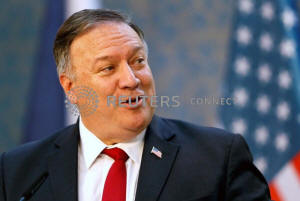
U.S. Secretary of State Mike Pompeo addresses the media at a joint
news conference with the Czech prime minister, at the start of a
four-nation tour of Europe, in Prague, Czech Republic August 12,
2020. Petr David Josek/Pool via REUTERS

U.S.-China relations are at their lowest ebb in decades, with
President Donald Trump taking a tough line on Beijing ahead of his
Nov. 3 re-election bid.
The world's top two economies are at loggerheads on issues ranging
from the handling of the coronavirus pandemic to China's crackdown
on freedoms in Hong Kong and what U.S. officials say is rampant
espionage activity to steal U.S. business and military secrets.
In his briefing, Stilwell said China had taken no action to address
fundamental U.S. concerns about where bilateral ties were going and
also referred to U.S. allegations that Chinese diplomats were
involved activities that undermined medical research and freedom of
speech.
"We are having discussions and we're emphasizing to them that they
need to address our fundamental concerns, and we will take steps if
they do not," Stilwell said, when asked about a recent statement by
China's Vice Foreign Minister Le Yucheng on the need to ensure the
relationship does not derail.
Stilwell said there were about 500 Confucius classrooms in the
United States affiliated with a university-based Confucius
Institute.
According to the U.S. non-profit organization, the National
Association of Scholars, there were 75 Confucius Institutes in the
United States as of June, including 66 at colleges and universities.
The association contends that the institutes compromise academic
freedom, defy Western norms of transparency, and are inappropriate
on campuses. China rejects that criticism, calling it politicized
and baseless.

(Reporting by David Brunnstrom, Humeyra Pamuk, Tim Ahmann and
Jonathan Landay, Cate Cadell; Editing by Susan Heavey, Sonya
Hepinstall and Tom Brown)
[© 2020 Thomson Reuters. All rights
reserved.] Copyright 2020 Reuters. All rights reserved. This material may not be published,
broadcast, rewritten or redistributed.
Thompson Reuters is solely responsible for this content. |