This African nation built its development on diamonds. Now it's crashing
down
[December 01, 2025] By
SELLO MOTSETA and FARAI MUTSAKA
GABORONE, Botswana (AP) — In a village outside Botswana ’s capital,
Keorapetse Koko sat on an aging couch in her sparsely furnished home,
stunned that a career — and an entire nation’s economy — built on
diamonds had fallen so far, so fast.
For 17 years, she had earned a living cutting and polishing the gems
that helped transform Botswana from one of the world’s poorest nations
into one of Africa’s success stories. Diamonds were discovered in 1967,
a year after independence, an abrupt change of fortune for the
landlocked country.
Botswana became the world’s top diamond producer by value, and
second-largest by volume after Russia. Diamonds are woven into the
national identity, with local Olympic champion runner Letsile Tebogo
heading a De Beers campaign celebrating how the industry funds schools
and stadiums.
The stones that Koko and thousands of others dug and polished over the
decades have funded Botswana’s health, education, infrastructure and
more. The country risked the “resource curse” of building its economy on
a single natural asset — and unlike many African nations, it was a
success.
But Koko lost her job a year ago, joining many others left adrift as
Africa’s trade in natural diamonds buckles under growing pressure from
cheaper lab-grown diamonds mass-produced mainly in China and India.

“I have debts and I don’t know how I am going to pay them,” said the
mother of two, who had survived on about $300 a month and relied on her
employer for medical insurance. It had been a decent situation for a
semi-skilled worker in a country where the average monthly salary is
about $500. “Every month they call me asking for money. But where do I
get it?”
‘Diamonds built our country’
Botswana, which has unearthed some of the world’s biggest stones, has
prided itself on prudently managing its natural wealth, avoiding the
corruption and fighting that have plagued many African peers. Its
marketing message has been simple: Its stones are conflict-free and help
fund development.
“Diamonds built our country,” said Joseph Tsimako, president of the
Botswana Mine Workers Union, which represents about 10,000 workers in
the nation of 2.5 million people. “Now, as the world changes, we must
find a way to make sure they don’t destroy the lives of the people who
helped build it.”
He warned that new U.S. tariffs under the Trump administration could
worsen Botswana’s downturn, triggering staffing freezes, unpaid leave
and more layoffs. The U.S. has imposed a 15% tariff on diamonds that are
mined, cut and polished there.
Diamond exports, roughly 80% of Botswana’s foreign earnings and a third
of government revenue, have tumbled.
Debswana, the largest local diamond producer and a joint venture between
the government and mining giant De Beers, saw revenues halve last year.
It has paused operations at some mines as Botswana and Angola enter
talks to take over controlling stakes in De Beers’ diamond mining unit.
In September, Botswana’s national statistics agency reported a 43% drop
in diamond output in the second quarter, the steepest fall in the
country’s modern mining history. The World Bank expects the economy to
shrink 3% this year, the second consecutive contraction.

The rise of synthetic diamonds
The global rise of synthetic diamonds has been swift. They have “given
stiff competition, especially in lower-quality stones,” said Siddarth
Gothi, chairman of the Botswana Diamond Manufacturers Association.
The gems emerged in the 1950s for industrial use. By the 1970s they had
reached jewelry quality. Lab-grown stones now sell for up to 80% less
than natural diamonds. Once making up just 1% of global sales in 2015,
they have surged to nearly 20%.
Glitzy social media videos have fueled the appeal of synthetic gems made
in weeks under intense heat and pressure and marketed as cheaper,
conflict-free and eco-friendly alternatives to stones formed over
billions of years.
[to top of second column] |
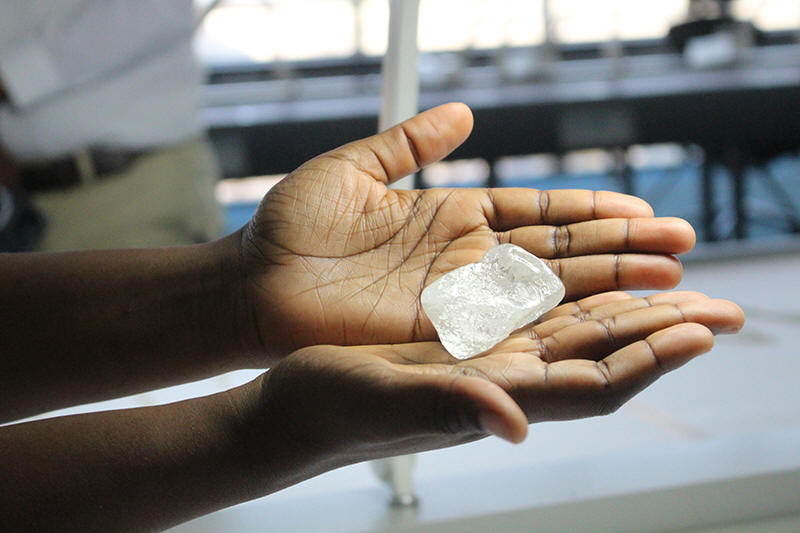
A raw diamond is displayed during a media tour of the Diamond
Trading Company in Gaborone, Botswana, Sept. 16, 2025. (AP Photo/Sello
Motseta)
 Environmental groups have said
natural diamond mining can drive deforestation, destroy habitats,
degrade the soil and pollute the water. But environmental claims
about the synthetic gems also face scrutiny, with critics noting
that production remains energy-intensive, often powered by fossil
fuels.
From “a marginal phenomenon,” an “unprecedented
flood” of synthetics now threatens the natural diamond’s value and
future, World Federation of Diamond Bourses president Yoram Dvash
warned in July.
Lab-grown stones now account for most new U.S. engagement rings, he
said. Natural diamond prices have fallen roughly 30% since 2022,
leaving the industry at what Dvash called “a critical juncture.”
Hollywood stars, including Billie Eilish and Pamela Anderson, and
Bollywood celebrities have boosted synthetic diamonds’ allure, along
with Gen Z influencers.
“The new generation of youngsters getting engaged, they’ve got far
more important things to spend their money on than a diamond,” said
Ian Furman, founder of Naturally Diamonds, which sells natural and
synthetic diamonds in neighboring South Africa. “So, it’s become so
attractive to them to buy lab diamonds."
Furman said that for every 100 diamonds his company sells, around 95
are synthetic when just five or six years ago it was overwhelmingly
natural diamonds.
African producers feel the pain
The shift is felt beyond Botswana. Across southern Africa, falling
production of natural diamonds and revenue have led to job cuts and
financial strain.

To counter the trend, Botswana, Angola, Namibia, South Africa and
Congo in June agreed to pool 1% of annual diamond revenues,
translating into millions of dollars, into a global marketing push
led by the Natural Diamond Council to promote natural stones. The
nonprofit’s members include major mining companies such as De Beers
Group and Rio Tinto, which have invested heavily in natural
diamonds.
Last year, the council launched a “Real. Rare. Responsible” campaign
starring actor Lily James in a bid to recast natural diamonds as
unique and ethically sourced.
Kristina Buckley Kayel, the council’s managing director for North
America, said restoring natural diamonds’ “desirability” is
essential to protect producer economies, particularly in southern
Africa.
With its diamond income no longer assured, Botswana’s government in
September created a sovereign wealth fund focused on investment and
diversification beyond mining, although details about its value and
investors sketchy. Suddenly, the country’s elephant-heavy tourism
industry and other mining options, including gold, silver and
uranium, are more important than ever.
But for Koko, the laid-off diamond worker, the policy shift may have
come too late.
“I was the breadwinner in a big family,” she said. “Now I don’t even
know how to feed my own. Looking for another job is very difficult.
The skills I learned are only relevant to the diamond industry.”
She never owned a diamond herself. Even the smallest would be a
luxury beyond her means.
___
Mutsaka reported from Harare, Zimbabwe. Associated Press writer
Mogomotsi Magome in Johannesburg, South Africa, contributed to this
report.
All contents © copyright 2025 Associated Press. All rights reserved |