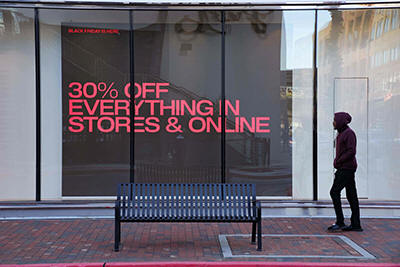
Why Cyber Monday could break spending records despite economic
uncertainty
[December 01, 2025] By
WYATTE GRANTHAM-PHILIPS
NEW YORK (AP) — Deals promoted as some of the best of the holiday season
are expected to keep people across the United States glued to their
computers and smartphones as the post-Thanksgiving shopping marathon
wraps up on Cyber Monday.
It's no secret that buying things online is now a staple of many
people's everyday routines. And year after year, those purchases mount
during the gift-giving holiday rush. Experts expect consumers to drive
record Cyber Monday spending this year, even amid wider economic
uncertainty.
Adobe Analytics has estimated that U.S. shoppers will spend $14.2
billion online Monday, or 6.3% more than in 2024. They already spent
$11.8 billion online for Black Friday and another $6.4 billion on
Thanksgiving Day, exceeding Adobe's forecasts.
Consumer spending for Cyber Week — the five major shopping days between
Thanksgiving and Cyber Monday — provides a strong indication of how much
shoppers are willing to spend for the holidays.
“Cyber Week is off to a strong start," Vivek Pandya, lead analyst at
Adobe Digital Insights, said. “Discounts are set to remain elevated
through Cyber Monday, which we expect will remain the biggest online
shopping day of the season and year.”
Deals on electronics and apparel are poised to peak Monday at 30% and
26% off average listed prices, per Adobe's latest estimates.

While the amount of money going into online shopping carts is expected
to reach new heights as consumers try to get the biggest bangs for their
bucks while they can, rising retail prices also may contribute to any
record sales figures that materialize.
Businesses and households have watched anxiously for financial impacts
from U.S. President Donald Trump's tariffs on foreign imports. Workers
in both the public and private sectors are also struggling with
anxieties over job security amid both corporate layoffs and the
after-effects of the 43-day government shutdown.
For the November-December holiday season overall, the National Retail
Federation estimates that U.S. shoppers will spend more than $1 trillion
for the first time this year. But the rate of growth is slowing — with
an anticipated increase of 3.7% to 4.2% year over year, compared to 4.3%
during last year's holiday season.
At the same time, credit card debt and delinquencies on other short-term
loans have been rising. More and more shoppers are turning to “buy now,
pay later” plans, which allow them to delay payments on holiday decor,
gifts and other items.
[to top of second column] |
Shoppers browse for Black Friday deals at Atlantic Station outdoor
mall, Friday, Nov. 28, 2025, in Atlanta, Ga. (AP Photo/Megan Varner)
 Buy now, pay later loans are
expected to drive $20.2 billion in online spending this holiday
season, according to Adobe, up 11% from last year. The firm
predicted that buy now, pay later loans would pass a new $1 billion
milestone on Cyber Monday, the vast majority involving purchases
made on mobile devices.
Overall, mobile devices have become the dominant shopping platform
consumers are turning to for the holidays. Adobe expects smartphones,
wearable tech and other handheld electronics to account for 56.1% of
online spending this season, worth a total of $142.7 billion.
Five years ago, a majority of online purchases were made on
desktops.
Shopping services powered by artificial intelligence are also
expected to play a role in what consumers choose to buy. Software
company Salesforce estimated that AI asssitants and digital agents
contributed to $14.2 billion of the total $79 billion it said was
spent online worldwide on Black Friday.
Cyber Monday's “hot sellers” will include gaming consoles such as
the Nintendo Switch 2 and toys-turned-fashion statements like Labubu
Dolls, Adobe said. The analystics firm anticipates the newest
editions of popular consumer electronics — including the iPhone 17,
Google Pixel 10 and Samsung Galaxy S25 — will also see high demand.
To many, Cyber Monday is billed as the “last call” to take advantage
of the deepest discounts in the days following Thanksgiving. But its
reach has grown over the years.
Cyber Monday is two decades old now, dating back to when the
National Retail Federation first coined the term in 2005. Today,
sales continue to bubble up throughout the week — riding on the hype
that the industry has built to fuel consumer spending.
All contents © copyright 2025 Associated Press. All rights reserved
 |