Why doing good also makes us feel good, during the holidays and beyond
[December 01, 2025]
By CHRISTINA LARSON
WASHINGTON (AP) — The holiday season is a time for giving thanks, giving
gifts — and for many, a time for giving back.
Food banks, services that deliver meals to seniors and other U.S.
charities typically see a surge in volunteering between Thanksgiving and
the end of the year. But there are good reasons to volunteer at any time
of the year.
Alfred Del Grosso volunteers weekly to work the lunch shift at
Shepherd’s Table, a food bank in Silver Spring, Maryland. “I feel more
connected to the broader community,” he said.
Most Thursdays, the retired chemist from Kensington, Maryland, also
lends an unpaid hand to help clear fallen trees and brush from local
trails with the Potomac Appalachian Trail Club. "It’s mostly volunteers
who help maintain the trails," he said.
Researchers who study human evolution and social psychology say that
giving back is deeply rooted in human nature. Volunteers say they feel
closer ties to the communities they serve.
“When we feel grateful for all we have, that motivates us to do good
things for other people who have helped us, and also to do good things
for new people," said Sarah Schnitker, a psychologist at Baylor
University.
“There’s a nice upwards reciprocal spiral between gratitude and
generosity,” often enhanced at holiday times, she said.
For many in the U.S., the season most associated with giving, receiving
and volunteering runs from Thanksgiving through Hanukkah and Christmas
to New Year’s.
But around the world, a giving season or festival is present in many
cultures, said Amrisha Vaish, a developmental psychologist at the
University of Virginia.

“Nearly all cultures have events or public festivals that allow people
to express gratitude,” she said. “In Hinduism, Divali is a time of
lights and festiveness and good eating, but also a time in which people
give gifts to really express what people have meant to them.”
For Muslims, Ramadan, which ends with the festival of Eid al-Fitr, is a
time for reflection, gratitude and acts of charity. Many Buddhist
traditions also emphasize gratitude.
The common purpose of such seasons, which also include non-religious
acts of service, is to reinforce our natural cooperative tendencies,
Vaish said.
“In human evolutionary history over hundreds of thousands of years,
we’ve had to become cooperative in order to work together and survive as
a species,” she said.
“We don’t have sharp claws, high speed, many other natural abilities.
But what we do have is that we’re super cooperators; we can do more in
groups than alone.”
[to top of second column]
|
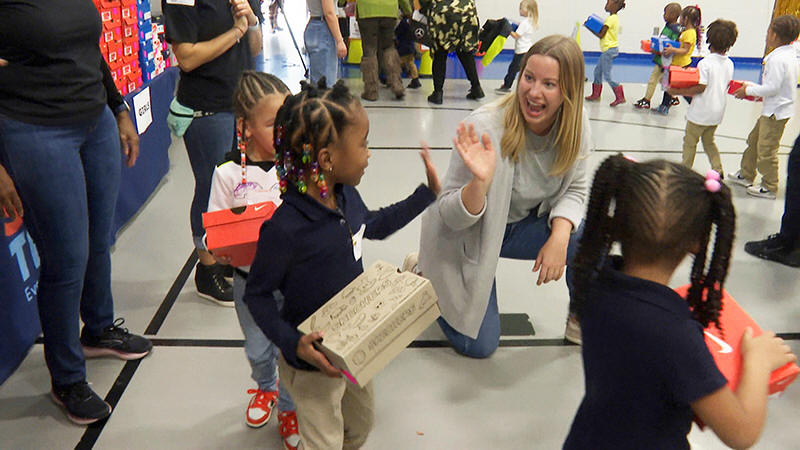
A volunteer waves to a student as she waits in line at Miles
Intermediate Elementary School in Atlanta after receiving new shoes
from Mercedes-Benz USA, as a part of their Season to Shine holiday
program, on Dec. 7, 2022. (AP Photo/Sharon Johnson, File)
 Of course, humans aren’t always
cooperative and generous — sometimes we’re also selfish and
stubborn.
The tension between selfishness and altruism was recognized even by
Darwin, said Michael Tomasello, a psychologist at Duke University.
“That’s why life is so complicated. We have all these motives mapped
together.”
But reflecting with gratitude on what we have, and seeing others do
good, can encourage our most generous tendencies, experts say.
On an individual level, “giving, volunteering and generosity have
the ability to increase our sense of meaning and purpose in life,”
said Jenae Nelson, a developmental psychologist at Brigham Young
University
“There’s a quick dopamine hit sometimes called the ‘helpers high.'
But there’s also that deeper reward of helping us to establish
purpose and meaning,” she said. “By helping other people and
believing that small acts can change the world, you can bring
coherence to your own life.”
After Mia Thelen retired as a nurse in Owosso, Michigan, she began
volunteering for the American Red Cross, starting out by minding the
office phones during blood drives before gradually taking on more
organizational and administrative responsibilities.
“It’s a good way to spend your time, making the lives of others a
little easier,” Thelen said. “I wanted to do something that helps
the community."
“And I’m learning a lot: learning computer skills, learning
communication skills. I have great co-volunteers.” She enjoys
feeling more connected with her neighbors.
Another common holiday tradition — sending greeting cards to family
and old friends — also provides a chance to enhance or renew social
ties, which people are often surprisingly reluctant to do, said Lara
Aknin, a social psychologist at Simon Fraser University.
Her research has shown that “people are actually hesitant to reach
out to old friends, they worry about being a burden or an
inconvenience,” she said. But on the flip side, “people who’ve just
heard from old friends report it as a really positive experience.”
So go ahead and write those cards or make those phone calls, she
said. Use the holidays as an excuse to reconnect, and share a laugh
or a warm mulled drink.
All contents © copyright 2025 Associated Press. All rights reserved |