Illinois rejects federal ‘no tax on tips’ rule, keeps state tax on
tipped income
[December 01, 2025]
By Catrina Barker | The Center Square contributor
(The Center Square) – Illinois is not adopting the new federal “no tax
on tips” provision, meaning tipped workers in the state will still owe
Illinois income tax on tips, even when those tips are exempt at the
federal level.
Manish Bhatt, senior policy analyst with the Tax Foundation, said
Illinois’ tax structure makes it possible for the state to decline the
new tip exemption.
“Only those states that begin state-level income tax calculations using
the federal definition of taxable income have it automatically
incorporated into the tax code,” Bhatt explained. “I don't believe
Illinois does that. So I think the states are certainly able to not
incorporate that individual sort of exemption on tips and overtime
wages.”
Even for states that do automatically conform to federal tax changes,
Bhatt said it may be wiser to “decouple” from the federal rule.
“It’s much more sound tax policy to not create carve-outs for certain
taxpayers at the expense of others,” he said. “More general reform
certainly needs to happen to bring the tax burden down for everybody.”
Bhatt said taxpayers who are seeing and hearing about the no tax on tips
at the federal level might not think about having to actually add those
back into their state return.

“It’s not that those individuals are trying to avoid taxation. They just
don’t know to add that back into their state income tax,” Bhatt told The
Center Square.
Bhatt warned that confusion could lead to filing mistakes or the need
for paid tax preparation services.
“If these individuals now have to hire a professional tax preparer when
they were otherwise doing it at home by themselves,” he said, “there’s a
number of inefficiencies … that lawmakers need to be aware of.”
Illinois remains a high-tax state, with one of the nation’s highest
property tax burdens. Bhatt acknowledged that it may be difficult to
persuade a tipped worker, already facing rising tax pressures, that
opting out of the exemption is sound policy.
[to top of second column]
|

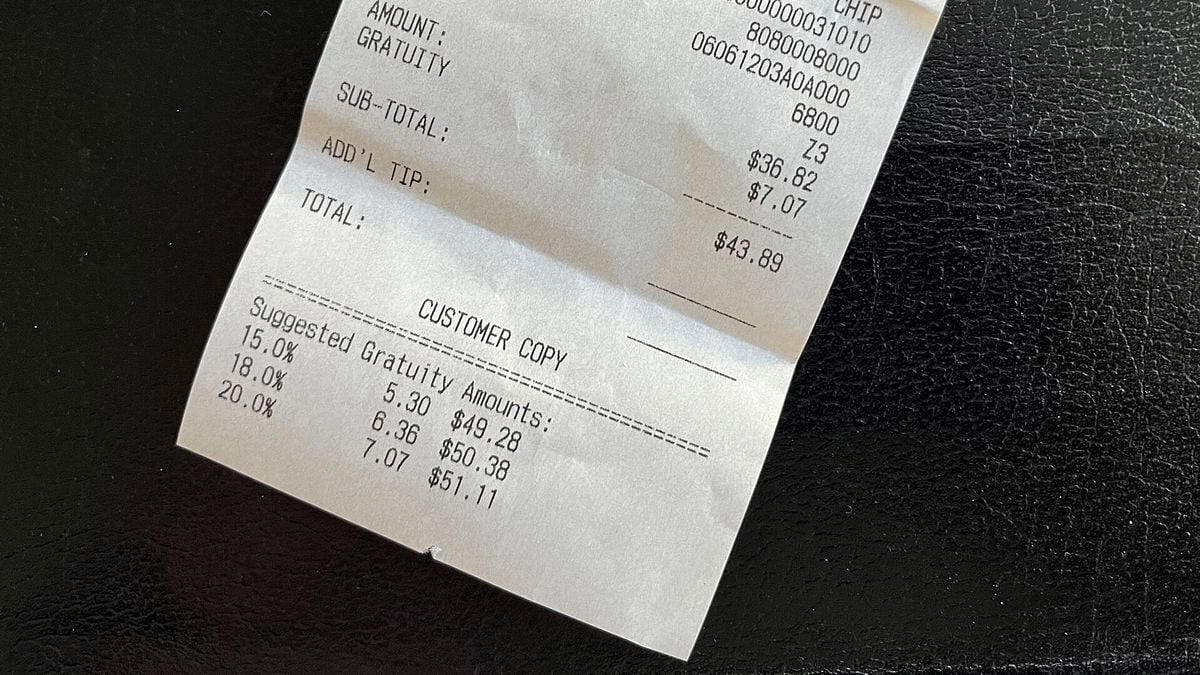
A restaurant receipt shows the bill total with suggested gratuity
amounts of 15%, 18% and 20%. Photo: Alan Wooten / The Center Square

“This is an example where good politics doesn’t always make good
policy,” he said. “When you create a carve-out for a certain
industry or a certain company, you're shifting the burden onto
somebody else.”
Illinois, he said, should instead pursue broad-based reform that
benefits all taxpayers—not just certain groups.
“Lawmakers should prioritize sound and broad tax reform in the state
so that everybody benefits,” he said.
Bhatt emphasized that while not taxing tips may sound attractive to
workers, selective exemptions distort the tax code.
“You could have two workers earning the same salary but facing
different tax burdens simply because of the nature of their jobs and
how they're paid,” he said.
He offered a simple example: a bank teller and a waiter each earning
$30,000 in a hypothetical flat-tax state. Under a no-tax-on-tips
system, the waiter would pay dramatically less than the teller—even
though they take home the same amount.
The imbalance could also push employers to restructure compensation.
“If this is implemented around the country, there will be the
incentive for employers to shift the way that their workers earn
their money,” Bhatt said. Some industries may try to shift employees
into tip-eligible roles “to attract and retain workers on the
promise of a lower tax bill.”
 |