Land and security are the main sticking points as Russia and Ukraine
mull Trump's peace proposal
[December 02, 2025]
By DASHA LITVINOVA and ISOBEL KOSHIW
Diplomats face an uphill battle to reconcile Russian and Ukrainian “red
lines” as a renewed U.S.-led push to end the war gathers steam, with
Ukrainian officials attending talks in the U.S. over the weekend and
Washington officials expected in Moscow early this week.
U.S. President Donald Trump's peace plan became public last month,
sparking alarm that it was too favorable to Moscow. It was revised
following talks in Geneva between the U.S. and Ukraine a week ago.
Ukraine’s President Volodymyr Zelenskyy has said the revised plan could
be “workable.” Russian President Vladimir Putin called it a possible
“basis” for a future peace agreement. Trump said Sunday “there’s a good
chance we can make a deal.”
Still, officials on both sides indicated a long road ahead as key
sticking points — over whether Kyiv should cede land to Moscow and how
to ensure Ukraine's future security — appear unresolved.
Here is where things stand and what to expect this week:
US holds talks with Kyiv then Moscow
Trump representatives met the Ukrainian officials over the weekend and
plan to meet with the Russians in coming days.
Ukraine’s national security council head Rustem Umerov, the head of
Ukraine’s armed forces Andrii Hnatov, presidential adviser Oleksandr
Bevz and others met with U.S. officials for about four hours on Sunday.
U.S. Secretary of State Marco Rubio said the session was productive but
more work remains. Umerov praised the U.S. for its support but offered
no details.

Zelenskyy’s former chief of staff and former lead negotiator for
Ukraine, Andrii Yermak, resigned Friday amid a corruption scandal and is
no longer part of the negotiating team. It was only a week ago that
Rubio met with Yermak in Geneva, resulting in a revised peace plan.
Trump said last week that he would send his envoy Steve Witkoff to
Russia. Kremlin spokesman Dmitry Peskov confirmed Monday that Putin will
meet Witkoff on Tuesday afternoon.
Trump suggested he could eventually meet with Putin and Zelenskyy, but
not until there has been more progress.
Witkoff’s role in the peace efforts came under scrutiny last week
following a report that he coached Yuri Ushakov, Putin's foreign affairs
adviser, on how Russia’s leader should pitch Trump on the Ukraine peace
plan. Both Moscow and Washington downplayed the significance of the
revelations.
Where the two sides stand
Eager to please Trump, Kyiv and Moscow have ostensibly welcomed the
peace plan and the push to end the war. But Russia has continued
attacking Ukraine and reiterated its maximalist demands, indicating a
deal is still a ways off.
Putin implied last week that he will fight as a long as it takes to
achieve his goals, saying that he will stop only when Ukrainian troops
withdraw from all four Ukrainian regions that Russia illegally annexed
in 2022 and still doesn’t fully control. “If they don’t withdraw, we’ll
achieve this by force. That’s all,” he said.
The plan, Putin said, “could form the basis for future agreements,” but
it is in no way final and requires “a serious discussion.”
Zelenskyy has refrained from talking about individual points, opting
instead to thank Trump profusely for his efforts and emphasizing the
need for Europe – whose interests are more closely aligned with
Ukraine's – to be involved. He also has stressed the importance of
robust security guarantees for Ukraine.

The first version of the plan granted some core Russian demands that
Ukraine considers nonstarters, such as ceding land to Moscow that it
doesn’t yet occupy and renouncing its bid to become a member of NATO.
Zelenskyy has said repeatedly that giving up territory is not an option.
One of the Ukrainian negotiators, Bevz, told The Associated Press on
Tuesday that Ukraine’s president wanted to discuss the territory issue
with Trump directly. Yermak then told The Atlantic in an interview on
Thursday that Zelenskyy would not sign over the land.
[to top of second column]
|
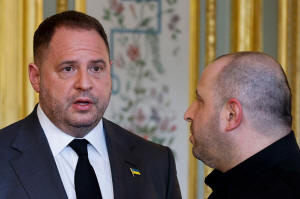
President Volodymyr Zelenskyy's chief of staff, Andrii Yermak, left,
and Ukraine's Defense Minister Rustem Umerov talk during a meeting
with French, U.S., German and British delegations at the Elysee
Palace, in Paris, on April 17, 2025. (Ludovic Marin, Pool Photo via
AP, File)

Zelenskyy also maintains that NATO membership is the cheapest way to
guarantee Ukraine’s security, and NATO’s 32 member countries said
last year that Ukraine is on an “irreversible” path to membership.
Since he took office, Trump has made it clear that NATO membership
is off the table.
Moscow, in turn, has bristled at any suggestion of a Western
peacekeeping force on the ground in Ukraine, and stressed that
keeping Ukraine out of NATO and NATO out of Ukraine was one of the
core goals of the war.
Putin seems to have time on his side
Zelenskyy, meanwhile, has been under pressure at home.
Yermak’s resignation was a major blow for Zelenskyy, although
neither the president nor Yermak have been accused of wrongdoing by
investigators.
“Russia really wants Ukraine to make mistakes. There won’t be
mistakes on our side," Zelenskyy said. "Our work continues, our
struggle continues. We don’t have a right not to push it to the
end.”
An activist with Ukraine's nongovernmental Anti-Corruption Center,
Valeriia Radchenko, said letting go of Yermak was the right decision
and would open a “window of opportunity for reform.”
Putin, meanwhile, seeks to project confidence, boasting of Russia’s
advances on the battlefield.
The Russian leader “feels more confident than ever about the
battlefield situation and is convinced that he can wait until Kyiv
finally accepts that it cannot win and must negotiate on Russia’s
well-known terms,” Tatiana Stanovaya of the Carnegie Russia and
Eurasia Center wrote on X. “If the Americans can help move things in
that direction — fine. If not, he knows how to proceed anyway. That
is the current Kremlin logic.”
Europe's conundrum
NATO and the EU are holding several meetings this week focused on
Ukraine.

Zelenskyy is holding talks with French President Emmanuel Macro n in
Paris on Monday. In Brussels, NATO Secretary-General Mark Rutte is
hosting Ukrainian Defense Minister Denys Shmyhal and EU defense and
foreign ministers are gathering to discuss European military support
for Ukraine and Europe’s defense readiness.
On Wednesday, NATO foreign ministers will gather again in Brussels.
The main issue for the EU right now is what to do with the frozen
Russian assets in Belgium that the Trump peace plan in its initial
version sought to use for post-war investment in Ukraine.
Those funds are central to European Commission President Ursula von
der Leyen’s strategy to ensure continued help for Ukraine while also
maintaining pressure on Russia. But Belgium’s prime minister is
holding out, worried about the legal implications of tapping the
frozen assets for Ukraine, the impact that could have on the euro —
and of Russian retaliation.
The diplomacy set in motion by Trump's peace plan “painfully
exposed” Europe's weakness, Nigel Gould-Davies of the International
Institute for Strategic Studies wrote in a recent commentary.
“Despite being the main source of Ukraine’s economic and military
support, it is marginal to the diplomacy of the war and has done
little more than offer amendments to America’s draft peace plan,”
Gould-Davies wrote.
All contents © copyright 2025 Associated Press. All rights reserved |