10 notable books of 2025: A posthumous memoir about Epstein, 'Hunger
Games' and reliving 2024
[December 03, 2025]
By HILLEL ITALIE
NEW YORK (AP) — The year in publishing saw such notable releases as the
latest “Hunger Games” novel and the first book in years from Thomas
Pynchon. Readers also sought life advice from Mel Robbins, campaign
books by former Vice President Kamala Harris, among others, and the
posthumous memoir from one of Jeffrey Epstein's accusers, Virginia
Giuffre.
Here are 10 notable books of 2025, in no particular order.
“Sunrise on the Reaping,” by Suzanne Collins
Suzanne Collins once swore she was done with “The Hunger Games,” but the
author has not given up on her blockbuster series and neither have her
readers. “Sunrise on the Reaping,” a prequel set 24 years before the
first book, sold more than 4 million copies worldwide, according to
Scholastic, even as the press-shy Collins declined to promote it or give
any interviews except for one with her editor, David Levithan.
Collins began the series in 2008 and many fans have grown up with it. At
an opening night event in February, numerous attendees were in their 20s
and 30s and spoke of how their teenage appreciation had deepened for
Collins' dystopian world, in which contestants hunt and kill each other
— all while being broadcast live. “As a kid you focus so much on the
plot and the action,” explained 26-year-old Savannah Miller. “As an
adult I connected to the characters a lot more and had more of an
emotional response.”
“The Let Them
Theory,”
by Mel Robbins
The year's most talked about self-help book, Mel Robbins' “The Let Them
Theory,” offered familiar and assuring messages for a troubled time:
Focus on the inner self, don't try to change what you can't change.
Robbins acknowledged debts to everyone from the ancient Stoics to the
Rev. Martin Luther King Jr., and the title of her opening chapter reads
like a variation of the Serenity Prayer: “Stop Wasting Your Life on
Things You Can't Control.” Released late last year, Robbins' blockbuster
was high on bestseller lists throughout 2025 and the author appeared
everywhere from “Meet the Press” to “The Tonight Show Starring Jimmy
Fallon.” Time magazine named Robbins among its top 100 creators: “She's
empowered millions to stop overthinking, start exercising and ignore
their inner critic.”

“Flesh,” by David Szalay
Literary fiction traveled in 2025, from India to New York ( Kiran
Desai's “The Loneliness of Sunny and Sonia”), from Houston to Japan
(Bryan Washington's “Palaver”), from the recent past to the 22nd century
( Ian McEwan's “What We Can Know”).
“Flesh,” winner of the Booker Prize, was a physical, economic and social
travelogue. It's a deadpan account of a working-class, half-dead
Hungarian, István, who proves equally attractive to women and disaster
as life pulls him along through sexual improprieties, juvenile
detention, military service in Iraq, the good life in London and back
down again. Happiness beyond the fleshy kind is almost entirely absent
from David Szalay's novel, but “Flesh” has a subtle, uncanny rhythm that
made admirers out of everyone from Dua Lipa to Booker judge Roddy Doyle,
who told reporters after the award was announced: “It is, in many ways,
a dark book but it is a joy to read.”
“Careless People,” by Sarah Wynn-Williams
Some books make news just by existing: Anticipating an angry response
from Meta, Flatiron waited until just days before publication to
announce an unflattering insider take on Meta by Sarah Wynn-Williams, a
former director of global public policy at was then Facebook.
Wynn-Williams alleged that CEO Mark Zuckerberg had offered to
accommodate the Chinese government’s demands to censor the social media
platform and that Sheryl Sandberg, Joel Kaplan and other executives had
enabled an abusive workplace that included sexual harassment.
Meta countered that “Careless People” was a mix of “out-of-date”
information and “false accusations,” and it convinced an emergency
arbiter that Wynn-Williams had violated a confidentiality agreement and
should be barred from promoting her book, which went on to top The New
York Times' nonfiction list. A headline from Vice read: “Meta Tries to
Kill Damning Tell-All Book, Accidentally Promotes It to Bestseller.”
“Nobody's Girl,” by Virginia Giuffre
The very existence of “Nobody's Girl” made news, and kept on making
news. Six months after the death of Virginia Giuffre, publisher Alfred
A. Knopf released her posthumous “Nobody's Girl: A Memoir of Surviving
Abuse and Fighting for Justice.” Her painful accounts of her years as a
“sex slave” helped build GOP support for releasing Justice Department
files on Epstein, who died in prison in 2019, and to President Donald
Trump's reversing his earlier objections. Her explicit memories of one
Epstein client, the former Prince Andrew, helped lead King Charles III
to strip his brother of his royal title and banish him to a private
residence.
“Their Majesties wish to make clear that their thoughts and utmost
sympathies have been, and will remain with, the victims and survivors of
any and all forms of abuse,” a statement from Buckingham Palace read at
the time.
[to top of second column]
|
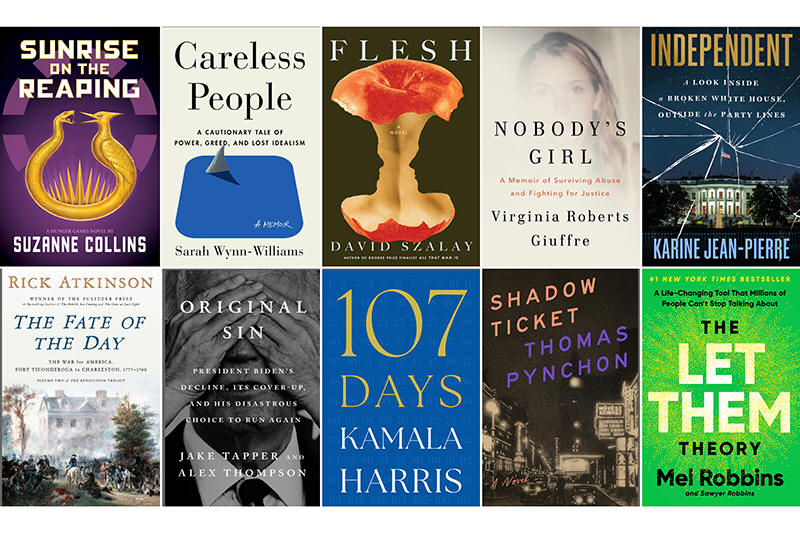
This combination of book cover images images shows, top row from
left, "Sunrise on the Reaping" by Suzanne Collins, "Careless People:
A Cautionary Tale of Power, Greed, and Lost Idealism" by Sarah
Wynn-Williams, "Flesh" by David Szalay," "Nobody's Girl: A Memoir of
Surviving Abuse and Fighting for Justice" by Virginia Roberts
Giuffre, "Independent: A Look Inside a Broken White House, Outside
the Party Lines" by Karine Jean-Pierre, bottom row from left, "The
Fate of the Day: The War for America, Fort Ticonderoga to
Charleston, 1777-1780" by Rick Atkinson, "Original Sin: President
Biden's Decline, Its Cover-Up, and His Disastrous Choice to Run
Again" by Jake Tapper and Alex Thompson, "107 Days" by Kamala
Harris, "Shadow Ticket" by Thomas Pynchon, and s "The Let Them
Theory: A Life-Changing Tool That Millions of People Can’t Stop
Talking About" by Mel Robbins and Sawyer Robbins.
(Scholastic/Flatiron/Scribner/Knopf/Legacy Lit/Crown/Penguin
Press/Simon & Schuster/Penguin Press/Hay house via AP)

“The Fate of the Day,” by Rick Atkinson
The second of Rick Atkinson's planned three-volume history of the
Revolutionary War was published to wide acclaim and helped establish him
as one of the foremost military scholars of his time, one given a
leading voice in Ken Burns' documentary on the country's independence.
With some 50 pages of source material listed, “The Fate of the Day”
combines precise and bloody details of battles fought between 1777 and
1780 with vivid sketches of protagonists known and obscure. “There is no
better writer of narrative history than the Pulitzer-winning Atkinson,”
a New York Times review read in part.
“Shadow Ticket” (and “Vineland”), by Thomas Pynchon
At age 89, Thomas Pynchon was back after a yearslong hiatus. “Shadow
Ticket” was a characteristically shaggy tale of a 1930s private
detective, Hicks McTaggart, whose search for a missing cheese heiress
lands him everywhere from Milwaukee to Budapest. Meanwhile, filmmaker
Paul Thomas Anderson transformed Pynchon's 1990 novel about aging
radicals, “Vineland,” into one of the year's most celebrated movies,
“One Battle After Another.” Anderson, who faithfully adapted Pynchon's
“Inherent Vice” in 2014, is apparently one of the privileged few to be
in contact with the famously private author.
“Realistically, for me, ‘Vineland’ was going to be hard to adapt,”
Anderson observed in the movie's press notes. “Instead, I stole the
parts that really resonated with me and started putting all these ideas
together. With (Pynchon’s) blessing.”
“Original Sin,” by Jake Tapper and Alex Thompson (Reliving 2024, Part I)
Books on the winning candidate in 2024, Trump, proved less attractive to
readers than accounts about the losing side. “Original Sin,” by CNN's
Jake Tapper and Axios' Alex Thompson, was among several notable works
that looked back and wondered how it went so wrong for the Democratic
Party. The Tapper-Thompson book centered on the aging of President Joe
Biden, made painfully public when he debated Trump, and on the aides and
family members the authors alleged were keeping his cognitive decline a
secret. “The original sin of Election 2024 was Biden's decision to run
for reelection — followed by aggressive efforts to hide his cognitive
diminishment,” the authors concluded.

“107 Days,” by Kamala Harris (Reliving 2024, Part II)
The title refers to the hurried (and unsuccessful) campaign the vice
president led when she took over from Biden after he dropped out in the
summer of 2024. Harris pointed fingers in many directions: at Biden's
staff (“Their thinking was zero-sum: If she's shining, he's dimmed”); at
herself, and her answer on “The View” that nothing “comes to mind” when
asked how she would govern differently than Biden (“I had no idea that
I'd just pulled the pin on a hand grenade”); and at the speed of time
(“One hundred and seven days were not, in the end, long enough to
accomplish the task of winning the presidency”).

“Independent,” by Karine Jean-Pierre (Reliving 2024, Part III)
Former White House press secretary Karine Jean-Pierre gained notice
simply from the title of her book, “Independent,” an early tip that she
had left the Democratic Party. The subtitle promised harsher takes: “A
Look Inside a Broken White House, Outside the Party Lines.” Unlike other
critics, she didn't argue that the party had become too “woke” or had
stayed with Biden for too long. She objected to how Biden was treated by
the press and by fellow Democrats and contended he “remained thoughtful,
clearheaded, and well-informed,” however poorly he came across in his
debate with Trump. “We had a major miss,” she concluded about the 2024
campaign, “and I was starting to take a hard look at my party.”
All contents © copyright 2025 Associated Press. All rights reserved |