West Virginia again bans religious reasons for school vaccine exemptions
[December 03, 2025]
By JOHN RABY
CHARLESTON, W.Va. (AP) — The West Virginia Board of Education on Tuesday
reinstated a school vaccination mandate after the state Supreme Court
paused a lower court's ruling that allowed parents to cite religious
beliefs to opt out of shots required for their children to attend
classes.
The Supreme Court earlier Tuesday issued a stay in last week's ruling by
Raleigh County Circuit Judge Michael Froble in a class-action lawsuit.
In issuing an injunction, Froble said children of families who objected
to the state’s compulsory vaccination law on religious grounds would be
allowed to attend school and participate in extracurricular sports.
The Supreme Court halted Froble's ruling pending resolution of appeals
in the case. In light of that, the board said in a statement that it “is
reinstating its directive to county boards of education not to accept
religious exemptions to compulsory vaccination laws. This directive will
be in effect until the Supreme Court issues further guidance.”
The board further said its priority is to ensure compliance with the
vaccine law “and safeguard the health and well-being of all students
across West Virginia.”
The board had suspended the vaccine mandate last week after Froble's
ruling, which said that a state policy barring parents from seeking
religious exemptions violated the Equal Protection for Religion Act
signed into law in 2023 by then-Republican Gov. Jim Justice.

West Virginia was among just a handful of states that granted only
medical exemptions from school vaccinations when Republican Gov. Patrick
Morrisey issued an executive order in January allowing religious
exemptions. In June, the board directed public schools to ignore
Morrisey's executive order. Two groups had sued over the executive
order, saying the Legislature, not the governor, has the authority to
make such decisions.
Legislation that would have allowed the religious exemptions was passed
by the state Senate and rejected by the House of Delegates earlier this
year. Froble said in his ruling that the failure of the legislation did
not determine the application of the 2023 law. He rejected the
defendants' argument that religious exemptions can only be created by
legislative action.
[to top of second column]
|
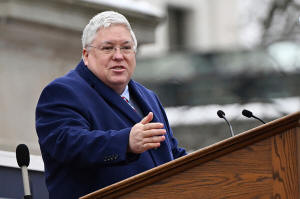
West Virginia Gov. Patrick Morrisey speaks at the state capitol in
Charleston, W.Va., Jan. 13, 2025. (AP Photo/Chris Jackson, File)
 Morrisey spokesman Drew Galang said
in a statement Tuesday night that the governor’s office is reviewing
the Supreme Court’s order.
Miranda Guzman and other parents sued the state and
local boards of education and the Raleigh County schools
superintendent. Guzman had obtained a religious exemption to the
vaccine mandate from the state health department and enrolled her
child in elementary school for the 2025-26 school year. But on June
17, Guzman received an email from the local school superintendent
rescinding the certificate, according to the lawsuit.
Last month, Froble certified the lawsuit as a class action involving
570 families who had sought and received religious exemptions in
other parts of the state. He said the class action also applies to
parents who seek religious exemptions in the future.
West Virginia’s school vaccination policy long has been heralded by
medical experts as one of the most protective in the country for
children. State law requires children to receive vaccines for
chickenpox, hepatitis B, measles, meningitis, mumps, diphtheria,
polio, rubella, tetanus and whooping cough before starting school.
At least 30 states have religious freedom laws, including one signed
by Georgia's governor in April. The laws are modeled after the
federal Religious Freedom Restoration Act, signed in 1993 by
then-President Bill Clinton, which allows federal regulations that
interfere with religious beliefs to be challenged.
All contents © copyright 2025 Associated Press. All rights reserved |