Appeals court weighs release of immigration detainees to electronic
monitoring
[December 03, 2025]
By Hannah Meisel
CHICAGO — A federal appeals court is deliberating whether hundreds of
undocumented immigrants arrested in the Chicago area in recent months
should be released from detention and sent home with electronic
monitoring.
Last month, U.S. District Judge Jeffrey Cummings ordered the Trump
administration to release several hundred detainees on a $1,500 bond.
While they waited for their immigration court dates, the former
detainees would have been tracked with devices like ankle monitors or a
smartphone app.
The judge ruled in response to immigration and civil rights lawyers’
allegations that Trump’s Department of Homeland Security has repeatedly
violated a 2022 federal consent decree restricting the use of
warrantless arrests for undocumented immigrants.
But the Trump administration appealed, and on Tuesday argued to the 7th
Circuit Court of Appeals that the judge overstepped his authority by
modifying the consent decree.
Criticism of ruling
At least one of the three judges on the panel — Trump appointee Thomas
Kirsch II — seemed to agree. He criticized Cummings’ November order to
release detainees along with his Oct. 7 order extending the consent
decree until February. Cummings was appointed by President Joe Biden.
During nearly an hour of oral arguments, Kirsch said he was “surprised —
I was shocked, actually” that Cummings’ October ruling “acts as if these
are two private parties negotiating over the terms of a contract.”

U.S. Department of Justice lawyer Benjamin Hayes contended that by
modifying the consent decree, Cummings was exercising power he didn’t
have and forcing the administration to ignore federal law. National
Immigrant Justice Center attorney Keren Zwick argued that Cummings was
merely interpreting existing federal law and enforcing the consent
decree in response to the Trump administration altering the playing
field.
Zwick and her colleagues argue the new administration’s policy
encouraging agents to carry blank warrant forms and fill them out at the
scene of an arrest is a violation of the consent decree. Cummings in
October agreed, writing the use of I-200 warrants was “explicitly
designed” to get around the requirement that agents have probable cause
to believe a person is in the country illegally and he or she is a
flight risk before arresting an undocumented immigrant.
Zwick told Kirsch that Cummings was well within his rights to modify the
consent decree because the use of I-200 warrants was “never
contemplated” in the years she and her colleagues negotiated with DHS
over the terms of the decree.
“So what?” Kirsch replied, saying that wasn’t enough for Cummings to
modify or extend the decree.
Judge John Lee, an appointee of former President Barack Obama, took the
opposite view on the I-200 forms.
“It seems to me odd that the government — whoever has the White House at
the time — can just say, ‘Oh, well, I think this sheet of paper is good
enough,’” Lee said.
Arrests exceed ‘worst of the worst’
Though the consent decree was scheduled to expire in May, plaintiffs’
attorneys had asked for an extension, which was supposed to have left it
in place while the judge weighed the arguments. Cummings’ October ruling
extended the decree through early February.
But since that ruling, “Operation Midway Blitz” reached a crescendo,
resulting in the arrests of several thousand people. Cummings would go
on to determine that not only did I-200 arrests violate the consent
decree, but so did a new DHS policy on mandatory detention.

Before a Sept. 5 decision from the U.S. Board of Immigration Appeals,
the vast majority of undocumented immigrants who were arrested would be
released on bond after an immigration judge determined a person didn’t
have a disqualifying criminal record and was not a danger to the
community or a flight risk.
But in the days before Operation Midway Blitz began last month, the
Trump administration’s immigration appeals board reversed decades of
precedent and ruled that detention would be mandatory for any
undocumented immigrant who entered the U.S. without being “admitted” by
an immigration officer.
[to top of second column]
|
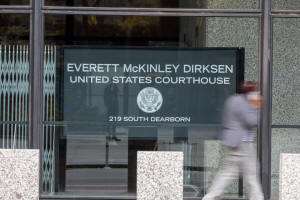
The Dirksen Federal Courthouse is pictured in Chicago. (Capitol News
Illinois file photo by Andrew Adams)

Then on Sept. 8, U.S. Supreme Court Justice Brett Kavanaugh issued a
decision that allows immigration officers to take a person’s “apparent
ethnicity” into account when determining reasonable suspicion to
question someone’s immigration status. As a result of those factors,
thousands more people were arrested in Midway Blitz than the “worst of
the worst” promised by the Trump administration, including immigrants
who’ve been in the U.S. for decades.
During a Nov. 13 hearing, Cummings said his staff had determined that
the vast majority of approximately 100 undocumented immigrants who have
active cases in Chicago federal court were arrested either at work or
commuting to and from work, including 20 landscapers and nine people
apprehended at Home Depot or Menards, “presumably either seeking work or
picking up materials.”
Based on that pattern, the judge said it was “highly likely” that many
arrestees should not be subject to mandatory detention and were
“unlikely … part of the group of drug dealers, violent criminals and
assorted ne’re-do-wells that fall into category that ICE calls worst of
the worst.”
Cummings has repeatedly pointed out that more than 100 of his colleagues
across the country have rejected DHS’ arguments on mandatory detention
since the agency began testing the new legal theory in July. But the
judge has also repeatedly said he doesn’t want anyone actually dangerous
to be released from ICE custody. Per his orders, DHS had identified
roughly 450 people who could potentially be released before the 7th
Circuit halted Cummings’ order on Nov. 19.
Kirsch, though, said the lower court judge’s theory of his power over
consent decrees could prove dangerous.
“What would stop the current administration from entering into a bunch
of consent decrees to entrench their policy preferences on the next
administration?” he asked.

Riot control weapons case dead
Meanwhile on Tuesday, protesters, clergy and media outlets who launched
a high-profile lawsuit against DHS this fall over immigration agents’
use of riot control weapons said in a court filing they plan to drop
their case.
Over nearly two months of litigation, attorneys for the plaintiffs
corralled hundreds of videos and photos alleging agents’ inappropriate
use of force against members of the public. They also forced the release
of thousands of hours of body camera footage from U.S. Customs and
Border Patrol agents participating in Operation Midway Blitz.
U.S. District Judge Sara Ellis ordered Border Patrol Commander Gregory
Bovino into her courtroom and later called him a liar. The judge issued
a temporary restraining order restricting weapons like tear gas, pepper
balls, flashbang grenades and other use of force, and last month issued
a more indefinite injunction.
But the 7th Circuit Court of Appeals last month stayed Ellis’ ruling,
calling it “overbroad” and ruling that the judge’s injunction
overstepped and “impermissibly” infringed on how the executive branch
conducts law enforcement activity.
Moving to dismiss the lawsuit will prevent the 7th Circuit or U.S.
Supreme Court from giving the Trump administration any permanent
expanded powers against civilians. Despite the specter of losses on
appeal, plaintiffs’ lawyers on Tuesday framed ending the case as a win.
Steve Art, an attorney with Loevy & Loevy, said in a statement that the
lawsuit “exposed” the Trump administration’s “justifications for its
conduct … as blatant lies.”
Operation Midway Blitz abruptly wound down last month, but immigration
agents are expected to return to the Chicago area in the spring.
Capitol News Illinois is
a nonprofit, nonpartisan news service that distributes state government
coverage to hundreds of news outlets statewide. It is funded primarily
by the Illinois Press Foundation and the Robert R. McCormick Foundation. |