Trump administration threatens to withhold SNAP management funds from
states that don't share data
[December 03, 2025]
By GEOFF MULVIHILL and DARLENE SUPERVILLE
WASHINGTON (AP) — President Donald Trump's administration warned on
Tuesday that it will withhold money for administering SNAP food aid in
most Democratic-controlled states starting next week unless those states
provide information about people receiving the assistance.
Agriculture Secretary Brooke Rollins said at a Cabinet meeting Tuesday
that the action is looming because those states are refusing to provide
data the department requested such as the names and immigration status
of aid recipients. She said the cooperation is needed to root out fraud
in the program. Democratic states have sued to block the requirement,
saying they verify eligibility for SNAP beneficiaries and that they
never share large swaths of sensitive program data with the federal
government.
States and the federal government split the cost of running SNAP, with
the federal government paying the full cost of benefits. After Rollins’
remarks, a USDA spokesperson later explained that the agency is
targeting the administrative funds — not the benefits people receive.
Twenty-two states and the District of Columbia previously sued over the
request for information, which was initially made in February. A San
Francisco-based federal judge has barred the administration, at least
for now, from collecting the information from those states.
The federal government last week sent the states a letter urging
compliance, but the parties all agreed to give the states until Dec. 8
to respond.
“We have sent Democrat States yet another request for data, and if they
fail to comply, they will be provided with formal warning that USDA will
pull their administrative funds,” the USDA said in a statement Tuesday.

Federal law allows the USDA to withhold some of the money states receive
for administering SNAP if there's a pattern of noncompliance with
certain federal regulations.
But “there’s never authority to withhold the SNAP benefits and, in this
case, there’s also no authority to withhold the administrative funding,”
said David Super, a law professor at Georgetown University who has
studied the food aid program for several decades.
Administration says data is needed to spot fraud
About 42 million lower-income Americans, or 1 in 8, rely on SNAP to help
buy groceries. The average monthly benefit is about $190 per person, or
a little over $6 a day.
Rollins has cited information provided by states that have complied,
saying it shows that 186,000 deceased people are receiving SNAP benefits
and that 500,000 are getting benefits more than once.
“We asked for all the states for the first time to turn over their data
to the federal government to let the USDA partner with them to root out
this fraud, to make sure that those who really need food stamps are
getting them,” Rollins said, “but also to ensure that the American
taxpayer is protected.”
Her office has not released detailed data, including on how much in
benefits obtained by error or fraud are being used.
[to top of second column]
|
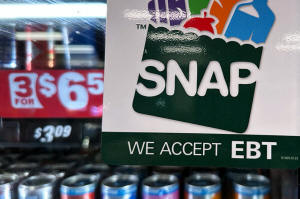
SNAP EBT information sign is displayed at a gas station in
Riverwoods, Ill., Saturday, Nov. 1, 2025. (AP Photo/Nam Y. Huh,
file)

The USDA said Tuesday evening that 28 states and Guam have complied
with the request for information. That list consists primarily of
states with Republican governors, though North Carolina — which has
a Democratic governor — also has complied.
Twenty-two states have sued to block the request.
Experts say that while there is certainly fraud in a $100
billion-a-year program, the far bigger problems are organized crime
efforts to steal the benefit cards or get them in the name of
made-up people — not wrongdoing by beneficiaries.
SNAP has been in the spotlight recently
U.S. Rep. Jahana Hayes, a Connecticut Democrat who is a co-sponsor
of legislation to undo recent SNAP changes, said Rollins is trying
to make changes without transparency — or without a role for
Congress — and that she is mischaracterizing the program.
“Individuals who are just trying to buy food, those aren’t the ones
who are gaming the system in the way that the administration is
trying to portray,” Hayes said in an interview on Tuesday before
Rollins announced her intention.
The impact of states losing administrative funds for SNAP isn’t
clear. But some advocates have warned that other policies that would
shift more administrative costs to states could be so costly that
some could drop out of SNAP entirely rather than absorb the extra
costs. States cannot tap the money used for benefits to cover
administrative costs.
The program is not normally in the political spotlight, but it has
been this year.
As part of Trump's big tax and policy bill earlier in the year, work
requirements are expanding to include people between the ages of 55
and 64, homeless people and others.
And amid the recent federal government shutdown, the administration
planned not to fund the benefits for November. There was a
back-and-forth in the courts about whether they could do so, but
then the government reopened and benefits resumed before the final
word.
In the meantime, some states scrambled to fund benefits on their own
and most increased or accelerated money for food banks.

___
Mulvihill reported from Haddonfield, New Jersey. Reporters Sophie
Austin in Sacramento, California; John Hanna in Topeka, Kansas;
Michael Hill in Albany, New York; Steve Karnowski in Minneapolis;
David A. Lieb in Jefferson City, Missouri; and Gary D. Robertson in
Raleigh, North Carolina, contributed.
All contents © copyright 2025 Associated Press. All rights reserved |