Chances dwindling for renewal of health care subsidies, risking premium
spikes for millions
[December 03, 2025]
By MARY CLARE JALONICK
WASHINGTON (AP) — Hopes for an extension of health care subsidies were
diminishing in Congress this week as Republicans and Democrats largely
abandoned the idea of bipartisan talks on the issue, increasing the odds
that millions of Americans could see sharp premium spikes starting Jan.
1.
Democrats who agreed earlier this month to reopen the government in
exchange for a December health care vote were hoping they could work
with Republicans to extend the COVID-era Affordable Care Act tax credits
that help many Americans pay for their health coverage. But lawmakers in
both parties have spent most of the time since talking amongst
themselves instead, while rehashing longstanding partisan arguments over
the law in public.
“I don’t think at this point we have a clear path forward, I don’t think
the Democrats have a clear path forward,” Senate Majority Leader John
Thune said Tuesday after Republicans met and discussed different
proposals to overhaul the law.
The impasse means the Senate vote, expected next week, could be a
party-line messaging exercise with no real chance of passage. Under the
deal struck to end the shutdown, Democrats can determine the legislation
that comes up for a vote. But Senate Democratic Leader Chuck Schumer has
indicated they are leaning toward a vote on a straight extension of the
subsidies with no new limits or tweaks to the law, which Republicans
have already rejected.
“So far the Republicans are in total disarray and have no plan,” Schumer
said Tuesday. “We have a plan.”

Democrats say they are willing to negotiate on the issue, and some have
said they would be open to new limits on the subsidies. But they argue
that two main issues are holding up talks: the lack of input from
President Donald Trump, and Republicans’ insistence that abortion
funding be part of the discussion.
“Our Republican colleagues aren’t going to engage with us” unless Trump
weighs in, said Sen. Peter Welch, D-Vt. “That’s the paralysis here.”
Abortion issue holds up compromise
Maine Sen. Angus King, an independent who caucuses with the Democrats,
was part of the group that struck a deal to end the shutdown. He says
there have been some informal bipartisan discussions since then, but
says they stalled as Republicans insisted on stricter abortion
restrictions on Affordable Care Act plans.
“They have set up a red line that is also a red line for the Democrats,”
King said of Republicans. “So they’re going to own these increases.”
Missouri Sen. Josh Hawley, who has said he wants to see the tax credits
extended, said the issue “should not be a deal-killer” since a ban on
federal funding for abortions is already in the law.
Democrats say current law should be sufficient. While many states ban
abortion coverage from all plans in the ACA marketplaces, others allow
or require abortion coverage that isn’t paid for with federal funding.
[to top of second column]
|
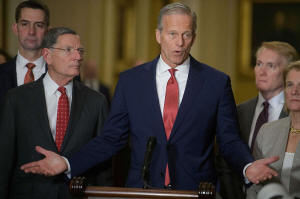
Senate Majority Leader John Thune, R-S.D., center, is joined by from
left: Sen. Tom Cotton, R-Ark., Sen. John Barrasso, R-Wyo., Sen.
James Lankford, R-Okla., and Sen. Shelley Moore Capito, R-W.Va.,
during the Senate Republican policy luncheon news conference at the
Capitol, Tuesday, Dec. 2, 2025, in Washington. (AP Photo/Rod Lamkey,
Jr.)

Republicans weigh different plans
Beyond the abortion issue, many Republicans have said for years that
they want to see the ACA scrapped or overhauled. But there is still
little consensus in the GOP about whether to do that or how.
Republican senators have discussed several competing proposals in
recent weeks. Louisiana Sen. Bill Cassidy and Florida Sen. Rick
Scott have suggested creating different types of health savings
accounts that would change the way people buy insurance — an idea
that Trump has endorsed in social media posts without much detail.
Other senators have suggested extending the subsidies with new
limits on income.
Thune said Tuesday that “we will see where the Republicans come
down, but that conversation continues.”
Republicans want to work on a constructive solution, he said, “but
that hasn’t landed yet.”
In the House lawmakers were also discussing different ideas. But
there was no indication that any of them could be ready by the end
of the year or generate enough bipartisan support.
“Health care is a very complicated issue,” House Speaker Mike
Johnson, R-La., said Tuesday, while insisting that Republicans were
still “pulling ideas together.”
Trump gives little guidance
Lawmakers in both parties have said it will be hard to move forward
without Trump’s support for a plan. But the president has yet to
formally endorse any legislation.
Last week, the White House circulated a proposal to extend the
subsidies with some limits, like new income caps and a requirement
that all recipients pay some sort of premium. The proposal would
also have allowed those in lower-tier plans, such as the
bronze-level or catastrophic plans, to put money into health savings
accounts.
But the proposal was never released.

Asked last week whether he wants to extend the subsidies, Trump
appeared to refer to the leaked plan, saying that “somebody said I
wanted to extend it for two years. ... I’d rather not extend them at
all.”
Still, he acknowledged that some sort of extension may be
“necessary.”
___
Associated Press writers Seung Min Kim, Lisa Mascaro and Ali Swenson
contributed to this report.
All contents © copyright 2025 Associated Press. All rights reserved |