Salesforce CEO vies to overcome investors' AI skepticism while touting
company's quarterly numbers
[December 04, 2025] By
MICHAEL LIEDTKE
SAN FRANCISCO (AP) — After riding the artificial intelligence craze to
new heights, business software maker Salesforce has been pummeled by a
wave of investor skepticism that’s intensified the pressure on its
persuasive CEO Marc Benioff to reverse the tide.
Benioff, who helped spearhead the transition to cloud computing after
founding Salesforce in 1999, got a chance to try to change the AI
narrative late Wednesday with the release of his company’s latest
quarterly results.
The key numbers covering August through October eclipsed the analyst
projections that help steer the stock market, providing Benioff with
some material to support his contention that Salesforce’s big bets on AI
will yield a jackpot. The San Francisco-based company earned $2.1
billion, or $2.19 per share, a 37% increase from the same time last year
while revenue rose 9% to nearly $10.9 billion. Salesforce also provided
an outlook for the current quarter ending in January that exceeded
analysts' predictions.
“We’re uniquely positioned for this new era,” Benioff boasted during a
25-minute address on an analyst conference call that sometimes sounded
like an AI sermon that also featured comments about “wow” moments that
customers experience when seeing the company's technology.
Salesforce’s shares initially surged by more than 5% after the results
came out, but backtracked to a gain of 2% following Benioff's
presentation.

It's unclear if that modest momentum will be sustained in Thursday's
regular trading session because making more money than analysts
anticipated isn’t necessarily enough to keep propelling a technology
stock amid persisting doubts about whether the hundreds of billions of
dollars being poured into the much-hyped technology will pay off.
Nvidia, the dominant maker of the chips needed to power AI, put a dent
in the wall of worry a couple weeks ago with a quarterly earnings report
that soared far beyond analyst estimates and initially eased fears about
a Big Tech bubble bursting.
But the tranquility quickly evaporated, leaving Nvidia’s stock price
slightly below where it was trading before the company’s stellar
earnings report and 15% below its peak price reached in late October
when the chipmaker became the first company to be valued at $5 trillion.
The AI jitters have punished Salesforce even more severely. Before the
earnings report was released, Salesforce's market value had plunged by
35%, wiping out about $125 billion in shareholder wealth, since
Salesforce’s stock price peaked at $369 a year ago.
The downturn has happened even as Benioff has been doing his best to
highlight AI's potential benefits while calling upon the flair for
salesmanship that he developed while become the become a chief
evangelist behind the rise of software subscription services amid the
ruins of the dot-com bust a quarter century ago.
[to top of second column] |
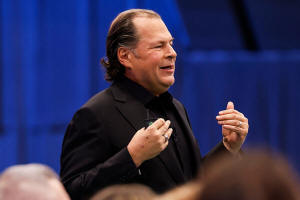
Salesforce CEO Marc Benioff delivers the keynote address at the
start of the Dreamforce conference at the Moscone Center, in San
Francisco, Oct. 14, 2025. (Jessica Christian/San Francisco Chronicle
via AP, File)
 Benioff, who owns Time magazine in
addition to his Salesforce job, also is among the Big Tech leaders
who have forged ties with President Donald Trump this year while
trying to persuade the administration to adopt AI-friendly policies
to protect U.S. interests as China also works feverishly on the
technology.
Salesforce has been primarily focused on creating Ai agents that can
automate more customer sales agents while spawning a digital labor
force that will take over jobs that have traditionally been filled
by people.
In a sign that Benioff intends to practice what he preaches,
Salesforce laid off 4,000 of its own customer support workers as its
“Agentforce” technology took over more of the responsibilities.
But the corporate customers that buy Salesforce’s services haven't
been embracing AI agents as quickly as investors initially thought,
turning the company into a “poster child” for the doubts hanging
over the technology, said Jay Woods, chief market strategist for
investment banking firm Freedom Capital Markets.
The second-guessing hasn’t dimmed Benioff’s AI exuberance – a
passion that recently displayed in a resounding endorsement of
Google’s latest version of the Gemini technology powering its AI
suite.
“We all know that the speed of innovation has exceeded the speed of
customer adoption,” Benioff conceded while confidently predicting
that dynamic is about to change dramatically as more companies and
government agencies build AI services into their operations.
Salesforce is projecting $60 billion in revenue for its fiscal year
ending in January 2030 – a target that would require average annual
increases of 10% from its forecasted sales of $41.5 billion for its
current fiscal year. The company also just completed an $8 billion
acquisition of another software maker, Informatica, that is building
AI tools to manage corporate data.
“We’re continuing to execute on the path to our $60 billion dream”
Benioff said.
All contents © copyright 2025 Associated Press. All rights reserved
 |