Affordable Care Act premiums are set to spike. A new poll shows
enrollees are already struggling
[December 04, 2025]
By ALI SWENSON, LINLEY SANDERS and AMELIA THOMSON-DEVEAUX
WASHINGTON (AP) — Fifty-two-year-old Dinam Bigny sank into debt and had
to get a roommate this year, in part because of health insurance
premiums that cost him nearly $900 per month.
Next year, those monthly fees will rise by $200 — a significant enough
increase that the program manager in Aldie, Virginia, has resigned
himself to finding cheaper coverage.
“I won’t be able to pay it, because I really drained out any savings
that I have right now,” he said. “Emergency fund is still draining out —
that’s the scary part.”
Bigny is among the many Americans dependent on Affordable Care Act
marketplace health insurance plans who are already struggling with the
high cost of health care, according to a new survey from the health care
research nonprofit KFF.
Most of the more than 1,300 enrollees surveyed in early November say
they anticipate that their health costs will be impacted next year if
Congress doesn’t extend expiring COVID-era tax credits that help more
than 90% of enrollees pay for health insurance premiums, per KFF. The
possibility of an extension looks increasingly unlikely.
The enhanced premium tax credits set to expire at the end of this year
have been at the center of recent tensions in Congress, with Democrats
calling for a straight extension and several Republican lawmakers
vehemently opposed to the idea. Their inability to agree on a path
forward fueled a record 43-day government shutdown earlier this fall.
President Donald Trump and some Republicans in Congress have circulated
proposals in recent weeks to offer a short-term extension or reform the
Affordable Care Act, but no plan has emerged as a clear winner.
Meanwhile, the window for Americans to shop for next year’s plans is
well underway with less than a month to go until the subsidies expire.

KFF’s poll reveals that marketplace enrollees — most of whom say they
would be directly impacted by the subsidies expiring — overwhelmingly
support an extension. The survey found this group is more likely to
blame Trump and Republicans in Congress than Democrats if the tax
credits are left to expire.
Enrollees already find it challenging to afford health expenses
The expiration of the tax credits — which a separate KFF analysis found
will more than double monthly payments for the average subsidized
enrollee — comes as Americans are already overwhelmed by high health
expenses, the poll shows.
About 6 in 10 Affordable Care Act enrollees find it “somewhat” or “very”
difficult to afford out-of-pocket costs for medical care, such as
deductibles and copays. That exceeds the roughly half of enrollees who
find it challenging to afford health insurance premiums. Most also say
they could not afford a $300 per year increase in their health insurance
costs without significantly disrupting their household finances.
Cynthia Cox, a vice president of KFF who leads the organization's ACA
research, said the population of Americans on Affordable Care Act health
insurance includes some high-earning entrepreneurs and small business
owners, but the bulk of enrollees are lower-income and therefore
vulnerable to even small increases in health costs.
“These are often going to be people who are living paycheck to paycheck,
who have volatile or unpredictable incomes as well,” she said.
“Increases that many of them are facing are going to be some sort of
financial hardship for them.”
Most enrollees see cost increases on the horizon
Slightly more than half of Affordable Care Act marketplace enrollees
believe their health insurance costs will increase “a lot more than
usual" next year, according to the poll. About another 4 in 10
anticipate increases that will be “a little more than usual” or “about
the same as usual.”
[to top of second column]
|
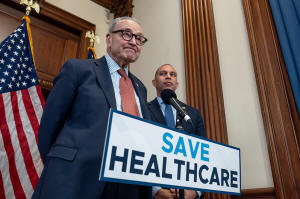
As Congress faces a year-end deadline on Affordable Care Act
subsidies, Senate Minority Leader Chuck Schumer, D-N.Y., left, and
House Minority Leader Hakeem Jeffries, D-N.Y., meet with reporters
about health care affordability, at the Capitol in Washington,
Wednesday, Dec. 3, 2025. (AP Photo/J. Scott Applewhite)

Larry Griffin, a 56-year-old investment banker and financial adviser in
Paso Robles, California, already pays $920 a month for his gold-level
health plan through the state's insurance marketplace. He says that
price will go up to about $1,400 a month next year — alongside jumps in
copays and his annual out-of-pocket maximum.
He’s concerned the increases will affect his ability to save money for
his upcoming retirement, but with the recent amputation of his left leg
below the knee, as well as other health issues, he said he can’t risk
going off health insurance or downgrading his plan.
Griffin is among the roughly three-quarters of marketplace enrollees who
say health insurance is “very important” for their ability to access the
health care they need.
“I’m not going to say that I can’t manage it, I can, but it’s just
another one of those things,” he said. “Here’s, you know, knock number
5,000 against me after all of the other things I’ve had to deal with.”
Patricia Roberts, 52, a full-time caregiver for her daughter in Auburn,
Alabama, expects her monthly health insurance premiums to rise from
around $800 a month to $1,100 a month next year — costs she can manage.
But her friends across the border in Georgia are staring down doubling
monthly fees next year.
“I don’t know how people are going to live, with it already being a
struggle just to pay for food and all the other things,” Roberts said.
Support for an extension stretches across political parties
The poll shows allowing the enhanced tax credits to expire would be
overwhelmingly unpopular with current marketplace enrollees.
Support for continuing the tax credits extends across party lines.
Nearly all Democrats and about 8 in 10 independents who are enrolled in
marketplace plans say the credits should be extended, as do about 7 in
10 Republicans. Support is similarly high among Republicans and
Republican-leaning independents who support the MAGA movement, and those
who don’t.
Yvette Laugier, 56, a Republican in Chicago, said while her income is
too high to qualify her for the enhanced premium tax credits, she
supports extending them temporarily with additional fraud protections to
give lower-income enrollees more time to consider their options.

Among those who think Congress should extend the credits, about 4 in 10
say Trump would deserve “most of the blame” if they were allowed to
expire and roughly one-third say that about Republicans in Congress.
Democrats in Congress are much less likely to receive blame: only 23% of
enrollees say they would deserve the bulk of responsibility.
Bigny, in Virginia, said the blame should be split between both
Democrats and Republicans. But he has hope they can come to a compromise
and potentially a temporary extension in the coming weeks.
“They should just sit and really look for what’s best for American
people overall,” he said.
___
Swenson reported from New York.
All contents © copyright 2025 Associated Press. All rights reserved |