Pentagon watchdog finds Hegseth’s use of Signal posed risk to US
personnel, AP sources say
[December 04, 2025]
By LISA MASCARO and BEN FINLEY
WASHINGTON (AP) — The Pentagon’s watchdog found that Defense Secretary
Pete Hegseth put U.S. personnel and their mission at risk when he used
the Signal messaging app to convey sensitive information about a
military strike against Yemen's Houthi militants, two people familiar
with the findings said Wednesday.
Hegseth, however, has the ability to declassify material and the report
did not find he did so improperly, according to one of the people
familiar with the findings who spoke on condition of anonymity to
discuss the information. That person also said the report concluded that
Hegseth violated Pentagon policy by using his personal device for
official business and it recommended better training for all Pentagon
officials.
Hegseth declined to sit for an interview with the Pentagon's inspector
general but provided a written statement, that person said. The defense
secretary asserted that he was permitted to declassify information as he
saw fit and only communicated details he thought would not endanger the
mission.
The initial findings, which were first reported by CNN, ramp up the
pressure on the former Fox News Channel host after lawmakers called for
the independent inquiry into his use of the commercially available app.
Lawmakers also just opened investigations into a news report that a
follow-up strike on an alleged drug-smuggling boat in the Caribbean Sea
in September killed survivors after Hegseth issued a verbal order to
“kill everybody."

Hegseth defended the strike as emerging in the “fog of war,” saying he
didn’t see any survivors but also “didn’t stick around” for the rest of
the mission and that the admiral in charge “made the right call” in
ordering the second strike. He also did not admit fault following the
Signal revelations, asserting that the information was unclassified.
“The Inspector General review is a TOTAL exoneration of Secretary
Hegseth and proves what we knew all along — no classified information
was shared,” Sean Parnell, the Pentagon’s chief spokesman said in a
statement. “This matter is resolved, and the case is closed.”
President Donald Trump “stands by” Hegseth, White House press secretary
Karoline Leavitt said in a statement, adding that the probe affirms that
“no classified information was leaked, and operational security was not
compromised.”
Journalist was added to a chat where sensitive plans were shared
In at least two separate Signal chats, Hegseth provided the exact
timings of warplane launches and when bombs would drop — before the men
and women carrying out those attacks on behalf of the United States were
airborne.
Hegseth’s use of the app came to light when a journalist, Jeffrey
Goldberg of The Atlantic, was inadvertently added to a Signal text chain
by then-national security adviser Mike Waltz. It included Vice President
JD Vance, Secretary of State Marco Rubio, Director of National
Intelligence Tulsi Gabbard and others, brought together to discuss March
15 military operations against the Iran-backed Houthis.
Hegseth had created another Signal chat with 13 people that included his
wife and brother where he shared similar details of the same strike, The
Associated Press reported.

Signal is encrypted but is not authorized for carrying classified
information and is not part of the Pentagon’s secure communications
network.
Hegseth previously has said none of the information shared in the chats
was classified. Multiple current and former military officials have told
the AP there was no way details with that specificity, especially before
a strike took place, would have been OK to share on an unsecured device.
[to top of second column]
|
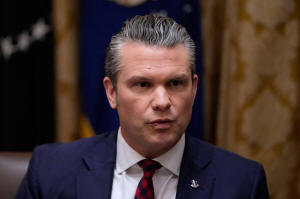
Defense Secretary Pete Hegseth speaks during a Cabinet meeting at
the White House, Tuesday, Dec. 2, 2025, in Washington. (AP
Photo/Julia Demaree Nikhinson)

The review was delivered to lawmakers, who were able to review the
report in a classified facility at the Capitol. A partially redacted
version of the report was expected to be released publicly later
this week.
Hegseth said he viewed the investigation as a partisan exercise and
did not trust the inspector general, according to one of the people
familiar with the report’s findings. The review had to rely on
screenshots of the Signal chat published by the Atlantic because
Hegseth could not provide more than a small handful of his Signal
messages, the person said.
When asked about the investigation in August, Pentagon press
secretary Kingsley Wilson told reporters that "we believe that this
is a witch hunt and a total sham and being conducted in bad faith.”
Lawmakers had called for inspector general to investigate
The revelations sparked intense scrutiny, with Democratic lawmakers
and a small number of Republicans saying Hegseth posting the
information to the Signal chats before the military jets had reached
their targets potentially put those pilots’ lives at risk. They said
lower-ranking members of the military would have been fired for such
a lapse.
Some Democrats on the House and Senate intelligence committees
suggested Wednesday that Hegseth’s actions would be a fireable
offense for anyone else.
“This was not an isolated lapse. It reflects a broader pattern of
recklessness and poor judgment from a secretary who has repeatedly
shown he is in over his head,” Sen. Mark Warner of Virginia said in
a statement.
The inspector general had opened its investigation into Hegseth at
the request of the Republican chairman of the Senate Armed Services
Committee, Sen. Roger Wicker of Mississippi, and the committee’s top
Democrat, Sen. Jack Reed of Rhode Island.

It all ties back to the campaign against Yemen’s Houthis
The Houthi rebels had started launching missile and drone attacks
against commercial and military ships in late 2023 in what their
leadership had described as an effort to end Israel’s offensive
against Hamas in the Gaza Strip. Their campaign greatly reduced the
flow of trade through the Red Sea corridor, which typically sees $1
trillion of goods move through it annually.
The U.S.-led campaign against the Houthis in 2024 turned into the
most intense running sea battle the Navy had faced since World War
II.
A ceasefire in the Israel-Hamas war had begun in January before
falling apart in March. The U.S. then launched a broad assault
against the Houthis that ended weeks later when Trump said they
pledged to stop attacking ships. The latest Gaza ceasefire began in
October.
Following the disclosure of Hegseth’s Signal chat that included the
Atlantic’s editor, the magazine released the entire thread in late
March. Hegseth had posted multiple details about an impending
strike, using military language and laying out when a “strike
window” starts, where a “target terrorist” was located, the time
elements around the attack and when various weapons and aircraft
would be used in the strike. He mentioned that the U.S. was
“currently clean” on operational security.
Hegseth told Fox News Channel in April that what he shared over
Signal was “informal, unclassified coordinations, for media
coordinations and other things.”
___
Associated Press writer Stephen Groves, Konstantin Toropin, Michelle
L. Price and David Klepper contributed to this report.
All contents © copyright 2025 Associated Press. All rights reserved |