NASCAR antitrust trial: Bob Jenkins
testifies about $100M loss and 'insulting' charter deal
[December 04, 2025]
By JENNA FRYER
CHARLOTTE, N.C. (AP) — Front Row Motorsports owner Bob Jenkins was
back on the stand Thursday to testify on the fourth day of the
explosive antitrust case that accuses NASCAR of being a monopolistic
bully in violation of federal antitrust laws.
Jenkins began his testimony Wednesday and the fast-food franchiser
said he was a passionate NASCAR fan who fulfilled a longtime dream
when he was finally able to own a car in the top motorsports series
in the United States.
But he said he has lost $100 million since becoming a team owner in
the early 2000s and that's even with a 2001 victory in the Daytona
500. His love of the sport and belief that it can be profitable have
kept him going, but what he believes is a no-win revenue model led
Front Row to join 23XI Racing in a federal lawsuit against NASCAR.
23XI is owned by Basketball Hall of Famer Michael Jordan and
three-time Daytona 500 winner Denny Hamlin. Jordan has the funding
to fight NASCAR and Jenkins joined the battle when he became
offended by NASCAR's “take-it-or-leave-it” offer on charter
agreements.
A charter is the equivalent of the franchise model used by other
sports leagues, but in NASCAR it guarantees a team a spot in the
field for all 38 races plus a designated percentage of revenue.
Front Row was one of the teams that received two charters for free
when NASCAR created the system in 2016 and Jenkins thought the
agreements were lousy then — but a step in the right direction.

All 15 Sprint Cup organizations fought for more than two years for
better terms on the charter extensions that began this year. But
when NASCAR's final offer was presented at 6 p.m. on a Friday last
year with six hours to sign the 112-page document, Jenkins balked
because it went “virtually backward in so many ways.
“It was insulting, it went so far backward," he testified Wednesday.
"NASCAR wanted to run the governance with an iron fist, it was like
taxation without representation. NASCAR has the right to do whatever
it wants.”
He said he was "honestly very hurt” by the sequence of events and
believed NASCAR “knew we had to blindly sign it. Some of these
owners have $500-$600 million facilities, long-term sponsors. They
couldn’t walk away from that.”
Jenkins testified that Joe Gibbs personally apologized to Jenkins
for signing the deal, and most owners reluctantly signed the
agreement.
“Not a single owner said, ‘I was happy to sign it.’ Not a single
one,” he testified. “100% of the owners think the charter system is
good,” Jenkins said. “The charter agreement is not.”
Front Row and 23XI were the only two organizations out of 15 that
refused to sign and instead went to court in a trial that could
completely rework NASCAR's framework.
The extensions ended more than two years of bitter negotiations in
which neither NASCAR or the teams budged.
Team losses
NASCAR executive vice president in charge of strategy Scott Prime
testified Wednesday that a study he worked on as a consultant found
the longevity of the sport was in danger if NASCAR didn’t act to
improve the health of their race teams.
[to top of second column] |
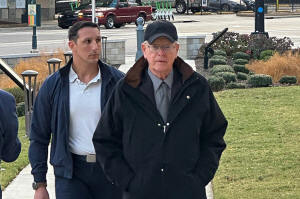
NASCAR chairman Jim France enters federal court in Charlotte, N.C.,
on Wednesday Dec 3, 2025. (AP Photo/Jenna Fryer)

Prime said NASCAR became concerned about the threat of a breakaway
stock car series during 2024 charter negotiations.
Jeffrey Kessler, attorney for the teams, told the jury Monday that
over a three-year period almost $400 million was paid to the France
Family Trust and a 2023 evaluation by Goldman Sachs found NASCAR to
be worth $5 billion. The pretrial discovery process revealed NASCAR
made more than $100 million in 2024.
NASCAR contends it is doing nothing wrong and has not restrained
trade or commerce by its teams. The series says the original
charters were given for free to teams when the system was created in
2016 and the demand for them created a market of $1.5 billion in
equity for chartered organizations.
The new charter agreement upped the guaranteed money for every
chartered car to $12.5 million in annual revenue, from $9 million.
But Hamlin and Jenkins have both testified it costs $20 million to
bring a single car to the track for all 38 races and that figure
does not include any overhead, operating costs or a driver’s salary.
Both testified they don’t have the ability to slash costs and teams
are too reliant on outside sponsorship to survive.
“It’s offensive to say I’ve overspent. We have a model that works
for us,” Jenkins testified. “I have never turned a profit. And it’s
not from malpractice. The level we compete at is just so expensive.”
Prime testified as much and noted in his consulting role he
discovered in 2014 that teams lost a combined $85 million, or an
average of $1.3 million a car. He also learned that under the system
before charters, when cars had to qualify for a race based on speed,
a team would lose $700,000 if it failed to make the field.
The trial is expected to last two weeks with Jordan, Rick Hendrick
and Roger Penske still set to testify. Jordan has been in court each
day and is occasionally demonstrative, either laughing at funny
remarks or shaking his head at testimony he disagrees with.
NASCAR is owned and operated by the France family, which founded the
series in 1948.
All contents © copyright 2025 Associated Press. All rights reserved
 |