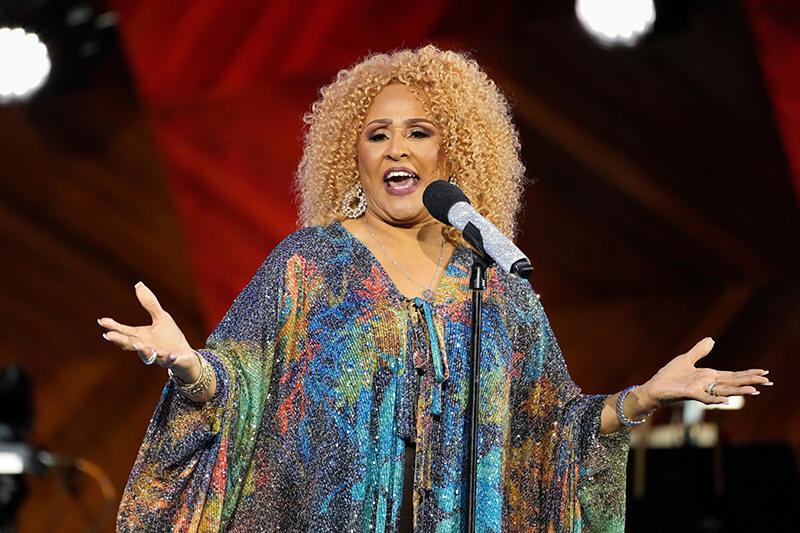
Darlene Love reflects on her enduring holiday classic, 'Christmas (Baby
Please Come Home)'
[December 06, 2025]
By HILLEL ITALIE
Darlene Love will never stop thinking of her holiday classic, “Christmas
(Baby Please Come Home).” At this time of year, she couldn't if she
tried.
“The post office, grocery store, elevator,” she says with a laugh,
listing a few locations where she keeps hearing the song. “It just feels
funny that my song is in that many places at Christmastime.”
Her signature song, first released in 1963, is as set in the pantheon as
such predecessors as Bing Crosby's “White Christmas” and such successors
as Mariah Carey's “All I Want for Christmas Is You.” Love sang
“Christmas” for years on David Letterman 's late night show, which ended
in 2015, and has since followed with appearances on “The View” and “The
Tonight Show Starring Jimmy Fallon,” where she will perform on Dec. 18,
along with Steve Van Zandt and former Letterman bandleader Paul Shaffer
among others.
Interviewed at the Sony Music Entertainment offices just off Madison
Square Park, the 84-year-old Love has a youthful, open-hearted spirit
that makes you believe she could break out at any time into the joyous
roar of “Christmas,” or “He’s a Rebel,” “He’s Sure the Boy I Love” and
other showcases. Revered by generations of musicians, Love was inducted
into the Rock and Roll Hall of Fame in 2011 and was among the singers
featured two years later in the Oscar-winning documentary, “Twenty Feet
from Stardom.”

She was born Darlene Wright in Los Angeles, a minister's daughter who
had been performing in front of people for years before Phil Spector
signed her up in 1962. He renamed her “Darlene Love” and launched her
career as a lead and backing singer whose mighty mezzo-soprano was more
than equal to the producer's booming orchestrations, what he called
“little symphonies for the kids.”
When Spector decided to record an album of Christmas music, he featured
Love on oldies (“White Christmas” and “Marshmallow World”) and the
original composition that became her trademark: “Christmas” was
conceived by Spector and one of the great songwriting teams of the era,
Jeff Barry and Ellie Greenwich. Love questioned the whole idea of a
“rock n roll Christmas song,” but remembered a transcendent, exhausting
session, and the challenge of making a summertime studio gathering feel
like winter.
“What Phil Spector did was he went out and got Christmas lights and a
Christmas tree and made it freezing cold in the studio,” she says. “I
told him 'You can’t do that because that’s going to close up all our
throats if you make it that cold in here.' So the only thing we had left
were the lights and everybody was in a great mood.”
Standing up to Spector
Love had a troubled relationship with Spector well before his mercurial
personality turned lethal and he was convicted in 2009 for the murder of
actor Lana Clarkson. (Spector died in prison in 2021). The producer
infuriated Love soon after they began working together when he recorded
her singing “He's Sure the Boy I Love” and, without telling her,
released it as a single by another Spector act, the Crystals. In the
1990s, she sued Spector for unpaid royalties for various songs and
received $250,000.

[to top of second column]
|
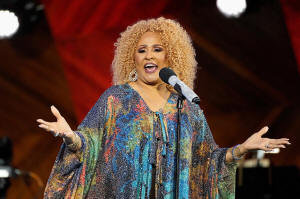
Darlene Love performs during the Boston Pops Fireworks Spectacular
in Boston on July 4, 2024. (AP Photo/Michael Dwyer, File)
 But during her interview, she spoke
warmly of Spector, recalling how she would tease him about his
hairpiece and his elevated shoes, or refuse to sing another take
when she was sure she had done it right. Love was in her early 20s
at the time but was married (her first of three), with a young son
and found herself acting as elder sibling and protector for two
teenagers who would become iconic in their own right — the
producer's future wife, Ronnie Spector, then known as Ronnie
Bennett; and the shy, but tough future wife of session man Sonny
Bono, Cher.
As Cher wrote in her eponymous 2024 memoir, and
Love confirms, Darlene Love was unafraid to challenge the men in the
room. During breaks between sessions, she would go out for
hamburgers across the street and bring Cher and Bennett with her,
indifferent to the objections of their controlling boyfriends. “Come
on, let’s go do this. Let’s go do this,” she remembered urging her
friends. “I was always getting everybody in trouble.”
Love and Cher have worked together often. Cher sang backing vocals
on “Christmas (Baby Please Come Home)” and Love has backed Cher on
tour. A couple of years ago, Cher was recording a Christmas album
and phoned Love, hoping she would join her on “Christmas (Baby
Please Come Home).” They grew up together in show business, but Love
at first didn't recognize the famous voice on the other end of the
connection.
“We talk to each other like maybe twice a year, and our careers went
in totally and completely different avenues,” Love says. “So Cher
calls and says, ‘Hey, doll.’ That’s what she calls me. She said,
‘This is Cher.’ And I said ‘Who?’ She said, ‘Cher, bitch!’ So I’m
like, ‘Oh yeah, this is you. What’s up?’”
A slow path to the top
“A Christmas Gift for You from Phil Spector,” now regarded as a
landmark, also features such long-running favorites as the Ronettes'
“I Saw Mommy Kissing Santa Claus” and “Frosty the Snowman” and the
Crystals' “Santa Claus Is Coming to Town.” But the album was
originally famous for its tragic timing; the release date was Nov.
22, 1963, the day President John F. Kennedy was assassinated. “A
Christmas Gift” would take years to fully catch on, while “Christmas
(Baby Please Come Home)” only became a perennial on Letterman's show
in the 1990s.
Love thinks “Christmas” endures because it's easy to sing (although
try singing it like her) and because the words can be about anyone,
a lover, “a sister who got lost, or somebody who passed.” Asked if
there was another holiday song she'd like to perform as often as
“Christmas,” she quickly answers, “Silent Night.”
“It's one of those songs that makes you feel good, and can make you
feel sad, too,” she explained. “Because you're talking about night,
and you're talking about a silent night, but a clear night, where
you can see all the stars.
“And you never know how many stars are in the sky. Somewhere in the
mountains where it’s black-dark. And it’s millions and millions and
millions of stars. So when you say ‘Silent night, holy night,’
you’re talking about stars.”
All contents © copyright 2025 Associated Press. All rights reserved |