Affordable Care Act enrollment is slightly ahead of last year so far,
despite expiring subsidies
[December 09, 2025]
By ALI SWENSON and NICKY FORSTER
NEW YORK (AP) — The number of Americans signing up for Affordable Care
Act health insurance for 2026 is moderately higher than it was at a
similar time last year, initial new federal data shows, even as
subsidies set to expire at the end of 2025 will make the coverage more
expensive for many.
Seen at face value, the data from the Center for Medicare and Medicaid
Services seems to defy predictions that many Americans facing pricier
plans would drop out of marketplace coverage altogether next year. But
experts caution that the numbers are an incomplete snapshot of total
enrollment, which could still show a decline by the end of the open
enrollment period.
“Overall, it’s just too early to know what any of this means,” said
Jason Levitis, a senior fellow in the health policy division at the
Urban Institute.
The data released Friday shows that by day 29 of the window for
Americans to shop for Affordable Care Act plans this year, nearly 5.8
million people had picked one. That’s nearly 400,000 more enrollments
than by day 30 of the open enrollment period last year.
Meanwhile, this year’s enrollment numbers are about 1.5 million lower
than the 7.3 million or so people who had signed up 32 days into the
open enrollment period two years ago, showing there is some fluctuation
year to year in when people sign up for coverage.
In most states, for Americans who want coverage to start Jan. 1, the
window to shop for Affordable Care Act coverage began Nov. 1 and ends
Dec. 15. People who want their coverage to start later can continue to
select plans through Jan. 15.

Five years ago, about 12 million people selected an Affordable Care Act
plan. Enhanced tax credits were introduced the following year and four
years later enrollment had doubled to over 24 million. Today, millions
of people benefit from the enhanced subsidies — and if they expire as
expected in the new year, the average person who receives a subsidy will
see their annual premiums more than double, according to health care
research nonprofit KFF.
The tax credits have been at the heart of fierce discussions in Congress
in recent weeks, with Democrats insisting that they be extended to help
Americans with rising health costs. The Senate is expected to vote this
week on a Democratic proposal to extend the subsidies without major
changes. But Republicans in charge have already rejected that proposal,
and hopes for any extension are diminishing with many Republicans
opposed.
[to top of second column]
|
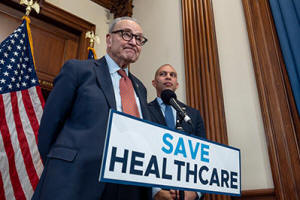
As Congress faces a year-end deadline on Affordable Care Act
subsidies, Senate Minority Leader Chuck Schumer, D-N.Y., left, and
House Minority Leader Hakeem Jeffries, D-N.Y., meet with reporters
about health care affordability, at the Capitol in Washington,
Wednesday, Dec. 3, 2025. (AP Photo/J. Scott Applewhite)
 Experts said there are various
potential explanations for this year's enrollment numbers tracking
higher so far, including that Affordable Care Act health insurance
has been prominent in the news as Congress debates a solution to the
expiring subsidies.
Another factor is that older, sicker people tend to choose their
health plans earlier in the enrollment period because they know they
will purchase coverage regardless of the cost. Americans on the
fence about canceling, meanwhile, could be considering their options
or waiting to see whether Congress comes to a last-minute extension
of the expiring subsidies.
Levitis of the Urban Institute noted that people may be swapping
higher-tier plans for less expensive ones that have pricier
deductibles and only later canceling, which could be causing a delay
in the impact of the expiring subsidies on enrollment.
“All of this stuff takes a while to diffuse through the system,” he
said.
Joe Antos, a health economist at the business-oriented American
Enterprise Institute, said Republicans will likely try to prop up
the latest data as evidence that expiring subsidies won't have a
negative impact on people being able to afford health coverage.
But “that’s not going to change what politicians in red states
know,” Antos said, noting that many Republicans in vulnerable U.S.
House districts are aware they could face backlash from
working-class constituents next year if an extension is not reached.
All contents © copyright 2025 Associated Press. All rights reserved
 |