Senate heads toward dueling partisan votes on health care, with each
likely to fail
[December 10, 2025]
By MARY CLARE JALONICK and ALI SWENSON
WASHINGTON (AP) — The Senate is heading toward dueling partisan votes on
health care this week after Republicans said Tuesday that they had
united around a plan, for now, that would allow COVID-era health care
subsidies to expire.
Both the Republican plan, which would replace the subsidies with new
savings accounts, and a Democratic bill to extend the enhanced
Affordable Care Act tax credits for three years lack the bipartisan
support needed for passage. Senate Majority Leader John Thune, R-S.D.,
said Tuesday that the Democratic legislation does not include enough
reforms to curb fraud or limit high-income recipients. That legislation
“will fail,” Thune said.
At the same time, Democratic Leader Chuck Schumer called the Republican
plan “phony” and said the bill is “dead on arrival.”
The burden is on Republicans “to vote with us,” Schumer said of
Democrats, who forced a 43-day government shutdown over the issue.
With Republicans and Democrats unable to agree — or even really
negotiate with each other — millions of people could see increases in
their premium payments when the tax credits expire in January. Both
sides blame the other for the increasingly likely failure of Congress to
act, bringing the issue into the midterm election year with political
talking points but little in the way of compromise on the subsidies that
have helped keep costs down for many of the more than 24 million
Americans.

Tentative GOP unity after years of disagreement
The Republican unity around a single plan, in the Senate at least, comes
as the party has wrangled for more than a decade over how to replace
former President Barack Obama’s signature law, also known as Obamacare.
The legislation by Louisiana Sen. Bill Cassidy, the chairman of the
Senate Health, Labor, Education and Pensions Committee, and Idaho Sen.
Mike Crapo, the chairman of the Senate Finance Committee, emerged this
week from many different proposals from Republican senators, including
some that would have extended the tax credits with new limits.
Despite those differences, Republicans worked to project unity as they
emerged from a lunch meeting Tuesday. Ohio Sen. Bernie Moreno, who had
just recently proposed legislation to extend the subsidies with new
income caps, said he is now “hyper-focused” on Cassidy and Crapo’s
legislation. Missouri Sen. Josh Hawley, who had his own bill to reduce
taxes on health care, said the consensus bill “isn’t perfect, but I’m
willing to give it a go.”
“I just think that Republicans can’t do nothing,” Hawley said after the
meeting. “I think we ought to be doing everything we can to try and get
down the cost of health care.”
Thune said there will now be “something out there that Republicans will
be able to talk about and support and vote for, and then we’ll see.”
There was less consensus in the House, where moderate Republicans who
are up for reelection have been pushing Speaker Mike Johnson, R-La., to
extend the subsidies with new reforms while the right flank of the party
has demanded deeper reforms to the ACA. House Majority Leader Steve
Scalise told reporters that GOP leadership will present options to
members on Wednesday for potential votes next week.
[to top of second column]
|
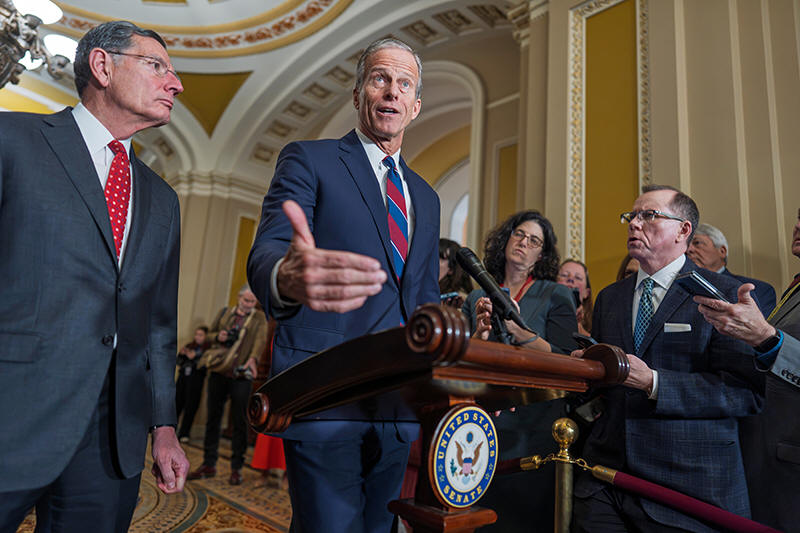
Senate Majority Leader John Thune, R-S.D., joined at left by Sen.
John Barrasso, R-Wyo., speaks to reporters after a closed-door
meeting with fellow Republicans, at the Capitol in Washington,
Tuesday, Dec. 9, 2025. (AP Photo/J. Scott Applewhite)

Proposed health savings accounts
The bill by Cassidy and Crapo would let the current subsidies, first
put in place during the COVID-19 pandemic, expire. The legislation
would then make payments to the new health savings accounts for the
next two years, for enrollees making less than 700% of the federal
poverty level who pick lower-cost, higher-deductible bronze or
catastrophic health insurance plans.
Eligible enrollees between the ages of 18 and 49 would get $1,000
per year, while those between 50 and 64 would get $1,500. The money
could be spent to defray out-of-pocket expenses like copays and
deductibles, or to purchase other qualified health-related items
directly from companies, but not to cover monthly premiums.
Cassidy and Crapo say their bill provides better support to
Americans than the expiring subsidies do because it hands money
directly to the people, giving them the power to decide how to spend
or save it — a message President Donald Trump has echoed in recent
weeks. Republicans say the plan could also cut down on fraud in the
health care system, pointing to a Government Accountability Office
report that found some fake recipients were able to get coverage.
The bill also includes new language limiting the use of Affordable
Care Act money for abortion — a dealbreaker for moderate Democrats
who say they would have been willing to negotiate on the issue.
Uncertainty over costs
Health analysts warn that the plan won’t do much to help
lower-income Affordable Care Act enrollees who rely on subsidies to
afford their monthly insurance fees.
The Republicans’ plan also requires enrollees to pick
higher-deductible plans to be eligible for the payments — meaning
heavy users of health insurance may end up saddled with
out-of-pocket costs far higher than the new influx of cash in their
pockets.

Oregon Sen. Ron Wyden, the top Democrat on the Senate Finance
Committee, said the GOP proposal “leaves middle-class Americans
saddled with sky-high premiums, and Big Insurance makes out like
bandits by selling junk plans to families that desperately need
health coverage.”
“Instead of working with Democrats to stop this health cost crisis,
Republicans are selling snake oil,” Wyden said.
___
Swenson reported from New York. Associated Press reporter Kevin
Freking contributed to this report.
All contents © copyright 2025 Associated Press. All rights reserved |