Indiana Republicans defy Trump and reject his House redistricting push
in the state
[December 12, 2025]
By ISABELLA VOLMERT, OBED LAMY and TOM BEAUMONT
INDIANAPOLIS (AP) — Indiana's Republican-led Senate decisively rejected
a redrawn congressional map Thursday that would have favored their
party, defying months of pressure from President Donald Trump and
delivering a stark setback to the White House ahead of next year's
midterm elections.
The vote was overwhelmingly against the proposed redistricting, with
more Republicans opposing than supporting the measure, signaling the
limits of Trump's influence even in one of the country's most
conservative states.
Trump has been urging Republicans nationwide to redraw their
congressional maps in an unusual campaign to help the party maintain its
thin majority in the House of Representatives. Although Texas, Missouri,
Ohio and North Carolina went along, Indiana did not — despite cajoling
and insults from the president and the possibility of primary
challenges.
“The federal government should not dictate by threat or other means what
should happen in our states,” said Spencer Deery, one of the Republican
senators who voted no on Thursday.
When the proposal failed 31-19, cheers could be heard inside the chamber
as well as shouts of “thank you!” The debate had been shadowed by the
possibility of violence, and some lawmakers have received threats.
Trump tried to brush off the defeat, telling reporters in the Oval
Office that he “wasn’t working on it very hard" despite his personal
involvement in the pressure campaign.

Republicans could have erased two Democratic districts
The proposed map was designed to give Republicans control of all nine of
Indiana’s congressional seats, up from the seven they currently hold. It
would have effectively erased Indiana’s two Democrat-held districts by
splitting Indianapolis among four districts that extend into rural
areas, reshaping U.S. Rep. André Carson’s safe district in the city. It
would have also eliminated the northwest Indiana district held by U.S.
Rep. Frank Mrvan.
District boundaries are usually adjusted once a decade after a new
census. But Trump has described redistricting as an existential issue
for the party as Democrats push to regain power in Washington.
“If Republicans will not do what is necessary to save our Country, they
will eventually lose everything to the Democrats,” Trump wrote on social
media the night before the vote.
The president said anyone who voted against the plan should lose their
seats. Half of Indiana senators are up for reelection next year, and the
conservative organization Turning Point Action had pledged to fund
campaigns against them.
David McIntosh, president of Club for Growth, which had backed
redistricting, said the vote allowed disloyal Republicans to “stick
their finger in the eye of the president of the United States.”
Former Indiana Gov. Mitch Daniels praised senators for “courageous
principled leadership" in rejecting the new map.
A Republican who has vocally criticized Trump, Daniels said the outcome
was “a major black eye for him and all the Washington groups that piled
in, spent money, blustered and threatened.” He added that “this thing
rubbed our state the wrong way and Republicans in our state very wrong
from the jump.”

Redistricting fails despite White House pressure
Inside the state Senate chamber, Democratic lawmakers spoke out against
redistricting ahead of the vote.
“Competition is healthy my friends,” Sen. Fady Qaddoura said. “Any
political party on earth that cannot run and win based on the merits of
its ideas is unworthy of governing.”
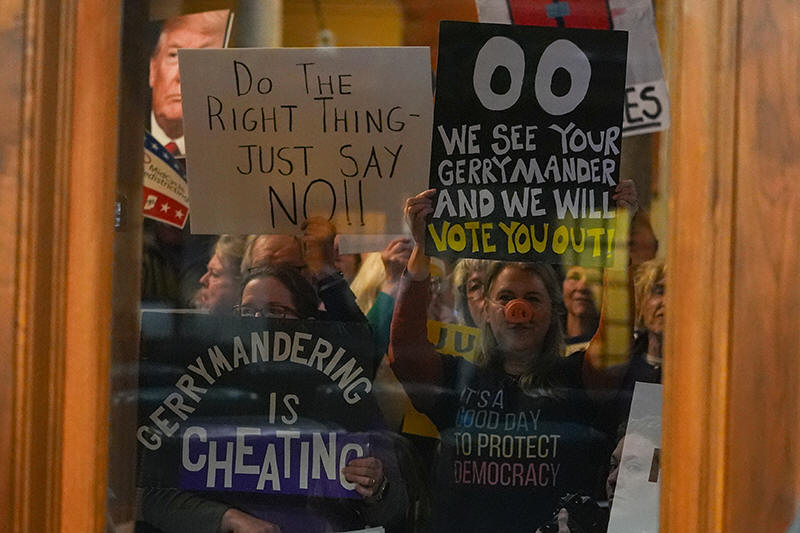
In the hallways outside, redistricting opponents chanted “Vote no!” and
“Fair maps!” while holding signs with slogans like “Losers cheat.”
[to top of second column]
|
Protesters are seen through a window in the Senate Chamber during
dissuasion before a vote to redistrict the state's congressional
map, Thursday, Dec. 11, 2025, at the Statehouse in Indianapolis. (AP
Photo/Michael Conroy)

Three times over the fall, Vice President JD Vance met with
Republican senators — twice in Indianapolis and once in the White
House — to urge their support. Trump joined a conference call with
senators on Oct. 17 to make his own 15-minute pitch.
Behind the scenes, James Blair, Trump’s deputy White House chief of
staff for political affairs, was in regular touch with members, as
were other groups supporting the effort such as the Heritage
Foundation and Turning Point USA.
“The administration made a full-court press,” said Republican Sen.
Andy Zay, who was on the phone with White House aides sometimes
multiple times per week, despite his commitment as a yes vote.
Across the country, mid-cycle redistricting so far has resulted in
nine more congressional seats that Republicans believe they can win
and six more congressional seats that Democrats think they can win.
However, some of the new maps are facing litigation.
In Utah, a judge imposed new districts that could allow Democrats to
win a seat, saying Republican lawmakers violated voter-backed
standards against gerrymandering.
Republicans were split over plan
Despite Trump’s push, support for gerrymandering in Indiana’s Senate
was uncertain. A dozen of the 50 senators had not publicly committed
to a stance ahead of the vote.
Republican Sen. Greg Goode signaled his displeasure with the
redistricting plan before voting no. He said some of his
constituents objected to seeing their county split up or paired with
Indianapolis. He expressed “love” for Trump but criticized what he
called “over-the-top pressure” from inside and outside the state.
Sen. Michael Young, another Republican, said the stakes in
Washington justify redistricting, as Democrats are only a few seats
away from flipping control of the U.S. House in 2026. “I know this
election is going to be very close,” he said.

Republican Sen. Mike Gaskill, the redistricting legislation's
sponsor, showed Senators maps of congressional districts around the
country, including several focused on Democratic-held seats in New
England and Illinois. He argued other states gerrymander and Indiana
Republicans should play by the same rules.
The bill cleared its first hurdle Monday with a 6-3 Senate committee
vote, although one Republican joined Democrats in opposing it and a
few others signaled they might vote against the final version. The
state House passed the proposal last week, with 12 Republicans
siding with Democrats in opposition.
Among them was state Rep. Ed Clere, who said state troopers
responded to a hoax message claiming a pipe bomb outside his home
Wednesday evening. Indiana state police said “numerous others”
received threats but wouldn't offer details about an ongoing
investigation.
In an interview, Clere said these threats were the inevitable result
of Trump’s pressure campaign and a “winner-take-all mentality.”
“Words have consequences,” Clere said.
___
Volmert reported from Lansing, Michigan. Beaumont reported from Des
Moines, Iowa.
All contents © copyright 2025 Associated Press. All rights reserved
 |