Trump sued by preservationists seeking reviews and congressional
approval for ballroom project
[December 13, 2025]
By BILL BARROW
President Donald Trump was sued on Friday by preservationists asking a
federal court to halt his White House ballroom project until it goes
through multiple independent reviews and wins approval from Congress.
The National Trust for Historic Preservation, a privately funded group,
is asking the U.S. District Court to block Trump’s White House ballroom
addition, which already has involved razing the East Wing, until it goes
through comprehensive design reviews, environmental assessments, public
comments and congressional debate and ratification.
The project has prompted criticism in the historic preservation and
architectural communities, and among his political adversaries, but the
lawsuit is the most tangible effort thus far to alter or stop the
president's plans for an addition that itself would be nearly twice the
size of the White House before the East Wing’s demolition.
“No president is legally allowed to tear down portions of the White
House without any review whatsoever — not President Trump, not President
Biden, and not anyone else,” the lawsuit states. “And no president is
legally allowed to construct a ballroom on public property without
giving the public the opportunity to weigh in.”

Additionally, the Trust wants the court to declare that Trump, by
fast-tracking the project, has committed multiple violations of the
Administrative Procedures Act and the National Environmental Policy Act,
while also exceeding his constitutional authority by not consulting
lawmakers.
No more work should be done, the Trust argues, until administration
officials “complete the required reviews — reviews that should have
taken place before the Defendants demolished the East Wing, and before
they began construction of the Ballroom.”
White House maintains that Trump has ‘full legal authority’ over the
building
Asked questions about the lawsuit, White House spokesman David Ingle
responded with a blanket assertion that Trump is within his “full legal
authority to modernize, renovate and beautify the White House — just
like all of his predecessors did.”
Ingle did not specifically address an Associated Press question asking
whether the president would consult Congress at any point.
The White House response correctly notes that essentially every
president makes some changes to the White House. But Trump's efforts are
the most sweeping since a nearly complete gutting of the decaying
interior of the oldest portion of the mansion during President Harry
Truman's tenure. Truman sought and received explicit authorization from
Congress, along with appropriations. Further, he consulted the American
Society of Engineers and the Commission on Fine Arts, and he appointed a
bipartisan commission to oversee the project.
Trump, a Republican, has emphasized since announcing the project that
he’s doing it with private money, including his own. But that would not
necessarily change how federal laws and procedures apply to what is
still a U.S. government project.
The president already has bypassed the federal government’s usual
building practices and historical reviews with the East Wing demolition.
He recently added another architectural firm to the project.

[to top of second column]
|

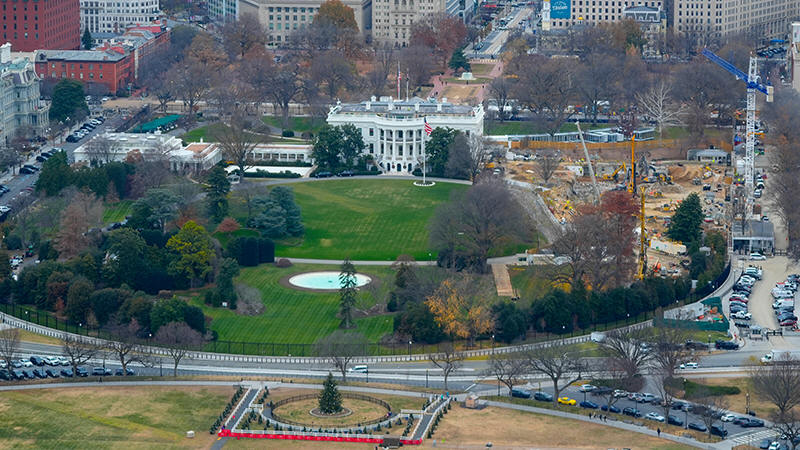
Work continues on the construction of the ballroom at the White
House, Tuesday, Dec., 9, 2025, in Washington, where the East Wing
once stood. (AP Photo/Pablo Martinez Monsivais)

Trump has long said a White House ballroom is overdue, complaining
that events were held outside under a tent because the East Room and
the State Dining Room could not accommodate bigger crowds. Trump,
among other complaints, said guests get their feet wet if it rains
during such events.
The White House is expected to submit plans for Trump’s new ballroom
to a federal planning commission before the year ends, about three
months after construction began.
Will Scharf, who was named by Trump as chairman of the National
Capital Planning Commission, said at the panel’s monthly meeting
last week that he was told by colleagues at the White House that the
long-awaited plans would be filed in December.
“Once plans are submitted, that’s really when the role of this
commission, and its professional staff, will begin,” said Scharf,
who also is one of the Republican president’s top White House aides.
He said the review process would happen at a “normal and
deliberative pace.”
Besides being too late, the Trust argues, that's not nearly enough.
Federal law cites ‘express authority of Congress’ over D.C.
projects
The Trust asserts that plans should have been submitted to the
National Capital Planning Commission, the Commission of Fine Arts
and Congress before any action. The lawsuit notes that the Trust
wrote to those entities and the National Park Service on Oct. 21,
after East Wing demolition began, urging a stop to the project and
asking the administration to comply with federal law.

“The National Trust received no response,” the lawsuit said.
The lawsuit cites a litany of federal statutes and rules detailing
the role the planning and fine arts commission and lawmakers play in
U.S. government construction projects.
Among them is a statute: “A building or structure shall not be
erected on any reservation, park, or public grounds of the Federal
Government in the District of Columbia without express authority of
Congress."
The Trust notes also that the range design and environmental
reviews, along with congressional deliberation, would involve public
input.
“This public involvement, while important in all preservation
matters, is particularly critical here, where the structure at issue
is perhaps the most recognizable and historically significant
building in the country,” the complaint says.
Besides the president, the lawsuit names as defendants the National
Parks Service, the Department of the Interior, and the General
Services Administration, along with leaders of those federal
agencies.
All contents © copyright 2025 Associated Press. All rights reserved |