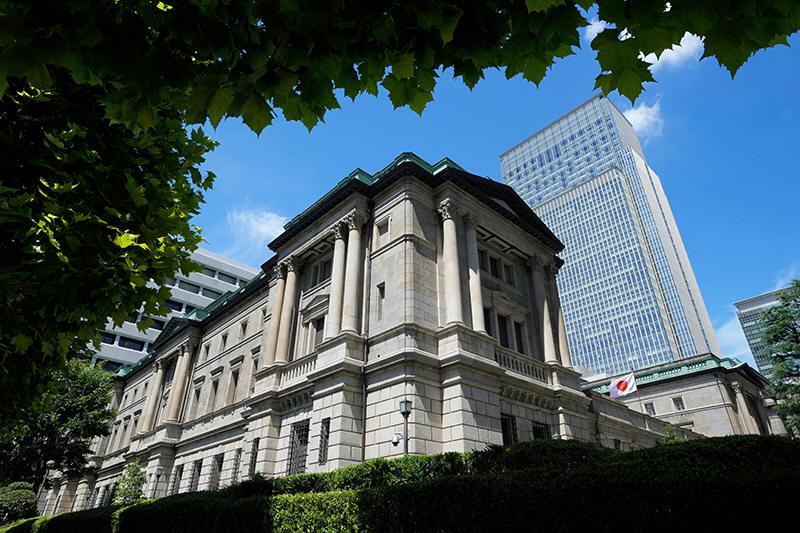
Quarterly 'tankan' survey shows slight improvement as Bank of Japan
weighs a rate hike
[December 15, 2025] By
ELAINE KURTENBACH
A quarterly survey of major Japanese manufacturers released Monday shows
business sentiment improving to its best level in four years, even after
President Trump raised tariffs on goods from the U.S. ally to a baseline
level of 15%.
The Bank of Japan is bound to take the results of its quarterly “tankan”
survey into account during a policy meeting this week, when it is
expected to raise its benchmark interest rate. Analysts said the
stronger results may sway the BOJ toward pressing ahead with a 0.25
percentage point rate hike that will take the key rate to 0.75%.
That expectation hit the price of bitcoin early Monday, as it dipped
below $88,000 from about $92,000. Higher rates would likely lead
Japanese investors to shift funds back home, sapping demand for
cryptocurrencies.
While the U.S. Federal Reserve has been trimming rates to counter a weak
jobs market, Japan’s central bank is moving in the other direction as it
contends with inflation and a weak currency. The economy contracted at
an annualized rate of 2.3% in July-September.
Still, the BOJ survey showed the measure of major manufacturers
expressing optimism rose to 15 from 14 in the last quarter, the highest
level in four years. The index shows the percentage of companies
reporting positive conditions minus the percentage reporting unfavorable
ones.
The measure of sentiment for all companies rose to 17 from 15, it said.
The survey “struck all the right notes from the Bank of Japan's
perspective,” Abhijit Surya of Capital Economics said in a report. “It
showed that business conditions are improving, profit margins remain
elevated and firms are upbeat about their investment intentions.”

[to top of second column] |
A Japanese flag flutters at the Bank of Japan headquarters in Tokyo
on July 29, 2022. (AP Photo/Shuji Kajiyama, File)
 The latest deal between Japan and
the Trump administration set tariffs on its exports to the U.S. at
15%, down from an earlier plan for a 25% tariff. To win the
agreement, among other things Japan promised to invest $550 billion
in the United States.
While the BOJ's overall survey showed improvement, forecasts for the
next quarter were less positive, and businesses expected inflation
to remain at 2.4%, above the central bank's target range.
The Bank of Japan has kept its key interest rate near or below zero
for years, trying to spur faster economic growth by keeping
borrowing costs very low.
Its policymaking has been complicated by the fact that Japan's
population is shrinking and aging rapidly. That has caused labor
shortages that have only slowly pushed wages higher. That should
lead consumers to spend more, but increases in income have lagged
behind inflation, denting their appetite for spending.
Prime Minister Sanae Takaichi has pledged, as have her predecessors,
to revive the economy. Last month, her cabinet approved a 21.3
trillion yen ($135.4 billion) stimulus package to spur growth
through expansionary government spending and relieve the impact of
higher prices.
All contents © copyright 2025 Associated Press. All rights reserved |