Americans like artificial Christmas trees even though few are made in US
and prices are up
[December 16, 2025] By
DEE-ANN DURBIN
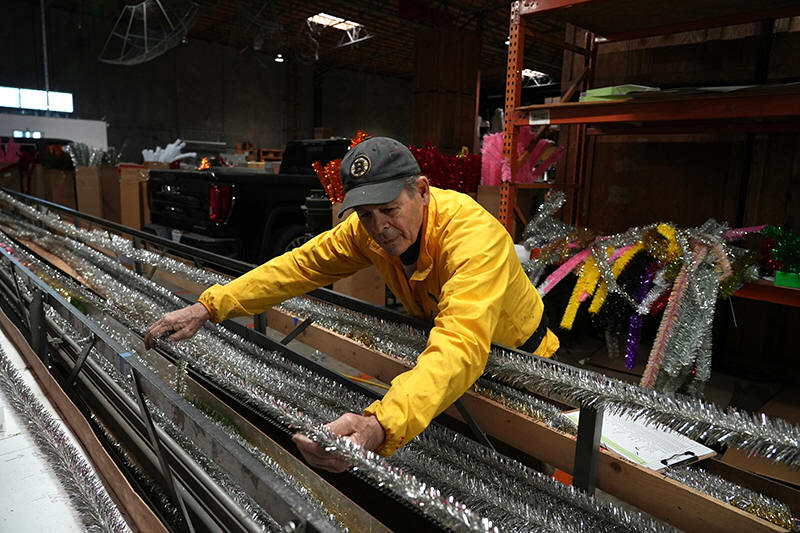
On a recent December day, Mark Latino and a handful of his workers spun
sheets of vinyl into tinsel for Christmas tree branches. They worked on
a custom-made machine that’s nearly a century old, churning out strands
of bright silver tinsel along its 35-foot (10-meter) length.
Latino is the CEO of Lee Display, a Fairfield, California-based company
that his great-grandfather founded in 1902. Back then, it specialized in
handmade velvet and silk flowers for hats. Now, it's one of the only
companies in the United States that still makes artificial Christmas
trees, producing around 10,000 each year.
Tariffs and trees
Tariffs shone a twinkling light this year on fake Christmas trees — and
the extent to which America depends on other countries for its plastic
fir trees.
Prices for fake trees rose 10% to 15% this year due to the new import
taxes, according to the American Christmas Tree Association, a trade
group. Tree sellers cut their orders and paid higher tariffs for the
stock they brought in.
Despite those issues, tree companies say they aren’t likely to shift
large-scale production back to the U.S. after decades in Asia. Fake
trees are labor-intensive and require holiday lights and other
components the U.S. doesn’t make, said Chris Butler, CEO of the National
Tree Co., which sells more than 1 million artificial trees each year.
Americans are also very price-sensitive when it comes to holiday décor,
Butler said.
“Putting a ‘Made in the U.S.A.’ sticker on the box won’t do any good if
it’s twice as expensive,” Butler said. “If it’s 20% more expensive, it
won’t sell.”

Americans prefer fake trees
About 80% of the U.S. residents who put up a Christmas tree this year
planned to use a fake one, according to the American Christmas Tree
Association. That percentage has been unchanged for at least 15 years.
Mac Harman, the founder and CEO of Balsam Brands, which sells hundreds
of thousands of Balsam Hill trees each year, said Americans like to set
up their trees on Thanksgiving and leave them up for weeks, which dries
out fresh-cut trees. Others prefer fake trees because they’re allergic
to the mold spores on real trees, he said.
Americans also like convenience; 80% of the fake trees sold each year
have the lights already strung on them, Butler said.
That preference is one reason artificial tree production shifted away
from the U.S., first to Thailand in the early 1990s and to China about a
decade later. Winding lights around the branches is time-consuming and
tedious, Harman said.
“Where are we going to get 15,000 people in America who want to string
lights on Christmas trees?” Harman said.
Labor-intensive work
It takes an hour or two to make an artificial Christmas tree, from
molding and cutting the needles to tying branches together and attaching
the lights, Butler said. Workers in China, where 90% of fake trees are
made, are paid $1.50 to $2 per hour, he said.
Harman said the workers who wrap the lights on Balsam Hill's trees are
so efficient “it's like watching an Olympian.”
One of Balsam Brands’ Chinese partners employs 15,000 to 20,000 people;
another in Indonesia has up to 10,000, he said. Many are seasonal
workers, since orders for Christmas décor slow down between October and
February.
Balsam Brands, which is based in Redwood City, California, studied
whether it could make faux trees in Ohio during the first Trump
administration, when President Donald Trump threatened -– but eventually
delayed –- tariffs on imported Christmas décor, Harman said.
[to top of second column] |
Mark Latino, CEO of Lee Display, works with a machine that makes
tinsel brush for artificial Christmas trees at the company's
warehouse, in Fairfield, Calif., Tuesday, Dec. 9, 2025. (AP
Photo/Terry Chea)
 The company hired consultants and
considered automating some work. But it concluded a tree that
currently sells for $800 would cost $3,000 if it was made in the
U.S. Harman said Balsam couldn’t even find a U.S. company to make
the pair of gloves it includes in each box for fluffing out
branches.
American-made trees
Lee Display employs three or four people for most of the year,
adding more during the holiday rush to help with installations and
displays. About half its business is making custom displays for
companies such as Macy’s, while the other half is selling directly
to consumers.
Latino said he likes that he can produce an order quickly instead of
waiting for it to ship from overseas.
“You have more control over it. I like to think that everything here
is either my fault or my mistake or my careful planning and skill,”
he said.
The tariffs still affected Lee Display. Latino's son James, who
leads business development and marketing, said the company didn’t
import lights or decorations from China this year and relied on
items it already had in stock. It's getting low on lights, so next
year it will have to pay more to import them, he said.
Responding to tariffs
Some artificial tree companies are branching out so they’re less
reliant on China. National Tree Co., which is based in Cranford, New
Jersey, moved some manufacturing to Cambodia in 2024, and could
source all its trees from outside China by next year if it wanted
to, Butler said.
But diversifying their suppliers didn't make those companies immune
from the impact of tariffs either. In April, the Trump
administration threatened a 49% tariff against products from
Cambodia. That rate was eventually reduced to 19%. Tariffs on
artificial trees from China also bounced around but now average 20%,
according to the American Christmas Tree Association.
Butler said his company imported fewer trees this year and also
raised prices by 10%. He said he used a lot of the money to offer
customer discounts since demand was weak because of consumer worries
about the economy.

“It’s a discretionary item. People say, ‘I can wait one more year,’”
Butler said.
Balsam Brands cut its workforce by 10%, canceled travel, froze
raises and even stopped serving lunch in the office once a week to
absorb the impact of tariffs, Harman said. It also raised tree
prices by 10%.
Harman said his sales are down 5% to 10% this year in the U.S. but
up 10% or more in Germany, Australia, Canada and France. That tells
him tariffs have decreased U.S. demand.
“If a merry Christmas is measured in how many decorations people put
up, by that measure it's going to be a slightly less merry
Christmas,” he said.
___
AP Video Journalist Terry Chea contributed from Fairfield,
California.
All contents © copyright 2025 Associated Press. All rights reserved |