Senate passes $901 billion defense bill that pushes Hegseth for boat
strike video
[December 18, 2025]
By STEPHEN GROVES
WASHINGTON (AP) — The Senate gave final passage Wednesday to an annual
military policy bill that will authorize $901 billion in defense
programs while pressuring Defense Secretary Pete Hegseth to provide
lawmakers with video of strikes on alleged drug boats in international
water near Venezuela.
The annual National Defense Authorization Act, which raises troop pay by
3.8%, gained bipartisan backing as it moved through Congress. It passed
the Senate on a 77-20 vote before lawmakers planned to leave Washington
for a holiday break. Two Republicans — Sens. Rand Paul and Mike Lee —
and 18 Democrats voted against the bill.
The White House has indicated that it is in line with President Donald
Trump's national security priorities. However, the legislation, which
ran over 3,000 pages, revealed some points of friction between Congress
and the Pentagon as the Trump administration reorients its focus away
from security in Europe and toward Central and South America.
The bill pushes back on recent moves by the Pentagon. It demands more
information on boat strikes in the Caribbean, requires that the U.S.
keep its troop levels in Europe at current levels and sends some
military aid to Ukraine.
But overall, the bill represents a compromise between the parties. It
implements many of Trump's executive orders and proposals on eliminating
diversity and inclusion efforts in the military and grants emergency
military powers at the U.S. border with Mexico. It also enhances
congressional oversight of the Department of Defense, repeals several
years-old war authorizations and seeks to overhaul how the Pentagon
purchases weapons as the U.S. tries to outpace China in developing the
next generation of military technology.

“We're about to pass, and the president will enthusiastically sign, the
most sweeping upgrades to DoD's business practices in 60 years,” said
Sen. Roger Wicker, the Republican chair of the Senate Armed Services
Committee.
Still, the sprawling bill did face objections from both Democratic and
Republican leadership on the Senate Commerce Committee and the head of
the National Transportation Safety Board. That’s because the legislation
could allow military aircraft to obtain a waiver to operate without
broadcasting their precise location, as an Army helicopter had done
before a midair collision with an airliner over Washington, D.C., in
January that killed 67 people.
To address those concerns, the Senate advanced a bill to require all
military and civilian aircraft to broadcast their locations. Republican
Sen. Ted Cruz, the chair of the Senate Commerce Committee, said the
tragedy might have been avoided had the Black Hawk been broadcasting its
location before the crash.
That bill will now go to the House, and Cruz said he's optimistic it
could reach the president's desk as soon as next month. The White House
supports the bill and is committed to helping get it passed, said an
official who spoke on condition of anonymity ahead of the formal public
statement on the bill.
Boat strike videos
Republicans and Democrats agreed to language in the defense bill that
threatened to withhold a quarter of Hegseth’s travel budget until he
provided unedited video of the strikes, as well as the orders
authorizing them, to the House and Senate Committees on Armed Services.
Hegseth was on Capitol Hill Tuesday ahead of the bill's passage to brief
lawmakers on the U.S. military campaign in international water near
Venezuela. The briefing elicited contrasting responses from many
lawmakers, with Republicans largely backing the campaign and Democrats
expressing concern about it and saying they had not received enough
information.
The committees are investigating a Sept. 2 strike — the first of the
campaign — that killed two people who had survived an initial attack on
their boat. The Navy admiral who ordered the “double-tap” strike, Adm.
Frank “Mitch” Bradley, also appeared before the committees shortly
before the vote Wednesday in a classified briefing that also included
video of the strike in question.
[to top of second column]
|
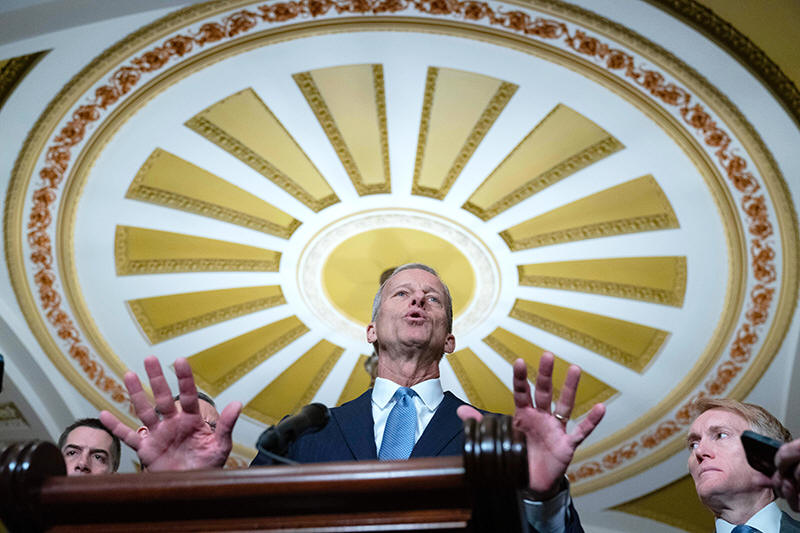
Senate Majority Leader John Thune, R-S.D., speaks to reporters
following the weekly policy luncheons at the Capitol, Tuesday, Dec.
16, 2025, in Washington. (AP Photo/Jose Luis Magana)

Several Republican senators emerged from the meeting backing Hegseth
and his decision not to release the video publicly, but other GOP
lawmakers stayed silent on their opinion of the strike.
Democrats are calling for part of the video to be released publicly
and for every member of Congress to have access to the full footage.
“The American people absolutely need to see this video,” said Sen.
Richard Blumenthal, a Connecticut Democrat. "I think they would be
shocked.”
Congressional oversight
Lawmakers have been caught by surprise by the Trump administration
several times in the last year, including by a move to pause
intelligence sharing with Ukraine and a decision to reduce U.S.
troop presence in NATO countries in eastern Europe. The defense
legislation requires that Congress be kept in the loop on decisions
like that going forward, as well as when top military brass are
removed.
The Pentagon is also required, under the legislation, to keep at
least 76,000 troops and major equipment stationed in Europe unless
NATO allies are consulted and there is a determination that such a
withdrawal is in U.S. interests. Around 80,000 to 100,000 U.S.
troops are usually present on European soil. A similar requirement
also keeps the number of U.S. troops stationed in South Korea at
28,500.
Lawmakers are also pushing back on some Pentagon decisions by
authorizing $400 million for each of the next two years to
manufacture weapons to be sent to Ukraine.
Cuts to diversity and climate initiatives
Trump and Hegseth have made it a priority to purge the military of
material and programs that address diversity, anti-racism or gender
issues, and the defense bill would codify many of those changes. It
will repeal diversity, equity and inclusion offices and trainings,
including the position of chief diversity officer. Those cuts would
save the Pentagon about $40 million, according to the
Republican-controlled House Armed Services Committee.
The U.S. military has long found that climate change is a threat to
how it provides national security because weather-related disasters
can destroy military bases and equipment. But the bill makes $1.6
billion in cuts by eliminating climate-change related programs at
the Pentagon.

Repeal of war authorizations and Syria sanctions
Congress is writing a closing chapter to the war in Iraq by
repealing the authorization for the 2003 invasion. Now that Iraq is
a strategic partner of the U.S., lawmakers in support of the
provision say the repeal is crucial to prevent future abuses. The
bill also repeals the 1991 authorization that sanctioned the
U.S.-led Gulf War.
The rare, bipartisan moves to repeal the legal justifications for
the conflicts signaled a potential appetite among lawmakers to
reclaim some of Congress's war powers.
___
Associated Press Transportation Writer Josh Funk contributed from
Omaha, Nebraska.
All contents © copyright 2025 Associated Press. All rights reserved
 |