Bit by bit, small US groups chip away at historic levels of social
isolation
[December 19, 2025]
By PETER SMITH
Across the country, small groups are working to rebuild social
connection amid rising loneliness in their own modest ways.
It sounds simple — building relationships. But they’re up against
powerful cultural forces.
By many measures, Americans are socially disconnected at historic
levels.
They're joining civic groups, clubs and unions at lower rates than in
generations. Recent polling shows that membership rates in religious
congregations are around the lowest in nearly a century. Americans have
fewer close friends than they used to. They trust each other less.
They’re hanging out less in shared public places like coffee shops and
parks.
About one in six adults feels lonely all or most of the time. It’s the
same for about one in four young adults.
No one has a simple solution. But small groups with diverse missions and
makeups are recognizing that social disconnection is a big part of the
problems they’re trying to address, and reconnection is part of the
solution.
There’s a Baltimore neighborhood trying to build a culture of giving and
mutual support, and a Pittsburgh ministry focused on healing those
wounded by poverty and violence. In Kentucky, a cooperative is
supporting small farmers in hopes of strengthening their rural
communities, while groups in Ohio are restoring neighborhoods and
neighborliness.
“We need to build a movement centered around connection,” former Surgeon
General Vivek Murthy told The Associated Press. “The good news is that
that movement is already starting to build. … What we have to do now is
accelerate that movement.”

In 2023, Murthy issued a report on an “epidemic of loneliness and
isolation,” similar to previous surgeon generals’ reports on smoking and
obesity. Social isolation and loneliness “are independent risk factors
for several major health conditions, including cardiovascular disease,
dementia, depression, and premature mortality,” it said.
Finding ‘personal connections’ in Akron
Murthy recently met with groups working toward community repair in
Akron, Ohio, as part of his new Together Project, supported by the
Knight Foundation.
In one meeting, leaders of the Well Community Development Corp. told of
fostering affordable housing and small businesses in a marginalized
neighborhood and cultivating social gatherings, whether at the local
elementary school or the coffee shop it launched in the former church
that houses its offices.
One encouraging development: Families have resumed trick-or-treating
after years of largely dormant Halloweens in the neighborhood.
“Those types of things make a big difference,” said Zac Kohl, executive
director of The Well. “It’s not just a safe, dry roof over your head.
It’s the personal connections.”
Across town, more local leaders met in a community room overlooking
Summit Lake.
The urban lakefront, once obscured by overgrowth, now draws joggers,
fishers, boaters, people grilling. Summit Lake Nature Center provides
educational programs and urban garden plots. The lakefront adjoins a
public housing development and a recreational trail.
“It’s strategically located to try to get people in the space to talk
and interact with one another,” said Erin Myers, director of real estate
development for the Akron Metropolitan Housing Authority.
“I love that you’ve worked on creating spaces where people can gather
and connecting them with nature,” Murthy told the gathering.
Neighbors 'responsible for each other' in Baltimore
On an October afternoon on Baltimore's outskirts, neighbors set out
trays heaped with vegan jambalaya, beet salad, fresh-roasted goat meat
and more. A rooster crowed insistently from a nearby backyard.

Before the neighborhood feast, dozens of visitors gathered for a walking
tour. Ulysses Archie described how this short block of Collins Avenue
became a hub of backyard farming, environmental cleanup and neighborly
connection.
Visitors saw hens and rabbits raised by neighbors, and they explored a
“Peace Park” created out of an abandoned lot, which now hosts food
distributions and summer camps for neighborhood kids.
“The core of what we do is building relationships, and building
relationships with nature,” Archie said.
Neighbors described helping to clear overgrowth and create footpaths in
an adjacent urban forest. They described their “intentional” community —
not a formal program, but a commitment to caring for each other and the
wider community, sharing anything from potlucks to rides to child care.
Michael Sarbanes and his late wife, Jill Wrigley, moved to the
neighborhood three decades ago. They spent long hours of youth mentoring
and other services.
“We were burning out,” Sarbanes recalled. They recognized, “We need to
be doing this in community.”
They reached out to other families involved in social justice work.
Though not everyone on the block is an active participant, several moved
in or got involved over the years.
Some belong to a local Catholic Worker group. Others are Protestants,
Muslims, those with no religion, “but believing we are responsible for
each other,” said resident Suzanne Fontanesi.
Participants include Ulysses and Chrysalinn Archie, who founded the
Baltimore Gift Economy, a small nonprofit.
Years earlier, Ulysses Archie suffered an injury that left him
struggling financially and in spirit.
He joined an urban farming program, “put my hands in the soil, and my
life was kind of normal again,” he said. That healing work helped
inspire the backyard farming.
While the Archies appreciated the charities that supported their family
during his long recovery, they often felt treated impersonally.

With the Baltimore Gift Economy, they’re seeking a more personal
approach. A couple times a week, for example, they place food donated by
nearby organic stores at the Peace Park. Participants take what suits
their diet and needs.
Participants are respectful and don’t hoard, Ulysses Archie said.
The food isn’t labeled “free.”
“‘Free’ is really transactional,” Archie said. “When we present it as a
gift, it’s really relational.” The group encourages recipients “to
realize that they have something to give.”
[to top of second column]
|
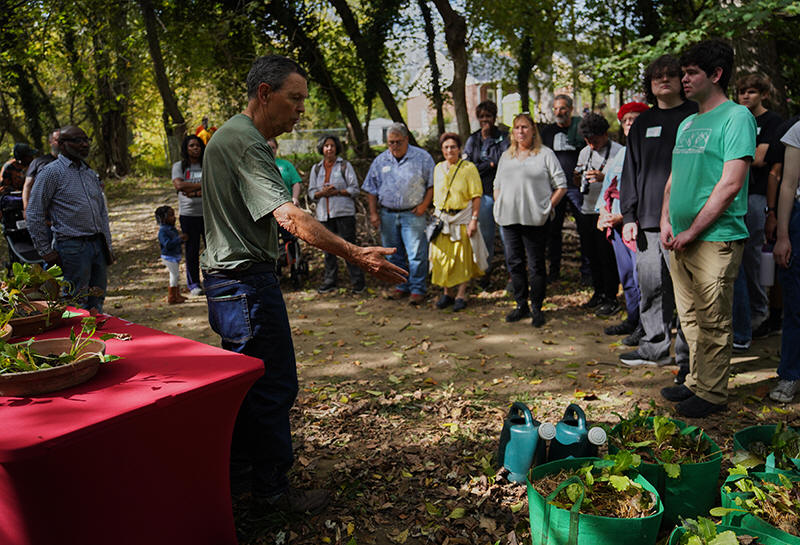
Visitors learn about fall crops like lettuce and kale while on a
walking tour of Collins Avenue during the Baltimore Gift Economy's
third annual "Finding Home" gathering, Sunday, Oct. 19, 2025, in
Baltimore. (AP Photo/Jessie Wardarski)
 Myk Lewis, 56, who returned to
Baltimore after years in California, tends chickens and rabbits in
his backyard. Neighbors support him as he cares for his aging
mother.
“I probably wouldn’t have been able to move back and start my life
over if it wasn’t for them,” he said.
Connecting to the land and each other in
Kentucky
On another October day in the small Kentucky town of New Castle, a
guitarist played folk-rock classics as patrons lined up beneath a
tent pavilion.
Area chefs served them smoked brisket with salsa, beef Wellington
bites, Thai beef salad and other specialties.
But this “Beef Bash” was about much more than beef.
Its sponsor, a cooperative of local farmers who raise grass-fed
cattle, coordinates the processing and marketing of their beef to
area restaurants and individuals. The program aims to provide a
dependable income — helping small farmers stay on the farm and, in
turn, strengthening rural communities.
“With just a little help, people and land can heal,” said Mary
Berry, executive director of the Berry Center of New Castle, which
launched the cooperative.
The cooperative adapts methods from a former tobacco quota system
that provided some stability for small farmers. After that program’s
demise in 2004, “people lost what they held in common, which was an
agricultural economy and calendar,” Berry said. “We also needed each
other.”
The surrounding community remains rural, but less tight-knit, she
said, as many commute elsewhere or farm at a larger scale.
The center promotes the agrarian principles of her father, the
novelist and essayist Wendell Berry.
At the end of the Beef Bash, farmers cheerfully gathered for a group
photo, trading stories of tractor mishaps and middle of the night
calving.
They were finding community and mutual support.

“If we keep our farms going, we’re all winning,” said one farmer,
Ashley Pyles.
Another, Kylen Douglas, underscored the effects of strained social
bonds.
“Everything’s so digital, and everything’s with the phone,” Douglas
said. “We’re disconnected not only from where our food comes from,
but just the center of life. Fewer people are going to church. Rural
communities are having a hard time.”
Stronger farms can strengthen these communities, he said. “Everybody
should be able to have the opportunity to live here.”
Healing ‘block by block’ in Pittsburgh
On a recent weekday at the Neighborhood Resilience Project in
Pittsburgh, some residents were upstairs, training for a project to
get more people qualified to perform CPR in marginalized
neighborhoods.
Downstairs amid the fragrant incense of St. Moses the Black Orthodox
Church, worshippers were concluding a prayer liturgy. Afterward,
they set out folding tables for a light meal of soup, hummus and
conversation.
The parish is closely fused with the Neighborhood Resilience
Project, an Orthodox social service agency.
They share a modest brick building in Pittsburgh’s Hill District, a
historically Black neighborhood just blocks from downtown but a
world away — long suffering from crime, gun violence, racism and
displacement.
The project’s mission is “trauma-informed community development.” It
hosts a food pantry and free health clinic. It deploys community
health deputies and provides emotional support at violent crime
scenes.
“In our work, community building is absolutely the core
intervention,” said the Rev. Paul Abernathy, its founder and CEO.
Social isolation “is no longer simply the experience of marginalized
communities,” he observed. “Now it seems as though the infection of
isolation has spread across society.”
The center serves people regardless of faith. Not everyone on staff
belongs to the church, though the church is attracting members.
“It felt like real community, and people my age who want to actually
do some things and not just talk about doing something,” said
Cecelia Olson, a recent college graduate. “We’re going to feed
people because they’re hungry, and it’s not that complicated.”

Fidelia Gaba, a University of Pittsburgh medical student who grew up
in another church tradition, recently was confirmed at St. Moses.
One Sunday, she felt emotionally distanced and couldn’t even sing.
“I remember being carried by the church,” she said. “What was broken
in me was healed.”
Project workers are reaching the isolated. Kim Lowe, a community
health deputy, helps residents get to a food bank, address a child’s
conflict at school, “whatever the need is,” she said.
One recent afternoon, Lowe visited Tricia Berger in the small
apartment she shares with her daughter and grandson. Berger said she
has multiple sclerosis and struggles with depression and anxiety.
Lowe provides practical help, and the two enjoy conversing and
watching comedy routines.
“We connect well, with common interests, as well as her helping me
get beyond my loneliness and conquering my fear,” Berger said.
For Abernathy, such efforts exemplify community healing.
“It has to be healed person by person, relationship by relationship,
block by block,” he said. “Honestly, neighborhood by neighborhood,
it can be healed.”
___
AP videojournalist Jessie Wardarski contributed.
All contents © copyright 2025 Associated Press. All rights reserved |