Bolivia's largest cities brought to standstill by transportation strike
over fuel price hike
[December 20, 2025] By
CARLOS VALDEZ
LA PAZ, Bolivia (AP) — The streets of Bolivia's largest cities, La Paz
and Santa Cruz, were brought to a standstill on Friday as public
transportation workers went on strike against a 100% fuel price increase
ordered by the new government in the South American country.
Food and transportation prices soared, and the workers have demanded
that officials revoke the fuel increase.
In La Paz, protesters blocked street corners, while in other cities,
public transportation was shut down, long lines formed and residents
joined the protests with marches.
Protests could spread nationwide in the coming days, if the government
doesn't restore subsidies for gasoline and diesel, said Edson Valdez, a
leader of the transportation union.
"The government has given the people the worst Christmas gift,” he said.
“Not only have transportation fares doubled, food prices are through the
roof, they’ve risen again,” said Natalia Rodríguez, a homemaker.
People crowded into markets to stock up before prices climb further.
“The decree will not be touched," Presidency Minister José Luis Lupo
said. "It is not negotiable.
“It is a painful measure, but it must be done,” he said. “We will
negotiate public service rates, but there is no other way.”
The government delegated to mayors the negotiations over urban fares
with drivers.

President Rodrigo Paz, a center-right politician, took office more than
a month ago, ending two decades of leftist rule in Bolivia.
“We inherited a country hurt in its
economy, hurt in its reserves, without dollars, with rising
inflation, without fuel and with a ransacked state,” Paz said.
[to top of second column] |
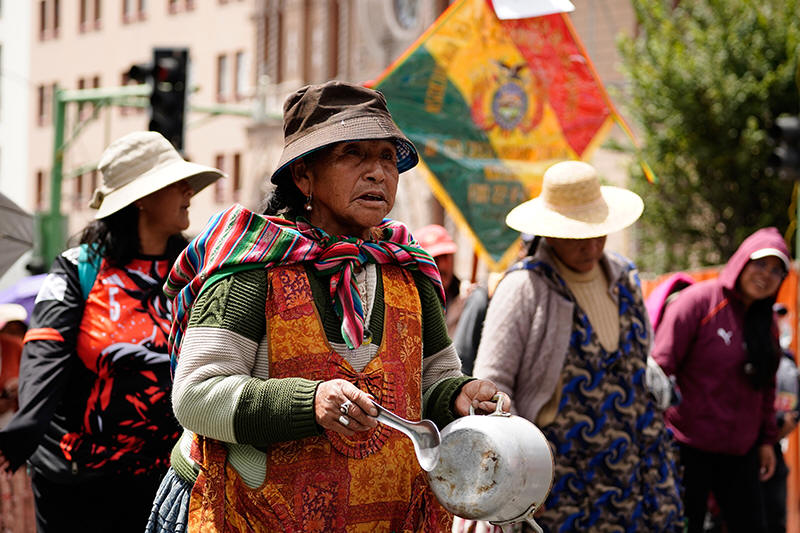
People protest President Rodrigo Paz's announcement to stop
subsidizing fuel in La Paz, Bolivia, Friday, Dec. 19, 2025. (AP
Photo/Freddy Barragan)
 Lupo said that “these measures close a populist cycle that
encouraged waste and corruption, and now it is up to us to stabilize
the economy to generate growth."
According to the Ministry of Economy, accumulated inflation will
close the year at 22%, with a fiscal deficit of 12.5% of gross
domestic product. Cutting fuel subsidies “will allow savings of $3
billion that will go to investments,” the office said.
Bolivia has imported half of its gasoline and nearly all of its
diesel for domestic use and sold it at half price, draining its
foreign currency reserves. Fuel shortages have severely affected
food production and pushed food prices higher.
The president's latest measures — which also include a 20% wage
increase and the preservation of social bonuses for poor sectors —
have received backing from business leaders and the U.S. government.
A delegation of U.S. business leaders met with Paz on Thursday to
learn about the government’s plans for investors, while the
Legislative Assembly approved an initial $550 million loan from the
Andean Development Corp., known by its Spanish acronym CAF, aimed at
stabilizing the economy and paying down debt.
All contents © copyright 2025 Associated Press. All rights reserved |