India and New Zealand finalize a free trade agreement, eyeing growth as
global uncertainties persist
[December 22, 2025] By
RAJESH ROY
NEW DELHI (AP) — India and New Zealand announced Monday they have
reached a free trade deal, seeking to deepen economic ties and shore up
growth at a time of mounting global trade uncertainties.
The move comes as New Delhi accelerates efforts to diversify export
destinations as part of a broader strategy to offset the impact of steep
U.S. import tariffs.
A formal signing of the agreement between India and New Zealand is
expected in the first quarter of next year after legal scrubbing of the
negotiated text, India’s chief negotiator Petal Dhillon told reporters.
The India-New Zealand trade agreement, negotiated over nine months, aims
to lower tariffs, ease regulatory barriers and expand cooperation across
goods, services and investments.
It underscores India’s push to lock in trade partnerships beyond
traditional markets as global commerce faces strains from unpredictable
tariffs and geopolitical tensions, slowing growth and raising
protectionism.
As part of the deal, India would get zero-duty-export access for all its
goods to New Zealand while Wellington would get duty concessions and
market access for about 70% of New Delhi’s tariff lines, covering 95% of
its exports in a phased manner, Indian officials said.
India's major sectors that will gain from tax free exports include
textiles, apparel, engineering goods, leather and footwear, and marine
products, while New Zealand's major gains will be in horticulture, wood
exports, coal, and sheep wool and meat, among others.

New Zealand has committed investments worth $20 billion in India over a
period of 15 years as part of the agreement, India's Trade Ministry
said.
New Delhi has excluded from the deal dairy imports such as milk, cream,
whey, yoghurt, and cheese, along with animal and vegetable products,
including goat meat, onions and almonds, citing “domestic
sensitivities.”
Bilateral trade between India and New Zealand remains modest compared
with New Delhi’s bigger partners, but officials said the deal has strong
growth potential. Two-way trade that includes merchandise goods and
services stood at $2.4 billion in 2024, which the two sides hope to
double in about five years, Trade Secretary Rajesh Agarwal said.
“Given the limited scale of bilateral trade, the agreement is less a
trade breakthrough than a framework for deeper cooperation,” trade
analyst Ajay Srivastava said.
New Zealand Prime Minister Christopher Luxon said in a post on X Monday
that he spoke to his Indian counterpart Narendra Modi on conclusion of
the talks. He said New Zealand's exports to India are forecast to
increase by $1.1 billion to $1.3 billion annually over the coming two
decades as a result of the agreement.
[to top of second column] |
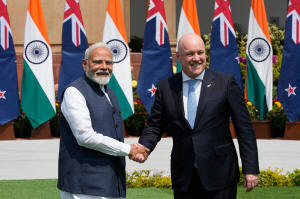
Indian Prime Minister Narendra Modi, left, greets visiting New
Zealand Prime Minister Christopher Luxon before their meeting in New
Delhi, India, Monday, March 17, 2025. (AP Photo/Manish Swarup, File)
 “Boosting trade means more Kiwi
jobs, higher wages and more opportunities for hard working New
Zealanders,” he said.
New Zealand Trade Minister Todd McClay said the agreement gives the
country access to markets that India has not provided to any other
country.
“New Zealand is the first country to secure any
access for apples and honey into India in an FTA. We have secured
the best access for kiwi fruit into India of any country in the
world,” he said.
Indian Trade Minister Piyush Goyal said the agreement demonstrates
India was “rapidly expanding” its trade relations with countries
that complement the Indian economy rather than competing with it.
India is betting that a wider network of trade agreements will help
cushion external shocks and anchor its export ambitions. In recent
months, New Delhi has accelerated a push to finalize several free
trade agreements. The country is in advanced talks with the European
Union and Chile, among others, and hopes to finalize terms of
reference soon to negotiate a pact with Canada.
The stepped-up negotiations come as Indian exporters face pressure
from higher U.S. import tariffs, which went into effect in August.
The tariffs include an additional 25% levy on India for its unabated
purchases of discounted Russian oil, bringing the combined tariffs
imposed by the United States on its ally to 50%.
India has been the second biggest importer of Russian crude after
China, drawing criticism from Washington that it was helping finance
Moscow’s war machine against Ukraine.
While India and the U.S. have been negotiating a bilateral trade
agreement, the tariffs have weighed on sectors such as textiles,
auto components, metals and labor-intensive manufacturing.

India signed comprehensive economic cooperation and trade agreements
with the United Arab Emirates and Australia in recent years, lifting
bilateral trade with both countries. In May, Britain and India
announced a hard-wrought FTA that will slash tariffs on products
including Scotch whisky and English gin shipped to India, and Indian
food and spices sent to the U.K.
Last week, India signed a comprehensive economic partnership
agreement with Oman.
All contents © copyright 2025 Associated Press. All rights reserved |