You finally got a doctor's appointment. Here's how to get the most out
of it
[December 22, 2025]
By LAURAN NEERGAARD
WASHINGTON (AP) — It’s not unusual for a 20-something to text Mom in a
panic from the doctor’s office, seeking help answering a question. And
patients of any age can struggle to recall all their medicines — or
forget to mention a concern.
Getting the most out of a doctor’s visit requires some advance
preparation. Even the professionals plan ahead.
“It is really hard — even for me as a doctor going to see my own family
doctor — to remember the things that I wanted to bring up,” said Dr.
Sarah Nosal, president of the American Academy of Family Physicians.
“The worst is when you’ve had that moment with your doctor” only to
recall another problem after walking out, she said. “You’ve lost that
time.”
Her top tip: Bring a list of symptoms and questions to show at the start
of the visit. The first item should be your top concern, but seeing the
full list helps your doctor prioritize what’s most medically urgent.
“I’m actually going to be able to see, is there a red flag?” explained
Nosal, who has some advice about prepping for a typical primary care
visit.
Your primary care doctor monitors your overall health
Some illnesses require specialists like a cardiologist or
rheumatologist. But regardless of your age or how healthy you are,
research has long shown that a relationship with a primary care provider
is important for overall health. It might be a family physician like
Nosal, who cares for all ages, or an internist. Some patients choose
gynecologists, geriatricians, or have a primary care team that includes
nurse practitioners or physician assistants.

Primary care is more than preventive checkups to help avoid illness,
such as vaccinations, cancer screenings or health advice. It also
includes detecting and treating common problems like high blood
pressure, and helping to find and coordinate specialty care.
“That ongoing relationship also helps me know your ‘normal,’” Nosal
explained. “If something’s different or changes or you feel off, when
you tell me that information and I also have known you over time, we can
really figure out together what’s going on.”
Quiz your family before the appointment
Young adults navigating health care on their own for the first time may
need help filling out forms with their personal medical history. Have
you ever had general anesthesia? Is your tetanus shot up to date?
If you still have access to the patient portal at your former
pediatrician’s office, you can see records of vaccinations and prior
illnesses, or you may have to request them or quiz parents.
For all ages, family medical history is critical — and needs regular
updating. Ask what diseases your close relatives have had and how they
fared. For example, if Type 2 diabetes runs in the family, or Grandma
had a stroke, or someone had cancer at a young age, that information
could help tailor your preventive care, Nosal said.
Fill out your paperwork ahead of the visit
Filling out paperwork from home makes it easier to check medicine
bottles for the name and dose. Include both prescription and
over-the-counter medicines, pills or creams — and don’t forget vitamins
and supplements.
[to top of second column]
|
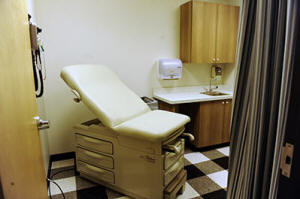
An exam room at a medical clinic in Detroit on July 29, 2015.
(Charles V. Tines/Detroit News via AP, File)
 Why are the latter important? Some
can interact with prescription medicines. Nosal cited some patients
whose longtime treatments quit working after they started taking
turmeric, a spice also sold as a supplement.
Also before your visit, check if the doctor received records of
recent lab tests, hospitalizations or visits to other health
providers, since electronic medical records aren’t always
automatically shared.
Keep a running list of questions before a doctor visit
Some symptoms are bad enough to prompt an urgent visit. But if
you’ve got a checkup coming, whether it’s routine or to follow up on
health problems, start a list of questions in advance.
Notice a pain when you move a certain way? Or chatting with a friend
who just got a colonoscopy and wonder if you’re due? Pop those on
your list right away, before you forget — and be specific in
describing symptoms.
Nosal keeps a running list on her phone and, ahead of visits with
her own doctor, sends it as a heads-up through her patient portal.
Patients also can include their list on visit check-in forms.
The idea is to address the most urgent questions first, rather than
patients running out of time before raising a key concern. Nosal
said questions about mental or sexual health and wellness especially
tend to come up at the last minute.
Whatever the medium, “please bring that list,” she said. “That’s the
most critical of all pieces.”
It's OK to ask again
People may know to ask questions about treatments, such as how well
they work and what side effects to expect. But it’s also important
to understand why a doctor makes a particular diagnosis or,
conversely, isn’t as worried about a symptom as you might be.
Don’t hesitate to say, “Explain to me what else could be going on,”
Nosal advised. “What would be the next step? How would you evaluate
that for me, to know if it’s this or that?”

Most health advocacy groups also advise bringing along a friend or
relative, especially if you have serious or multiple health
problems. They can help ask questions and take notes.
“Whether you are 20 or you are 85, you will not remember everything
from your medical visit,” Nosal said.
All contents © copyright 2025 Associated Press. All rights reserved |