US says talks with Ukraine, Europe on ending war with Russia
'constructive'
[December 22, 2025]
A White House envoy said Sunday he held “productive and constructive”
talks in Florida with Ukrainian and European representatives to end the
nearly four-year war between Russia and Ukraine.
Posting on social media, Steve Witkoff said the talks aimed at aligning
on a shared strategic approach between Ukraine, the United States and
Europe.
“Our shared priority is to stop the killing, ensure guaranteed security,
and create conditions for Ukraine’s recovery, stability, and long-term
prosperity. Peace must be not only a cessation of hostilities, but also
a dignified foundation for a stable future," U.S. President Donald
Trump's envoy said.
The talks are part of the Trump administration’s monthslong push for
peace. Trump has unleashed an extensive diplomatic push to end the war,
but his efforts have run into sharply conflicting demands by Moscow and
Kyiv. Putin has recently signaled he is digging in on his maximalist
demands on Ukraine, as Moscow’s troops inch forward on the battlefield
despite huge losses.
Positive assessments
Witkoff's assessment comes as negotiations have been proceeding with
Russia as well. A Kremlin envoy said Saturday that the talks were
pressing on “constructively” in Florida.
“The discussions are proceeding constructively. They began earlier and
will continue today, and will also continue tomorrow,” Kirill Dmitriev
told reporters in Miami on Saturday. There were no immediate updates on
the talks with Russia on Sunday.
Dmitriev met with Witkoff and Trump’s son-in-law Jared Kushner, Russian
state news agency RIA Novosti reported.
For Ukraine, President Volodymyr Zelenskyy wrote on Telegram Sunday that
diplomatic efforts were “moving forward quite quickly, and our team in
Florida has been working with the American side.”

The Kremlin denied Sunday that trilateral talks involving Ukraine,
Russia and the U.S. were under discussion, after Zelenskyy said Saturday
that Washington had proposed the idea of three-way discussions.
“At present, no one has seriously discussed this initiative, and to my
knowledge it is not being prepared,” Russian President Vladimir Putin's
foreign affairs adviser Yuri Ushakov said, according to Russian state
news agencies.
[to top of second column]
|
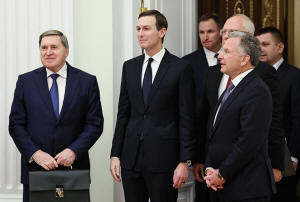
Russian Presidential foreign policy adviser Yuri Ushakov, left, U.S.
President Donald Trump's son-in-law Jared Kushner, center, U.S.
special envoy Steve Witkoff, foreground right, and Russian Direct
Investment Fund CEO Special Presidential Representative for
Investment and Economic Cooperation with Foreign Countries Kirill
Dmitriev, behind Witkoff, arrive to attend talks with Russian
President Vladimir Putin at the Senate Palace of the Kremlin in
Moscow, Russia, Dec. 2, 2025. (Alexander Kazakov, Sputnik, Kremlin
Pool Photo via AP, File)

Ukrainian civilians moved to Russia
In Ukraine, the country’s human rights ombudsman Dmytro Lubinets on
Sunday accused Russian forces of forcibly removing about 50
Ukrainian civilians from the Ukrainian Sumy border region to Russian
territory.
Writing on Telegram, he said that Russian forces illegally detained
the residents in the village of Hrabovske on Thursday, before moving
them to Russia on Saturday.
Lubinets said he contacted Russia’s human rights commissioner,
requesting information on the civilians’ whereabouts and conditions,
and demanding their immediate return to Ukraine.
Possible French-Russian talks
The French presidency on Sunday welcomed Putin’s willingness to
speak with President Emmanuel Macron, saying it would decide how to
proceed “in the coming days.”
“As soon as the prospect of a ceasefire and peace negotiations
becomes clearer, it becomes useful again to speak with Putin,”
Macron’s office said in a statement. “It is welcome that the Kremlin
publicly agrees to this approach.”
The statement came after reports that Putin was open to holding
talks with the French president if there was mutual political will.
European Union leaders agreed on Friday to provide 90 billion euros
($106 billion) to Ukraine to meet its military and economic needs
for the next two years, although they failed to bridge differences
with Belgium that would have allowed them to use frozen Russian
assets to raise the funds. Instead, they were borrowed from capital
markets.
All contents © copyright 2025 Associated Press. All rights reserved |