While signing Laken Riley Act, Trump says he'll send 'worst criminal
aliens' to Guantanamo
 Send a link to a friend
 [January 30, 2025]
By WILL WEISSERT [January 30, 2025]
By WILL WEISSERT
WASHINGTON (AP) — President Donald Trump on Wednesday signed the Laken
Riley Act into law, giving federal authorities broader power to deport
immigrants in the U.S. illegally who have been accused of crimes. He
also announced at the ceremony that his administration planned to send
the “worst criminal aliens” to a detention center in Guantanamo Bay,
Cuba.
The bipartisan act, the first piece of legislation approved during
Trump’s second term, was named for Riley, a 22-year-old Georgia nursing
student who was slain last year by a Venezuelan man in the U.S.
illegally.
“She was a light of warmth and kindness,” Trump said during a ceremony
that included Riley’s parents and sister. “It’s a tremendous tribute to
your daughter what’s taking place today, that’s all I can say. It’s so
sad we have to be doing it.”
Trump has promised to drastically increase deportations, but he also
said at the signing that some of the people being sent back to their
home countries couldn't be counted on to stay there.
“Some of them are so bad that we don’t even trust the countries to hold
them because we don’t want them coming back, so we’re gonna send ’em out
to Guantanamo,” Trump said. He said that he'd direct federal officials
to get facilities in Cuba ready to receive immigrant criminals.
“We have 30,000 beds in Guantanamo to detain the worst criminal aliens
threatening the American people,” the president said.

The White House announced a short time later that Trump had signed a
presidential memorandum on Guantanamo. Migrant rights groups quickly
expressed dismay.
“Guantanamo Bay’s abusive history speaks for itself and in no uncertain
terms will put people’s physical and mental health in jeopardy,” Stacy
Suh, program director of Detention Watch Network, said in a statement.
Trump said the move would double U.S. detention lockup capacities, and
Guantanamo is “a tough place to get out of.”
The Guantanamo facility could hold “dangerous criminals” and people who
are “hard to deport,” said a Trump administration official speaking on
condition of anonymity because they weren’t authorized to speak publicly
on the matter.
Defense Secretary Pete Hegseth said his department can set up a
detention center “very rapidly” and called Guantanamo Bay “a perfect
spot.”
“We don’t want illegal criminals in the United States, not a minute
longer than they have to be,” he said Wednesday evening on Fox News’
“Jesse Watters Primetime.” “Move them off to Guantanamo Bay, where they
can be safely maintained until they are deported to their final
location, their country of origin.”
Homeland Security Secretary Kristi Noem said the administration would
seek funding via spending bills Congress will eventually consider.
The U.S. military base has been used to house detainees from the U.S.
war on terrorism for years. But authorities have also detained migrants
at sea at a facility known as the Migrant Operations Center on
Guantanamo, a site the U.S. has long leased from the Cuban government.
Many of those housed there have been migrants from Haiti and Cuba.
The U.S. has leased Guantanamo land from Cuba for more than a century.
Cuba opposes the lease and typically rejects the nominal U.S. rent
payments. Cuban President Miguel Díaz-Canel said Trump wanting to ship
immigrants to the island is “an act of brutality.”
“The U.S. government’s decision to imprison migrants at the Guantanamo
Naval Base, in an enclave where it created torture and indefinite
detention centers, shows contempt for the human condition and
international law,” Cuban Foreign Minister Bruno Rodríguez wrote in a
post on X.
[to top of second column]
|
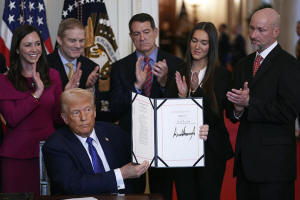
President Donald Trump holds the document after signing the Laken
Riley Act during an event in the East Room of the White House,
Wednesday, Jan. 29, 2025, in Washington. (AP Photo/Evan Vucci)

The Supreme Court ruled in 2008 that enemy combatants in the war on
terror held without charge at the military prison at Guantanamo had the
right to challenge their detention in federal court. But the justices
did not decide whether the president had the authority to detain people
at all.
Before Trump took office, the Democratic administrations of Barack Obama
and Joe Biden worked to reduce the number of terrorism suspects held at
Guantanamo.
Laken Riley was out for a run in February 2024 when she was killed by
Jose Antonio Ibarra, a Venezuelan national who was in the country
illegally. Ibarra was found guilty in November and sentenced to life
without parole.
Ibarra had been arrested for illegal entry in September 2022 near El
Paso, Texas, and released to pursue his case in immigration court.
Federal officials say he was arrested by New York police in August 2023
for child endangerment and released. Police say he was also issued a
citation for shoplifting in Georgia in October 2023.
The act quickly passed the newly Republican-controlled Congress with
some Democratic support even though opponents said it possibly could
lead to large roundups of people for offenses as minor as shoplifting.
The swift passage, and Trump’s quickly signing it, adds to the potent
symbolism for conservatives. To critics, the measure has taken advantage
of a tragedy and could lead to chaos and cruelty while doing little to
fight crime or overhaul the immigration system.
Riley’s mother thanked Trump while holding back tears.
“He said he would secure our borders and he would never forget about
Laken and he hasn’t,” she said.
Several top Republican lawmakers and Noem attended the signing ceremony,
as did Democratic Sen. John Fetterman of Pennsylvania, a cosponsor.
Under the new law, federal officials would have to detain any immigrant
arrested or charged with crimes such as theft or assaulting a police
officer, or offenses that injure or kill someone. State attorneys
general could sue the U.S. government for harm caused by federal
immigration decisions — potentially allowing the leaders of conservative
states to help dictate immigration policy set by Washington.

Some Democrats have questioned whether it is constitutional. The ALCU
says the law can allow people to be “mandatorily locked up — potentially
for years — because at some point in their lives, perhaps decades ago,
they were accused of nonviolent offenses.”
Hannah Flamm, interim senior director of policy at the International
Refugee Assistance Project, said the measure violates immigrants’ basic
rights by allowing for detaining people who have not been charged with
wrongdoing, much less convicted.
“The latent fear from the election cycle of looking soft on crime
snowballed into aiding and abetting Trump’s total conflation of
immigration with crime,” Flamm said.
She also noted, “I think it is pivotal to understand: This bill, framed
as connected to a tragic death, is pretext to fortify a mass deportation
system."
___
Associated Press writers Rebecca Santana and Ellen Knickmeyer
contributed to this report.
All contents © copyright 2025 Associated Press. All rights reserved |