Protesters call for governor’s resignation after Rio’s deadliest police
raid
[November 01, 2025]
By ELÉONORE HUGHES
RIO DE JANEIRO (AP) — Hundreds of protesters on Friday marched through
one of the favelas targeted in Rio de Janeiro's most lethal police raid
that left more than 100 dead, calling for Rio state Gov. Cláudio Castro
to resign amid continued outrage over the deadly operation.
Locals, politicians, activists, grieving mothers who lost their sons in
prior operations and people from other Rio neighborhoods gathered to
voice their fury in Vila Cruzeiro, part of the Penha complex of favelas,
where days prior residents laid out scores of bodies they had collected
from a nearby green area following the raid.
At least 121 people were killed in Tuesday’s operation, including four
policemen, according to police. Rio’s public defender’s office says 132
people died.
“Coward, terrorist, assassin! His hands are dirty with blood,” said Anne
Caroline Dos Santos, 30, referring to Castro, an ally of former
President Jair Bolsonaro and opponent of leftist President Luiz Inácio
Lula da Silva.
Castro has accused the federal government of abandoning Rio in its fight
against organized crime, a claim that Lula's administration has refuted.
Dos Santos came from Brazil’s biggest favela Rocinha in Rio’s southern
zone to voice her indignation. Like many other protesters, she accused
law enforcement of torture and extrajudicial killings.
“Mothers are now battling to retrieve their sons’ bodies and bury them,”
she said, adding that she had lost a friend in the operation.

Many shops have reopened since shuttering early this week, but there
were still signs of recent events on the streets, including burned cars
used as barricades against the police’s entry into the low-income
neighborhood.
Many were wearing white, which a protester said symbolized their desire
for peace, with some T-shirts printed with red hands. Others held signs
saying: “stop killing us” or wore stickers reading “enough massacres.”
“This is a disgrace to Brazil,” said Leandro Santiago, 44, who lives in
Vila Cruzeiro and earns a living through his motorbike, giving rides and
doing deliveries. “Nothing justifies this.”
Tuesday’s raid, conducted by some 2,500 police and soldiers, targeted
the notorious gang Red Command in the Complexo de Alemao and Complexo da
Penha favelas.
The operation’s stated objectives were capturing leaders and limiting
the territorial expansion of Red Command, which has increased its
control over favelas in recent years but also spread across Brazil,
including in the Amazon rainforest.
The police raid drew gunfire and other retaliation from gang members,
sparking scenes of chaos across the city.
Castro said on Tuesday that Rio was at war against “narco-terrorism,” a
term that echoed the Trump administration in its campaign against drug
smuggling in Latin America. He called the operation a success.
The state government said those killed were criminals who resisted the
police.
[to top of second column]
|
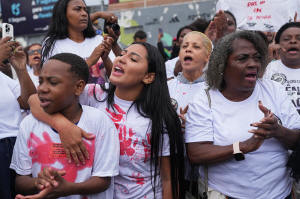
People protest days after a deadly police operation targeting a drug
trafficking gang at the Complexo da Penha favela in Rio de Janeiro,
Friday, Oct. 31, 2025. (AP Photo/Silvia Izquierdo)

But the death toll, the highest ever in a Rio police operation,
sparked condemnation from human rights groups and the U.N. and
intense scrutiny from authorities. Brazil’s Supreme Court,
prosecutors and lawmakers ordered Castro to provide detailed
information about the operation.
Supreme Court Justice Alexandre de Moraes scheduled a hearing with
the state governor and the heads of the military and civil police in
Rio on Nov. 3.
Much of the fury in Vila Cruzeiro on Friday was directed at Castro,
with protesters calling him an “assassin” and demanding his
resignation or even that he be sent to prison.
“The governor said he was doing this operation to combat
drug-trafficking. But we need to suffocate who is financing it. We
need policies that seek to tackle corruption,” said Mônica Benício,
a local councilwoman and the widow of slain councilwoman Marielle
Franco.
“Assassinating young people in favelas isn’t public policy, it’s a
massacre,” she added.
While some in Brazil, particularly right-wing voters and
politicians, applauded the operation against the heavily-armed gang,
others questioned whether it would achieve lasting results and
argued that many of those killed were low-ranking and easily
replaceable.
On Friday, the state government said that of the 99 suspects
identified so far, 42 had outstanding arrest warrants and at least
78 had extensive criminal records.
But local newspaper O Globo said that none of the 99 names were
indicted by the Rio de Janeiro public prosecutor’s office in the
investigation that supported the major operation.
At the protest, many condemned the state the bodies were found in,
with at least one decapitated, while others reportedly found with
puncture wounds or tied up.
Adriana Miranda, a 48-year-old lawyer at Friday’s demonstration,
said that even if the young men killed were suspected of
participating in organized crime, they still had rights.
“Suspicions need to be investigated. There is a whole procedure
established in the Penal Code and the Code of Criminal Procedure
that must be followed,” she said. “The constitution guarantees
everyone’s rights.”
All contents © copyright 2025 Associated Press. All rights reserved
 |