Republican leaders reject Trump's demands to scrap the Senate filibuster
to end the shutdown
[November 01, 2025]
By LISA MASCARO and MARY CLARE JALONICK
WASHINGTON (AP) — Back from a week abroad, President Donald Trump threw
himself into the shutdown debate, calling on the Senate to scrap the
filibuster and reopen the government, an idea swiftly rejected Friday by
Republican leaders who have long opposed such a move.
Trump pushed his Republican Party to get rid of the Senate rule that
requires 60 votes to overcome objections and gives the minority
Democrats a check on GOP power. In the chamber that's currently split,
53-47, Democrats have had enough votes to keep the government closed
while they demand an extension of health care subsidies. Neither party
has seriously wanted to nuke the rule.
“THE CHOICE IS CLEAR — INITIATE THE ‘NUCLEAR OPTION,’ GET RID OF THE
FILIBUSTER,” Trump said in a late night social media post Thursday.
Trump’s sudden decision to assert himself into the shutdown now in its
31st day — with his highly charged demand to end the filibuster — is
certain to set the Senate on edge. It could spur senators toward their
own compromise or send the chamber spiraling toward a new sense of
crisis. Or, it might be ignored.
Republican leaders responded quickly, and unequivocally, setting
themselves at odds with Trump, a president few have dared to publicly
counter.
Senate Majority Leader John Thune has repeatedly said he is not
considering changing the rules to end the shutdown, arguing that it is
vital to the institution of the Senate and has allowed them to halt
Democratic policies when they are in the minority.
The leader's “position on the importance of the legislative filibuster
is unchanged,” Thune spokesman Ryan Wrasse said Friday.

A spokeswoman for Wyoming Sen. John Barrasso, the No. 2 Republican, said
his position opposing a filibuster change also remains unchanged. And
former GOP leader Mitch McConnell, who firmly opposed Trump’s filibuster
pleas in his first term, remains in the Senate.
House Speaker Mike Johnson also defended the filibuster Friday, while
conceding “it’s not my call,” from his chamber across the Capitol.
“The safeguard in the Senate has always been the filibuster,” Johnson
said, adding that Trump’s comments are “the president’s anger at the
situation.”
Broad GOP support for filibuster
Even if Thune wanted to change the filibuster, he would not currently
have the votes to do so in the divided Senate.
“The filibuster forces us to find common ground in the Senate,”
Republican Sen. John Curtis of Utah posted on X Friday morning,
responding to Trump's comments and echoing the sentiments of many of his
Senate Republican colleagues. “Power changes hands, but principles
shouldn’t. I’m a firm no on eliminating it.”
Debate has swirled around the legislative filibuster for years. Many
Democrats pushed to eliminate it when they had full power in Washington,
as the Republicans do now, four years ago. But ultimately, enough
Democratic senators opposed the move, predicting such an action would
come back to haunt them.
Little progress on shutdown
Trump's demand comes as he has declined to engage with Democratic
leaders on ways to end the shutdown, on track to become the longest in
history.
He said in his post that he gave a “great deal” of thought to his choice
on his flight home from Asia and that one question that kept coming up
during his trip was why “powerful Republicans allow” the Democrats to
shut down parts of the government.
But later Friday, he did not mention the filibuster again as he spoke to
reporters departing Washington and arriving in Florida for a weekend at
his Mar-a-Lago home.
While quiet talks are underway, particularly among bipartisan senators,
Trump has not been seriously involved. Democrats refuse to vote to
reopen the government until Republicans negotiate an extension to the
health care subsidies. The Republicans say they won't negotiate until
the government is reopened.
[to top of second column]
|
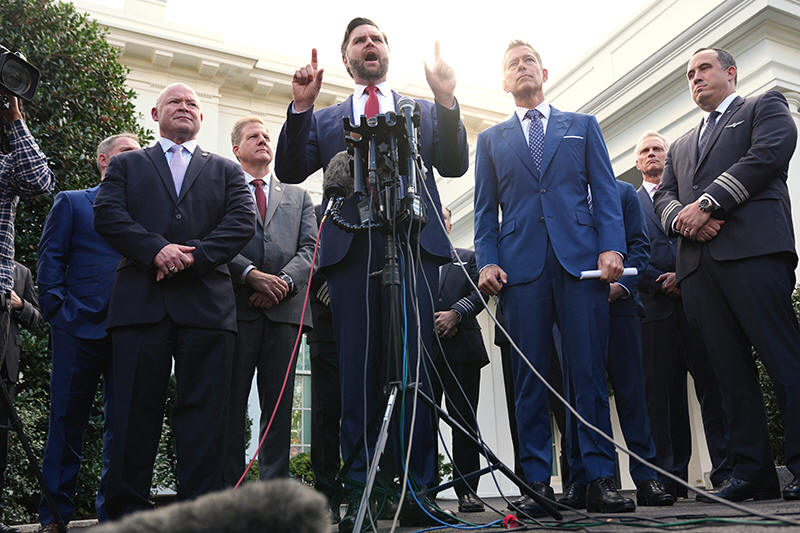
Vice President JD Vance speaks to the media alongside Sean O'Brien,
President of the International Brotherhood of Teamsters, from left,
Chris Sununu, president & CEO of Airlines for America, and
Transportation Secretary Sean Duffy, and aviation industry
representatives, about the impact of the government shutdown on the
aviation industry, outside of the West Wing of the White House,
Thursday, Oct. 30, 2025, in Washington. (AP Photo/Jacquelyn Martin)

House Democratic Leader Hakeem Jeffries said on CNN that Trump needs
to start negotiating with Democrats, arguing the president has spent
more time with global leaders than dealing with the shutdown back
home.
From coast to coast, fallout from the dysfunction of the shuttered
federal government is hitting home. SNAP food aid is scheduled to
shut off. Flights are being delayed. Workers are going without
paychecks.
And Americans are getting a first glimpse of the skyrocketing health
care insurance costs that are at the center of the stalemate.
“People are stressing,” said Sen. Lisa Murkowski of Alaska, as food
options in her state grow scarce.
“We are well past time to have this behind us.”
Money for military, but not food aid
The White House has moved money around to ensure the military is
paid, but refuses to tap funds for food aid. In fact, Trump's “big,
beautiful bill” signed into law this summer, delivered the most
substantial cut ever to the Supplemental Nutrition Assistance
Program, known as SNAP, projected to result in some 2.4 million
people off the program.
Agriculture Secretary Brooke Rollins said Friday the agency cannot
release contingency funds to keep SNAP running, but two judges ruled
nearly simultaneously Friday that the administration must continue
to fund the food aid program. How quickly that might happen remains
to be seen, as further consultation with the courts is expected on
Monday.
Trump, in a social media post, said administration lawyers will be
asking the courts “to clarify how we can legally fund SNAP as soon
as possible.”
“If we are given the appropriate legal direction by the Court, it
will BE MY HONOR to provide the funding,” Trump said.
“We are holding food over the heads of poor people so that we can
take away their health care,” said Rev. Ryan Stoess during a prayer
with religious leaders earlier this week at the U.S. Capitol.
“God help us,” he said, “when the cruelty is the point.”
Deadlines shift to next week
The House remains closed under Johnson with no plans to resume the
session, and senators left for the weekend and are due back Monday.

The next inflection point comes after Tuesday's off-year elections —
the New York City mayor's race, as well as elections in Virginia and
New Jersey that will determine those states' governors. Many expect
that once those winners and losers are declared, and the Democrats
and Republicans assess their political standing with the voters,
they might be ready to hunker down for a deal.
If the shutdown continues into next week, it could surpass the
35-day lapse that ended in 2019, during Trump’s first term, over his
demands to build the U.S.-Mexico border wall.
___
Associated Press writers Matt Brown and Josh Boak in Tokyo
contributed to this report.
All contents © copyright 2025 Associated Press. All rights reserved |