Trump scraps tariffs on beef, coffee and tropical fruit in a push to
lower grocery store prices
[November 15, 2025] By
WILL WEISSERT
WASHINGTON (AP) — President Donald Trump announced Friday that he was
scrapping U.S. tariffs on beef, coffee, tropical fruits and a broad
swath of other commodities — a dramatic move that comes amid mounting
pressure on his administration to better combat high consumer prices.
Trump has built his second term around imposing steep levies on goods
imported into the U.S. in hopes of encouraging domestic production and
lifting the U.S. economy. His abrupt retreat from his signature tariff
policy on so many staples key to the American diet is significant, and
it comes after voters in off-year elections this month cited economic
concerns as their top issue, resulting in big wins for Democrats in
Virginia, New Jersey and other key races around the country.
“We just did a little bit of a rollback on some foods like coffee,”
Trump said aboard Air Force One as he flew to Florida hours after the
tariff announcement was made.
Pressed on his tariffs helping to increase consumer prices, Trump
acknowledged, “I say they may, in some cases" have that effect.
“But to a large extent they’ve been borne by other countries,” the
president added.
Meanwhile, inflation — despite Trump's pronouncements that it has
vanished since he took office in January — remains elevated, further
increasing pressure on U.S. consumers.

The Trump administration has insisted that its tariffs had helped fill
government coffers and weren't a major factor in higher prices at
grocery stores around the country. But Democrats were quick to paint
Friday's move as an acknowledgement that Trump's policies were hurting
American pocketbooks.
“President Trump is finally admitting what we always knew: his tariffs
are raising prices for the American people," Virginia Democratic Rep.
Don Beyer said in a statement. “After getting drubbed in recent
elections because of voters’ fury that Trump has broken his promises to
fix inflation, the White House is trying to cast this tariff retreat as
a ‘pivot to affordability.'"
Grocery bill worries
Trump slapped tariffs on most countries around the globe in April. He
and his administration still say that tariffs don’t increase consumer
prices, despite economic evidence to the contrary.
Record-high beef prices have been a particular concern, and Trump had
said he intended to take action to try and lower them. Trump’s tariffs
on Brazil, a major beef exporter, had been a factor.
Trump signed an executive order that also removes tariffs on tea, fruit
juice, cocoa, spices, bananas, oranges, tomatoes and certain
fertilizers. Some of the products covered aren’t produced in the United
States, meaning that tariffs meant to spur domestic production had
little effect. But reducing the tariffs will still likely mean lower
prices for U.S. consumers.
The Food Industry Association, which represents retailers, producers and
a variety of related industry firms and services, applauded Trump's move
to provide “swift tariff relief,” noting that import U.S. taxes "are an
important factor” in a “complex mix” of supply chain issues.

[to top of second column] |
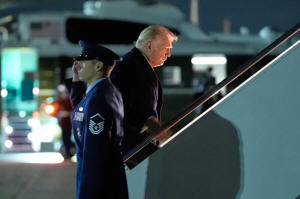
President Donald Trump boards Air Force One at Joint Base Andrews,
Md., on his way to his Mar-a-Lago estate in Palm Beach, Fla.,
Friday, Nov. 14, 2025. (AP Photo/Manuel Balce Ceneta)
 “President Trump’s proclamation to
reduce tariffs on a substantial volume of food imports is a critical
step ensuring continued adequate supply at prices consumers can
afford,” the association said in a statement.
In explaining the tariff reductions, the White House said Friday
that some of the original levies Trump relished imposing on nearly
every country on earth months ago were actually no longer necessary
given the trade agreements he'd since hammered out with key U.S.
trading partners.
Indeed, Friday's announcement follows the Trump administration
having reached framework agreements with Ecuador, Guatemala, El
Salvador and Argentina meant to increase the ability of U.S. firms
to sell industrial and agricultural products in these countries,
while also potentially easing tariffs on agricultural products
produced there.
During an interview that aired earlier in the week with Laura
Ingraham of Fox News Channel, Trump hinted that lower tariffs might
be coming.
“Coffee, we’re going to lower some tariffs,” the president said
then. “We’re going to have some coffee come in.”
Tariff checks?
Despite pulling back on so many tariffs, Trump used his comments
aboard Air Force One on Friday night to repeat his past assertions
that his administration would use revenue the federal government has
collected from import levies to fund $2,000 checks for many
Americans.
The president suggested such checks could be issued in 2026, but was
vague on timing, saying only, “Sometime during the year.” Trump,
however, also said federal tariff revenue might be used to pay down
national debt — raising questions about how much federal funding
would be needed to do both.

Trump rejected suggestions that attempting direct payments to
Americans could exacerbate inflation concerns — even as he suggested
that similar checks offered during the coronavirus pandemic, and by
previous administrations to stimulate the economy, had that very
effect.
“This is money earned as opposed to money that was made up,” Trump
said. “Everybody but the rich will get this. That’s not made up.
That’s real money. That comes from other countries.”
__
Associated Press writer Chris Megerian on Air Force One contributed
to this report.
All contents © copyright 2025 Associated Press. All rights reserved |