As nations push for more ambition at climate talks, chairman says they
may get it
[November 17, 2025]
By SETH BORENSTEIN, ANTON L. DELGADO and MELINA WALLING
BELEM, Brazil (AP) — Going into United Nations climate negotiations, the
Brazilian hosts weren’t looking for big end-of-session pronouncements on
lofty goals. This conference was supposed to hyperfocus on
“implementation” of past promises not yet kept.
Throw that out the window.
The urgency of climate change is causing some negotiators to push for
more big-picture action — on weak plans to cut emissions of
heat-trapping gases, on too little money to help nations wracked by
climate change, on putting teeth into phasing out coal, oil and gas.
Because of that pressure to do more — including from Brazil President
Luiz Inácio Lula da Silva — the diplomat chairing the talks said
Saturday he'll consider a big-picture, end-of-negotiations communiqué,
sometimes known as a decision or cover text.
“I think things have changed, which is a very good thing,” said veteran
observer Jean Su of the Center for Biological Diversity. “So I think
there’s momentum that we will get some type of decision text, and our
hope is that in particular there’s going to be some commitment on
phasing out fossil fuels.”
“I would say that what’s at stake now is probably higher than the last
several COPs because you’re looking at an ambition gap,″ said former
Philippine negotiator Jasper Inventor, international program director at
Greenpeace International. “There’s a lot of expectation, there’s a lot
of excitement here, but there’s also a lot of political signals that’s
been sent by President Lula.”
“We’re at the middle of the COP, and at the middle of COP is usually
where the negotiators stare each other eye-to-eye. It’s almost like a
staring contest,” Inventor said. “But next week, this is where the
negotiations need to happen, where political decisions are made by the
ministers.”

Because this process stems from the Paris climate Agreement, which is
mostly voluntary, these end statements grab headlines and set global
tone but have limited power. The last few COP end statements have made
still-unfulfilled pledges for rich countries to give money to poor
nations to cope with climate change and the world to phase out fossil
fuels.
Decision time
Key among those issues is the idea of telling nations to go back to the
drawing board on what experts consider inadequate climate-fighting plans
submitted this year.
In the 2015 Paris agreement, which is being celebrated here on its 10th
anniversary, nations are supposed to have submitted climate-fighting,
emissions-curbing plans every five years. So far 116 of 193 countries
have filed theirs this year, but what they promised isn’t much. United
Nations and Climate Action Tracker, a group of scientists, calculates
that these new pledges barely reduced future projections for Earth's
warming.
Even if the world does all it promises, Earth would be about
seven-tenths of a degree Celsius (1.3 degrees Fahrenheit) above the
Paris goal of limiting warming to 1.5 degrees Celsius (2.7 degrees
Fahrenheit) above pre-industrial times, the groups estimated.
So small island nations, led by Palau, asked that this conference
confront the gap between what’s planned in national pledges and what’s
needed to keep the world from hitting the temperature danger zone.
That's not on the agenda for these talks. Nor are specific details on
how to fulfill last year’s pledge by rich nations to provide $300
billion annually in climate financial aid.

[to top of second column]
|
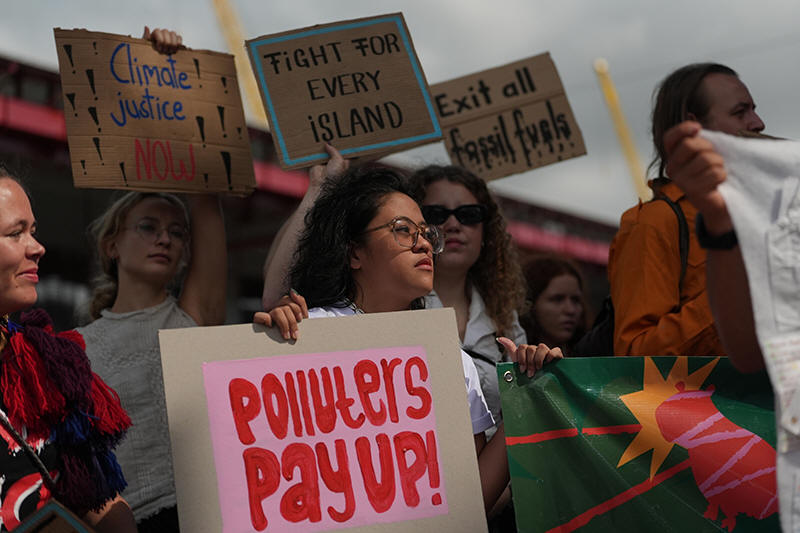
Rachelle Junsay, center, stands with other activists participating
in a youth climate demonstration during the COP30 U.N. Climate
Summit, Friday, Nov. 14, 2025, in Belem, Brazil. (AP Photo/Joshua A.
Bickel)

So when nations early on wanted to address these issues, COP
President André Corrêa do Lago, a veteran Brazilian diplomat, set up
special small confabs to try to decide if the controversial topics
should be discussed.
On Saturday, the conference punted the issue to the incoming
ministers.
“The parties will decide how they want to proceed,” do Lago said at
a Saturday evening news conference. Given what countries are saying
and past history that usually means a final end-of-COP message to
the world, several experts said.
In a casual exchange with a reporter about how the conference is
going, COP President do Lago said: “Eh, could be better but not as
bad as it could be.”
Momentum to phase out fossil fuels
U.N. General Assembly President Annalena Baerbock, the former German
foreign minister who has been to 10 of these sessions, told The
Associated Press Saturday morning before the evening's session that
she saw “new momentum” in Belem.
“We can fight the climate crisis only together if we commit to a
strong mitigation target,” she said. “This means also transitioning
away from fossil fuels, investing into renewable energy.”
Two years ago in Dubai, the world agreed to “transition away from
fossil fuels,” but last year no mention of that was made and
there've been no details on how or when to do this.
Baerbock hailed as crucial Lula's call during the Leaders' Summit
last week for “a road map for humanity to overcome, in a just and
planned way, its dependence on fossil fuels, reverse deforestation,
and mobilize the resources needed to do so.”
“I think what we have before us are the ingredients of a potential
high-ambition package for the outcome of this conference,” Iskander
Erzini Vernoit, executive director of the Moroccan IMAL Initiative
for Climate and Development, said.
Getting Indigenous voices heard
Indigenous groups breached and blockaded the venue twice this week
with demands to be further included in the U.N. talks, despite this
conference’s promotion as the “Indigenous Peoples’ COP.”

The COP so far “was a testament that unfortunately, for Indigenous
peoples to be heard, they actually need to be disruptive,” said Aya
Khourshid, an Egyptian-Palestinian member of A Wisdom Keepers
Delegation, a group of Indigenous people from around the world.
Indigenous people are putting a lot of energy “to be in this space
but to not necessarily be given a platform or voice at the decision
table with the ministers and those who are in power,” said Whaia, a
Ngāti Kahungunu Wisdom Keeper.
“There's an imbalance here at COP30," she said. “There's the
privileged and the not-so lucky who don't get a say on what's
actually going on in their own home.”
All contents © copyright 2025 Associated Press. All rights reserved |