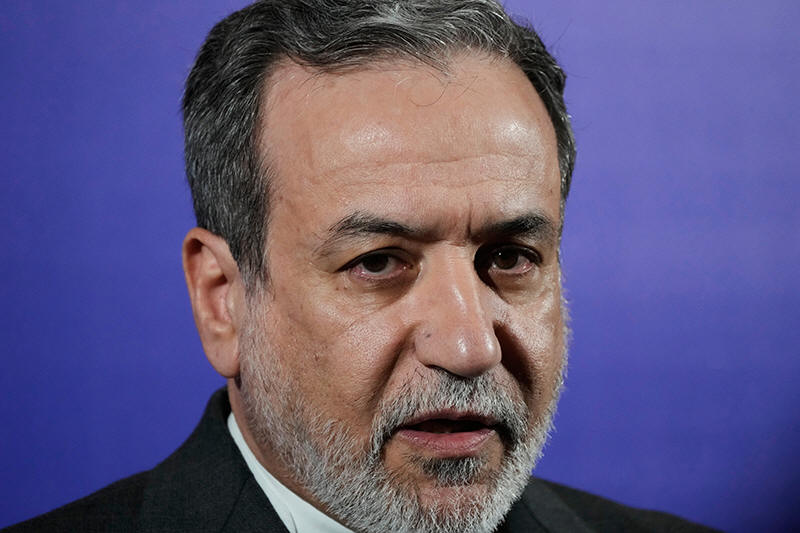
Iran's foreign minister says the nation is no longer enriching uranium
at any site in the country
[November 17, 2025]
By JON GAMBRELL
TEHRAN, Iran (AP) — Iran’s foreign minister said Sunday that Tehran is
no longer enriching uranium at any site in the country, trying to signal
to the West that it remains open to potential negotiations over its
atomic program.
Answering a question from an Associated Press journalist visiting Iran,
Foreign Minister Abbas Araghchi offered the most direct response yet
from the Iranian government regarding its nuclear program following
Israel and the United States' bombing of its enrichment sites in June
during a 12-day war.
“There is no undeclared nuclear enrichment in Iran. All of our
facilities are under the safeguards and monitoring” of the International
Atomic Energy Agency, Araghchi said. “There is no enrichment right now
because our facilities — our enrichment facilities — have been
attacked.”
Iran says it is threatened over accessing bombed sites
Asked what it would take for Iran to continue negotiations with the U.S.
and others, Araghchi said Iran's message on its nuclear program remains
"clear.”
“Iran’s right for enrichment, for peaceful use of nuclear technology,
including enrichment, is undeniable," the foreign minister continued.
“We have this right, and we continue to exercise that, and we hope that
the international community, including the United States, recognize our
rights and understand that this is an inalienable right of Iran. And we
would never give up our rights.”
Iran’s government issued a three-day visa for the AP reporter to attend
a summit alongside journalists from major British outlets and other
media.

Mohammad Eslami, the head of the Atomic Energy Organization of Iran,
also attended the summit and told the gathering that Tehran had been
threatened over potentially accessing the bombed enrichment sites.
Satellite pictures analyzed by the AP since the attack show that Iran
has not done any major work at the sites at Fordo, Isfahan and Natanz.
“Our security situation hasn’t yet changed. If you watch the news, you
see that every day we are being threatened with another attack,” Eslami
said. “Every day we are told if you touch anything, you’ll be attacked.”
Iran had been enriching uranium up to 60% purity — a short, technical
step from weapons-grade levels — after U.S. President Donald Trump
unilaterally withdrew America from Tehran's 2015 nuclear deal with world
powers in 2018. Tehran long has maintained its atomic program is
peaceful, though the West and the IAEA say Iran had an organized nuclear
weapons program until 2003.
European nations also pushed through a measure to reimpose United
Nations sanctions on Iran over the nuclear program in September.
[to top of second column]
|
Iranian Foreign Minister Abbas Araghchi speaks in a new briefing
after attending a conference titled "International Law Under
Assault: Aggression and Self-Defense," in Tehran, Iran, Sunday, Nov.
16, 2025. (AP Photo/Vahid Salemi)

The IAEA's Board of Governors is set to meet this week and could
vote on a new resolution targeting Iran over its failure to
cooperate fully with the agency.
But Araghchi left open the possibility of further negotiations with
the U.S. should Washington's demands change.
He told journalists at the summit that the U.S. administration's
approach does not suggest they are ready for “equal, fair
negotiations to reach mutual interests.”
"What we have seen from the Americans so far has actually been an
effort to dictate their demands, which are maximalist and excessive.
We see no chance for dialogue in the face of such demands.”
Iran summit decries ‘aggression’
Iran’s Institute for Political and International Studies, affiliated
with the country’s Foreign Ministry, hosted the summit. Titled
“International Law Under Assault: Aggression and Self-Defense,” the
conference included papers by Iranian political analysts offering
Tehran’s view of the 12-day war in June, many seizing on comments
from German Chancellor Friedrich Merz praising Israel for having
done the “dirty work” in launching its attack.
“Iran’s defensive response was remarkable, inspiring, historic and
above all, pure,” wrote Mohammad Kazem Sajjadpour, an international
relations professor. “How can one possibly compare Israel’s dirty
deeds to the noble and clean actions of the Iranian nation?”
Images of children killed by Israel during the war lined the walkway
outside the summit, held inside the Martyr General Qassem Soleimani
Building, named for the Revolutionary Guard expeditionary leader
killed by a U.S. drone strike in 2020.
But Iran finds itself in a difficult moment after the war. Israel
decimated the country’s air defense systems, potentially leaving the
door open to further airstrikes as tensions remain high over the
nuclear program.
Meanwhile, economic pressures and societal change continue to
challenge Iran’s Shiite theocracy, which so far has held off on
making decisions about whether to enforce its mandatory hijab laws
or raise the price of government-subsidized gasoline, both of which
have sparked nationwide protests in the past.
All contents © copyright 2025 Associated Press. All rights reserved |