Judge scolds Justice Department for 'profound investigative missteps' in
Comey case
[November 18, 2025]
By ERIC TUCKER
WASHINGTON (AP) — The Justice Department engaged in a “disturbing
pattern of profound investigative missteps” in the process of securing
an indictment against former FBI Director James Comey, a federal judge
ruled Monday in directing prosecutors to provide defense lawyers with
all grand jury materials from the case.
Those problems, wrote Magistrate Judge William Fitzpatrick, include
“fundamental misstatements of the law” by a prosecutor to the grand jury
that indicted Comey in September, the use of potentially privileged
communications during the investigation and unexplained irregularities
in the transcript of the grand jury proceedings.
“The Court recognizes that the relief sought by the defense is rarely
granted,” Fitzpatrick wrote. “However, the record points to a disturbing
pattern of profound investigative missteps, missteps that led an FBI
agent and a prosecutor to potentially undermine the integrity of the
grand jury proceeding.”
The 24-page opinion is the most blistering assessment yet by a judge of
the Justice Department's actions leading up to the Comey indictment. It
underscores how procedural missteps and prosecutorial inexperience have
combined to imperil the prosecution pushed by President Donald Trump for
reasons separate and apart from the substance of the disputed
allegations against Comey.
The Comey case and a separate prosecution of New York Attorney General
Letitia James have hastened concerns that the Justice Department is
being weaponized in pursuit of Trump's political opponents. Both
defendants have filed multiple motions to dismiss the cases against them
before trial, arguing that the prosecutions are improperly vindictive
and that the prosecutor who filed the charges, Lindsey Halligan, was
illegally appointed.
A different judge is expected to decide by Thanksgiving on the
challenges by Comey and James to Halligan's appointment.

Questions about integrity
Though grand jury proceedings are presumptively secret, Comey’s lawyers
had sought records from the process out of concern that irregularities
may have tainted the case. The sole prosecutor who defense lawyers say
presented the case to the grand jury was Halligan, a former White House
aide with no prior prosecutorial experience who was appointed just days
before the indictment to the job of interim U.S. attorney for the
Eastern District of Virginia.
In his order Monday, Fitzpatrick said that after reviewing the grand
jury transcript himself, he had come away deeply concerned about the
integrity of the case.
“Here, the procedural and substantive irregularities that occurred
before the grand jury, and the manner in which evidence presented to the
grand jury was collected and used, may rise to the level of government
misconduct resulting in prejudice to Mr. Comey,” Fitzpatrick said.
The Justice Department responded to the ruling by asking that it be put
on hold to give prosecutors time to file objections. The government said
it believed Fitzpatrick “may have misinterpreted” some facts in issuing
his ruling. On Monday evening, U.S. District Judge Michael Nachmanoff,
the trial judge, froze the ruling pending the resolution of the
government's objections.
Fitzpatrick's order ticked off nearly a dozen irregularities in the case
that he said alarmed him.
They include two different comments that a prosecutor — presumably
Halligan — made to the grand jury that he said represented “fundamental
misstatements of the law.”
[to top of second column]
|
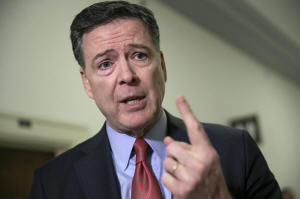
Former FBI Director James Comey speaks to reporters on Capitol Hill
Washington, Dec. 17, 2018. (AP Photo/J. Scott Applewhite, File)

The actual statements are blacked out, but Fitzpatrick said the
prosecutor seems to have ignored the fact that a grand jury may not
draw a negative inference about a person who exercises his right not
to testify in front of it. Comey did not appear before the panel. He
said she also appeared to suggest to grand jurors that they did not
need to rely only on what was presented to them and could instead be
assured that there was additional evidence that would be presented
at trial.
An ‘unusual series of events’
Fitzpatrick also drew attention to the jumbled manner in which the
indictment was obtained and indicated that a transcript and
recording of the proceedings do not provide a full account of what
occurred.
Halligan initially sought a three-count indictment of Comey, but
after the grand jury rejected one of the three proposed counts and
found probable cause to indict on the other two counts, a second
two-count indictment was prepared and signed. But Fitzpatrick said a
transcript and recording of the proceedings “do not reflect any
further communications after the grand jury began deliberating on
the first indictment,” creating what he said were unanswered
questions about whether the record is complete.
“Either way, this unusual series of events, still not fully
explained by the prosecutor’s declaration, calls into question the
presumption of regularity generally associated with grand jury
proceedings, and provides another genuine issue the defense may
raise to challenge the manner in which the government obtained the
indictment,” he wrote.
The two-count indictment charges Comey with lying to Congress in
September 2020 when he suggested under questioning that he had not
authorized FBI disclosure of information to the news media. His
lawyers say the question he was responding to was vague and
confusing but that the answer he gave to the Senate Judiciary
Committee was literally true.
The line of questioning from Sen. Ted Cruz appeared to focus on
whether Comey had authorized his former deputy director, Andrew
McCabe, to speak with the news media. But since the indictment,
prosecutors have made clear that their indictment centers on
allegations that Comey permitted a separate person — a close friend
and Columbia University law professor, Dan Richman — to serve as an
anonymous source in interactions with reporters.
The FBI executed search warrants in 2019 and 2020 to access messages
between Richman and Comey as part of a media leaks investigation
that did not result in charges.
But Fitzpatrick said he was concerned that communications between
the men that might have been protected by attorney-client privilege
— Richman has at times been a lawyer for Comey — were exposed to the
grand jury without Comey having had an opportunity to object. An FBI
agent exposed to potentially privileged communications appeared
before the grand jury.
“The government’s decision to allow an agent who was exposed to
potentially privileged information to testify before a grand jury is
highly irregular and a radical departure from past DOJ practice,”
Fitzpatrick wrote.
All contents © copyright 2025 Associated Press. All rights reserved
 |