Quarterly profit slide at Target hints at a challenging holiday season
for the retailer
[November 20, 2025] By
ANNE D'INNOCENZIO
NEW YORK (AP) — Target’s third-quarter profit tumbled as the retailer
struggles to lure shoppers that are being pressed by stubbornly high
inflation.
The Minneapolis company said Wednesday that it expects its sales slump
to extend through the critical holiday shopping season. The company also
announced that it's planning to invest another billion dollars next year
to remodel stores, build new ones, increasing the total cost for the
makeover to $5 billion.
Investors have punished Target’s stock recently, sending it down 45%
over the past 52 weeks. Shares fell $2.47, or nearly 3%, to close at
$86.06 Wednesday.
Turning around the 19% profit slide in the most recent quarter is the
latest challenge for incoming CEO Michael Fiddelke, a 20-year company
veteran who is replacing CEO Brian Cornell in February. The handover
arrives as the retailer tries to reverse a persistent sales malaise and
to revive its reputation as the place to go for affordable but stylish
products.
Comparable sales — those from established physical stores and online
channels — dipped 2.7% in its latest three-month period. That’s worse
then the 1.9% drop in the previous quarter and the third straight
quarterly decline.
Target’s troubles stand in stark contrast to rival Walmart, the nation’s
largest retailer, which is thriving. Walmart reports on its most recent
quarterly performance Thursday.
Target announced in October that it was eliminating about 1,800
corporate positions to streamline decision-making and accelerate company
initiatives. The cuts represent about 8% of Target’s corporate
workforce.

To pump up sales, Target is offering more than 20,000 new items, twice
as many as last year, and it has lowered prices on thousands of
groceries and other essential items.
“The environment around us continues to evolve, whether it’s shifting
consumer demand, changing competitor dynamics, or broader macroeconomic
pressures," Fiddelke said on an earnings call Wednesday. ”But let me be
clear. We are not waiting for conditions to improve. We are driving the
change ourselves right now."
With about 1,980 U.S. stores, Target has struggled to find its footing
since inflation caused Americans to curtail much of their discretionary
spending. At the same time, Target customers have complained of messy
stores lacking the budget-priced niche that long ago earned the retailer
the nickname “Tarzhay.”
Consumer boycotts since late January, when Target joined rival Walmart
and a number of other prominent American brands in scaling back its
corporate diversity, equity and inclusion initiatives, have compounded
the predicament.
Other, more recent macro headwinds, are buffeting the entire retail
sector.
[to top of second column] |
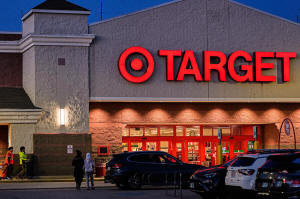
Shoppers walk towards a Target retail store, Tuesday, Nov. 18, 2025,
in Salem, N.H. (AP Photo/Charles Krupa)
 For almost a year, retailers have
struggled to navigate President Donald Trump’s wide-ranging tariffs
on imports and his immigration crackdown that threatened to shrink
the supply of workers available to U.S. companies.
The just ended 43-day federal shutdown is expected to be another
drag on an economy. Government contract awards have slowed and many
food aid recipients have seen their benefits interrupted, both of
which can cut into consumer spending at places like Target.
Fiddelke told reporters that the company saw a
weaker September but he said it was “tricky for us to isolate” the
different factors behind that.
The retailer’s profit fell to $689 million in the three-month period
ended Nov. 1, or $1.51 per share. Adjusted per share results added
up to $1.78. That is better than the $1.71 that Wall Street was
expecting, according to a poll by FactSet, but below the $1.85 per
share the company earned in the same period last year.
Sales fell 1.5% to $25.27 billion, just shy of analyst projections.
Sales gains in food and beverages were offset by continued weakness
in discretionary goods, with anxious shoppers focused increasingly
on buying essentials, even during the holidays.
For example, customers this year customers bought candy and costumes
for Halloween, but spent less on decorations, said Rick Gomez, chief
commercial officer for Target.
Gomez thinks they will make similar tradeoffs during the winter
holiday season.
"We think the consumer will prioritize what goes under the tree
versus what goes on the tree,” he said.
Target also announced a partnership with OpenAI on Wednesday that
will let users browse Target items through the tech company's app
ChatGPT. When customers are ready to buy, they'll be directed to the
Target app.
For the fourth quarter, Target expects that comparable sales will
decline by low single digits. For the full year, it now expects
earnings per share to be in the $7 per share to $8 per share range,
down from its earlier forecast of $7 to $9.
All contents © copyright 2025 Associated Press. All rights reserved
 |