Meta alerts young Australians to download their data before a social
media ban
[November 20, 2025] By
ROD McGUIRK
MELBOURNE, Australia (AP) — Technology giant Meta on Thursday began
sending thousands of young Australians a two-week warning to downland
their digital histories and delete their accounts from Facebook,
Instagram and Threads before a world-first social media ban on accounts
of children younger than 16 takes effect.
The Australian government announced two weeks ago that the three Meta
platforms plus Snapchat, TikTok, X and YouTube must take reasonable
steps to exclude Australian account holders younger than 16, beginning
Dec. 10.
California-based Meta on Thursday became the first of the targeted tech
companies to outline how it will comply with the law. Meta contacted
thousands of young account holders via SMS and email to warn that
suspected children will start to be denied access to the platforms from
Dec. 4.
“We will start notifying impacted teens today to give them the
opportunity to save their contacts and memories,” Meta said in a
statement.
Meta said young users could also use the notice period to update their
contact information “so we can get in touch and help them regain access
once they turn 16.”
Meta has estimated there are 350,000 Australians aged 13-to-15 on
Instagram and 150,000 in that age bracket on Facebook. Australia’s
population is 28 million.
Account holders 16-years-old and older who were mistakenly given notice
that they would be excluded can contact Yoti Age Verification and verify
their age by providing government-issued identity documents or a “video
selfie,” Meta said.

Terry Flew, co-director of Sydney University’s Center for AI, Trust and
Governance, said such facial-recognition technology had a failure rate
of at least 5%.
“In the absence of a government-mandated ID system, we’re always looking
at second-best solutions around these things,” Flew told the Australian
Broadcasting Corp.
The government has warned platforms that demanding that all account
holders prove they are older than 15 would be an unreasonable response
to the new age restrictions. The government maintains the platforms
already had sufficient data about many account holders to ascertain they
were not young children.
[to top of second column] |
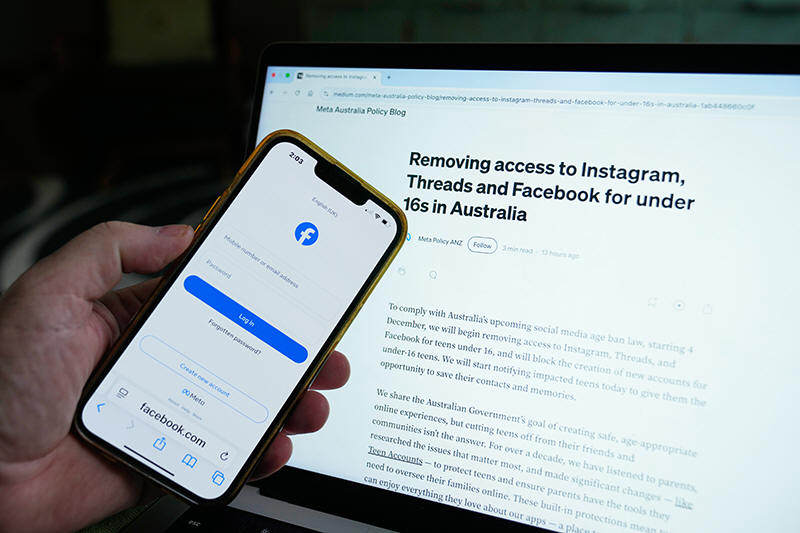
A logon screen for Facebook and the new Meta policy are photographed
in Sydney, Australia, Thursday, Nov. 20, 2025. (AP Photo/Rick
Rycroft)
 Failure to take reasonable steps to
exclude young children could earn platforms fines of up to 50
million Australian dollars ($32 million).
Meta's vice president and global head of safety, Antigone Davis,
said she would prefer that app stores including Apple App Store and
Google Play collect the age information when a user signs up and
verifies they are at least 16 year old for app operators such as
Facebook and Instagram.
“We believe a better approach is required: a standard, more
accurate, and privacy-preserving system, such as OS/app store-level
age verification,” Davis said in a statement.
“This combined with our investments in ongoing efforts to assure age
… offers a more comprehensive protection for young people online,”
she added.
Dany Elachi, founder of the parents’ group Heaps Up Alliance that
lobbied for the social media age restriction, said parents should
start helping their children plan on how they will spend the hours
currently absorbed by social media.
He was critical of the government's only announcing on the complete
list of platforms that will become age-restricted on Nov. 5.
“There are aspects of the legislation that we’re not entirely
supportive of, but the principle that children under the age of 16
are better off in the real world, that’s something we advocated for
and are in favor of,” Elachi said.
“When everybody misses out, nobody misses out. That’s the theory.
Certainly we expect that it would play out that way. We hope parents
are going to be very positive about this and try to help their
children see all the potential possibilities that are now open to
them,” he added.
All contents © copyright 2025 Associated Press. All rights reserved
 |