Fiber is something most people could use more of. But experts advise
caution with 'fibermaxxing'
[November 20, 2025]
By DEE-ANN DURBIN
U.S. consumers who have had their fill of finding protein added to
everything from cereal to ice cream are about to meet the next big food
fad: fiber.
Americans have been boosting their protein intake for years; even
Pop-Tarts and Starbucks are selling protein-enhanced products. But the
number of new products promoted with high or added fiber saw a big
uptick in the U.S. this year, according to market research firm Mintel.
Hundreds of videos on social media celebrate the benefits of dietary
fiber and share recipes to help viewers get more of it.
There’s even a term for trying to meet or exceed the recommended daily
fiber intake: fibermaxxing.
“I think fiber will be the next protein,” PepsiCo CEO Ramon Laguarta
said during a recent conference call with investors. “Consumers are
starting to understand that fiber is the benefit that they need.”
Fiber's benefits
Unlike muscle-building protein, fiber isn't sexy. It's a carbohydrate
found in plants that your body can't break down. It helps feed gut
bacteria and move food through the digestive system.
“Folks don’t want to talk about it at a dinner party,” said Debbie
Petitpain, a registered dietitian nutritionist and a spokeswoman for the
Academy of Nutrition and Dietetics.
There are two main types of fiber. Soluble fiber dissolves in water and
forms a gel-like material that feeds gut bacteria. It’s found in foods
like oats, peas, beans, apples and carrots. Insoluble fiber doesn’t
dissolve in water and moves food through the digestive system. It’s
found in whole wheat flour, popcorn, wheat bran, nuts, green beans and
potatoes.

Studies have shown that fiber lowers cholesterol levels, regulates blood
sugar and promotes weight loss, since high-fiber foods tend to make
eaters feel more full. It may also protect against heart disease,
diabetes, diverticulitis and colon cancer, according to the American
Heart Association.
Petitpain said rising use of GLP-1 weight loss drugs could be one reason
for the renewed focus on fiber, since GLP-1s naturally slow digestion
and fiber can prevent constipation. She said fiber has seen similar
spikes in interest when people wanted to alleviate symptoms from
high-fat diets like Atkins or keto.
How much fiber do we need?
Most people in Western countries could use more fiber because their
diets are low in vegetables, fruits and whole grains, said Sander
Kersten, director of the Division of Nutritional Sciences at Cornell
University.
Under the U.S. Department of Agriculture’s guidelines, adults should aim
for 14 grams of fiber for every 1,000 calories they consume. That’s
about 25 grams of fiber for women and 38 grams for men each day.
Petitpain said Americans generally only get about two-thirds of that
amount.
For reference, 1 cup of raspberries contains 8 grams of fiber, while a
banana contains 3.2 grams, according to the USDA. One-half cup of
avocado contains 5 grams of fiber and 1 cup of lima beans contains 13.2
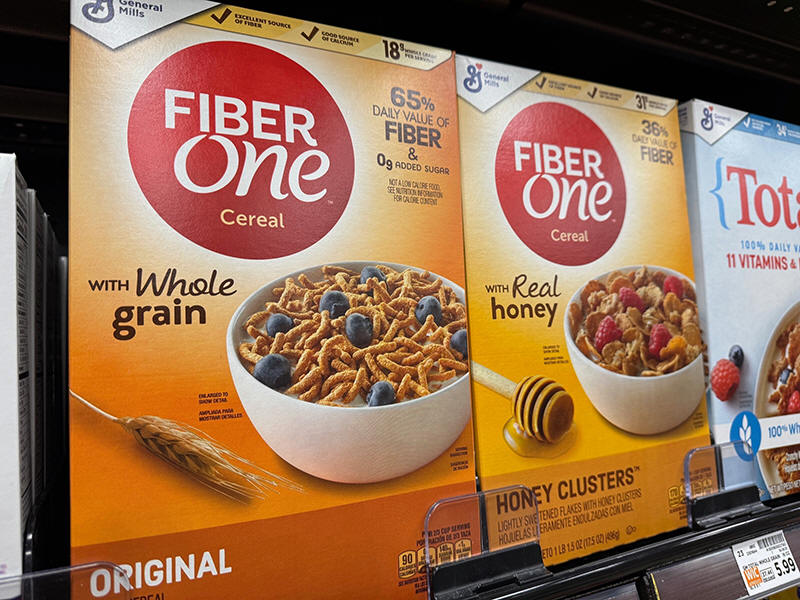
grams. Fiber One, a bran cereal, packs 18 grams of fiber into a 2/3-cup
serving.
[to top of second column]
|
Boxes of cereal promoting fiber sit on a shelf at a Kroger grocery
store, in Ann Arbor, Mich., Tuesday, Nov. 18, 2025. (AP
Photo/Dee-Ann Durbin)
 What are good ways to increase
fiber?
Kersten said long-term studies about the benefits of fiber have
looked at the consumption of whole foods and not packaged products
with added fiber.
“The way it is consumed as an additive and part of a diet that
doesn’t contain a lot of fiber may be different than a naturally
fiber-rich diet,” Kersten said. “You can eat a very processed,
Western diet and consume foods that are enriched, but we don’t know
if it confers the same benefit.”
Whole foods also help the body in other ways, Petitpain said. An
apple contains 4.8 grams of fiber as well as water, vitamins and
minerals, for example.
Here are some recommendations from the Mayo Clinic for adding fiber
to your diet:
— Choose a breakfast cereal with 5 grams or more of fiber a serving.
Top it with a sliced banana or berries.
— Choose breads with at least 2 grams of fiber per serving and try
other grains like brown rice, whole-wheat pasta and quinoa.
— When baking, substitute whole-grain flour for white flour. Add
wheat bran to muffins and cookies.
— Try to eat five or more servings of fruit and vegetables daily. If
you eat canned fruit, make sure it's canned in fruit juice and not
syrup, and make sure canned vegetables are low in sodium.
Think twice about fibermaxxing
There is no defined upper limit for fiber intake, Kersten said. But
increasing fiber can cause painful gas and bloating, especially if
it's done quicky.
Petitpain said people should increase their fiber intake gradually
and drink plenty of water.
“You’re feeding gut bacteria a food, and you can’t break it down.
You rely on them, and if you give them second, third and fourth
servings, there’s not enough of them to handle the extra load,”
Petitpain said.
Certain populations should also be extra careful about their fiber
intake, Petitpain said. People who are sensitive to gluten or
allergic to foods like soy, shellfish or psyllium husk should read
labels carefully since some foods with added fiber contain those
ingredients.

More broadly, Kersten questions the trend of focusing on one
nutrient, whether it's protein or fiber.
“We don’t need nutrients, we need foods. Ultimately, what you want
to be striving for is a healthy diet, and you should choose foods
that are considered to be an important part of a healthy diet,” he
said.
All contents © copyright 2025 Associated Press. All rights reserved |