Judge to proceed with contempt probe after US flew migrants to El
Salvador prison in March
[November 20, 2025]
By SUDHIN THANAWALA
A federal judge said Wednesday he plans to move ahead quickly on a
contempt investigation of the Trump administration for failing to turn
around planes carrying Venezuelan migrants to El Salvador in March.
U.S. District Judge James Boasberg in Washington said a ruling Friday by
the U.S. Court of Appeals for the District of Columbia Circuit gave him
the authority to proceed with the inquiry, which will determine whether
there is sufficient evidence to refer the matter for prosecution. He
asked attorneys by Monday to identify witnesses and offer plans for how
to conduct the probe and said he'd like to start any hearings on
December 1.
The judge has previously warned he could seek to have officials in the
administration prosecuted.
On March 15, Boasberg ordered the aircraft carrying accused gang members
to return to the U.S., but they landed instead in El Salvador, where the
migrants were held at a notorious prison.
“I am authorized to proceed just as I intended to do in April seven
months ago,” the judge said during a hearing Wednesday. He added later,
“I certainly intend to find out what happened on that day.”
Boasberg said having witnesses testify under oath appeared to be the
best way to conduct the contempt probe, but he also suggested the
government could provide written declarations to explain who gave orders
to “defy” his ruling. He suggested one witness: a former U.S. Justice
Department attorney who filed a whistleblower complaint that claims a
top official in the department suggested the Trump administration might
have to ignore court orders as it prepared to deport Venezuelan migrants
it accused of being gang members.

The Trump administration has denied any violation, saying the judge’s
directive to return the planes was made verbally in court but not
included in his written order. Justice Department attorney Tiberius
Davis told Boasberg the government objected to further contempt
proceedings.
Boasberg previously found probable cause to hold the Trump
administration in criminal contempt of court. The ruling marked a
dramatic battle between the judicial and executive branches of
government, but a divided three-judge appeals court panel later sided
with the administration and threw out the finding. The two judges in the
majority were appointed by President Donald Trump.
On Friday, a larger panel of judges on the D.C. Circuit said the earlier
ruling by their colleagues did not bar Boasberg from moving ahead with
his contempt probe. Boasberg’s contempt finding was a “measured and
essential response,” Judges Cornelia Pillard, Robert Wilkins and Bradley
Garcia wrote.
[to top of second column]
|
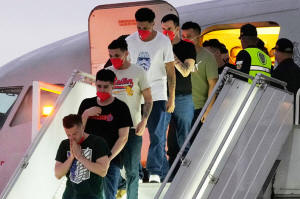
Migrants deported months before by the United States to El
Salvador under the Trump administration's immigration crackdown
arrive at Simon Bolívar International Airport in Maiquetia,
Venezuela, July 18, 2025. (AP Photo/Ariana Cubillos, File)

“Obedience to court orders is vital to the ability of the judiciary to
fulfill its constitutionally appointed role,” they wrote. “Judicial
orders are not suggestions; they are binding commands that the Executive
Branch, no less than any other party, must obey.”
The Trump administration invoked an 18th century wartime law to send the
migrants, whom it accused of membership in a Venezuelan gang, to a
mega-prison in El Salvador known as the Terrorism Confinement Center, or
CECOT. It argued that American courts could not order them freed.
In June, Boasberg ruled the Trump administration must give some of the
migrants a chance to challenge their deportations, saying they hadn’t
been able to formally contest the removals or allegations that they were
members of Tren de Aragua.
The judge wrote that “significant evidence” had surfaced indicating that
many of the migrants were not connected to the gang “and thus were
languishing in a foreign prison on flimsy, even frivolous, accusations.”
More than 200 migrants were later released back to Venezuela in a
prisoner swap with the U.S.
Their attorneys want Boasberg to issue another order requiring the
administration to explain how it will give at least 137 of the men a
chance to challenge their gang designation under the Alien Enemies Act.
The men are in danger in Venezuela and fear talking to attorneys, who
have been able to contact about 30 of them, but they “overwhelmingly”
want to pursue their cases, Lee Gelernt, an attorney with the American
Civil Liberties Union, said Wednesday.
Davis said it may be hard to take the men into custody again given
tensions between the U.S. and the government of Venezuelan President
Nicolas Maduro.
Boasberg did not immediately rule on the matter.
All contents © copyright 2025 Associated Press. All rights reserved
 |