Trump administration seeks to roll back protections for imperiled
species and their habitat
[November 20, 2025]
By MATTHEW BROWN and SUSAN MONTOYA BRYAN
BILLINGS, Mont. (AP) — President Donald Trump's administration moved
Wednesday to roll back protections for imperiled species and the places
they live, reviving a suite of changes to Endangered Species Act
regulations from the Republican's first term that were blocked under
former Democratic President Joe Biden.
The proposed changes include the elimination of the U.S. Fish and
Wildlife Service's “blanket rule" that automatically protects animals
and plants when they are classified as threatened. Government agencies
instead would have to craft species-specific rules for protections, a
potentially lengthy process.
The administration's announcement answers longstanding calls for
revisions to the Endangered Species Act from Republicans in Congress and
industries including oil and gas, mining and agriculture. Critics argue
the landmark 1973 environmental law has been wielded too broadly, to the
detriment of economic growth.
But environmentalists warned the changes could cause yearslong delays in
efforts to save species such as the monarch butterfly, Florida manatee,
California spotted owl and North American wolverine.
“We would have to wait until these poor animals are almost extinct
before we can start protecting them. That’s absurd and heartbreaking,”
said Stephanie Kurose with the Center for Biological Diversity.
Scientists and government agencies say extinctions are accelerating
globally because of habitat loss and other pressures.

Trump has made oil and gas production a centerpiece of his presidency
and sought to strip away environmental regulations that impede
development. Other pending proposals from the administration would
revise the definition of “harm” under the Endangered Species Act and
potentially bypass species protections for logging projects in national
forests and on public lands.
Interior Secretary Doug Burgum said in a statement that the
administration was restoring the Endangered Species Act to its original
intent while respecting “the livelihoods of Americans who depend on our
land and resources.”
“These revisions end years of legal confusion and regulatory overreach,
delivering certainty to states, tribes, landowners and businesses while
ensuring conservation efforts remain grounded in sound science and
common sense,” Burgum said in a statement.
Another proposed change tasks officials with analyzing economic impacts
when deciding whether habitat is critical to a species' survival.
Case of lizard shows potential outcome of proposals
The case of the Yarrow’s spiny lizard in the Southwest exemplifies the
potential consequences of the proposals. Rapidly warming temperatures
have ravaged a population of the lizard in Arizona’s Mule Mountains,
pushing the reptiles further up the mountainsides toward the highest
peaks and possibly toward extinction.
A petition filed Wednesday seeks protections for the lizard and the
designation of critical habitat. Advocates say analyzing the economic
impacts could delay protections. Designating critical habitat could be
another hurdle because the primary threat to this population of spiny
lizard is climate change.
[to top of second column]
|
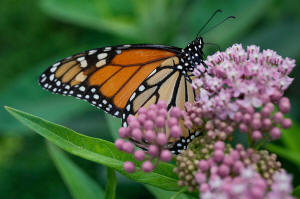
A monarch butterfly feeds on milkweed, July 15, 2025, in Chicago.
(AP Photo/Erin Hooley, file)

“We think that the species should be listed as endangered. In fact,
we are somewhat shocked that it is not already extinct,” said John
Wiens, a professor of ecology and evolutionary biology at the
University of Arizona, who co-authored the petition.
The Interior Department was sued over the blanket protection rule in
March, by the Property and Environment Research Center (PERC) and
Rocky Mountain Elk Foundation. The two groups argued the rule was
illegal and discouraged states and landowners from assisting in
species recovery efforts.
Species designated as “threatened” under the rule automatically
qualify for the same protections as those with the more severe
designation of “endangered.”
PERC Vice President Jonathan Wood said Wednesday's proposal was a
“necessary course correction.”
“This reform acknowledges the blanket rule's unlawfulness and puts
recovery back at the heart of the Endangered Species Act,” Wood
said.
Proposals would undermine protections, critic says
Kristen Boyles with the environmental law firm Earthjustice said the
changes undermine protections even more than in Trump's first term.
That includes allowing the Fish and Wildlife Service and National
Marine Fisheries Service to not count negative effects on species if
those impacts are not regulated by the agencies themselves, Boyles
said.
“The Services are required to prevent harmful consequences to
species, not ignore them,” she said.
Trump officials during his first term also rolled back protections
for individual species including the northern spotted owl and gray
wolf.
The spotted owl decision was reversed in 2021 after officials said
Trump’s political appointees used faulty science to justify opening
millions of acres of West Coast forest to potential logging.
Protections for wolves across most of the U.S. were restored by a
federal court in 2022.

The Endangered Species Act protects more than 1,600 species in the
United States and its territories. It is credited with helping save
the bald eagle, California condor and scores more animals and plants
from extinction since Republican President Richard Nixon signed it
into law.
__
Montoya Bryan reported from Albuquerque.
All contents © copyright 2025 Associated Press. All rights reserved |