ICC slashes Nicor, Ameren proposed gas rate hikes by over 40%
[November 21, 2025]
By Maggie Dougherty
CHICAGO — The Illinois Commerce Commission Wednesday sharply cut rate
increases proposed by Nicor Gas and Ameren Illinois, slowing the speed
of rising energy bills for customers in much of the state.
Instead of approving the full $314 million requested by Nicor and $129
million requested by Ameren, the ICC cut 47% and 43% from the requests,
respectively.
As a result, the ICC approved a rate increase of $168 million for Nicor
and $73 million for Ameren Illinois.
In a news release after the ruling in Chicago, ICC Chairman Doug Scott
said the decision was made after careful review to approve only
“necessary and justified” projects while striking “excess” spending.
“The ICC’s responsibility is to balance the interests of Illinois’
utilities and their customers,” Scott said in the release. “We recognize
that any decision impacting Illinoisians’ bills is not a small one.”
Nicor, the largest gas utility in the state, serves 2.3 million
customers in northern Illinois and the Chicago suburbs. In January,
Nicor originally requested a $309 million rate increase that was
estimated by the company to raise typical residential bills by about
$7.50 per month, or about 9%.
At the time, the request was the largest in state history before it was
amended up to the $314 million amount.

In a statement released after Wednesday’s decision, Nicor estimated that
typical residential customers would see an increase of less than $4.25
monthly, or less than 5% annually.
Ameren, which provides natural gas delivery to approximately 816,000
customers in central and southern Illinois, filed in January for a $134
million rate increase that a spokesperson said would increase typical
residential bills by about $9.09 per month, an 11.9% increase.
Ameren spokesperson Ellie Leonard said in an email to Capitol News
Illinois that Ameren was still reviewing the ICC’s order and running
calculations to determine the rate impact to consumers.
Infrastructure upgrades, repairs
The companies said the increase was needed to fund replacements or
retirements of aging infrastructure for gas transmission lines and
upgrades to gas storage facilities.
“As we enter the winter season, the safety and vitality of our 800,000
residential, public sector and business customers depends on our ability
to deliver natural gas on the coldest of days without interruption,”
Brad Kloeppel, Ameren gas operations and technical services senior
director, said in a statement.
The Ameren statement also touted use of underground storage facilities
which allow Ameren to purchase gas in the summer when prices are
typically lower and deliver it to customers at a stable price during the
winter heating season.
But consumer advocates say all the upgrades are not necessary, or at
least not now.
Abe Scarr, director of the Illinois Policy Interest Research Group, or
Illinois PIRG, said Nicor has a system that operates safely and well
overall. Investing in major infrastructure updates now, he said, does
not necessarily make sense for consumers.

“It makes a big difference if you invest in a new pipeline in 2020
versus 2025, and it makes a big impact on consumers and consumer rates,”
Scarr said. “So, it’s not only a question of ‘Is this investment
reasonable or prudent at all?’ It’s also, ‘Does it need to be made
now?’”
While consumer and environmental advocates applauded the ICC’s decision
to minimize rate increases, some said any amount was still too high
after repeated steep rate increases over the past decade.
[to top of second column]
|
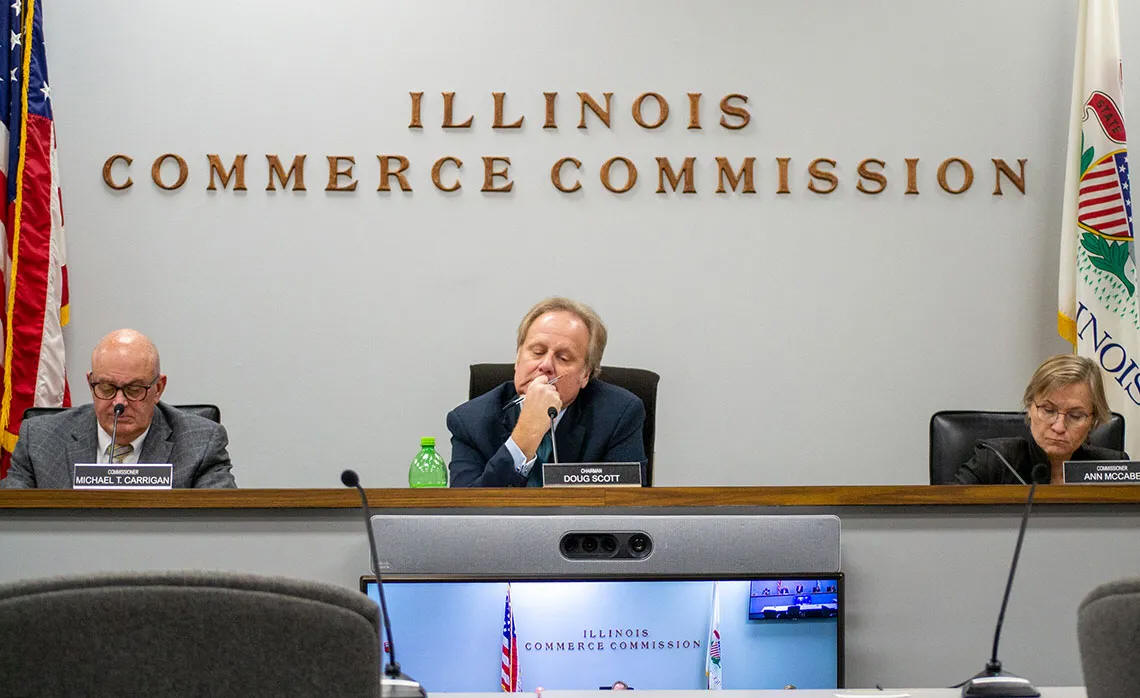
Illinois Commerce Commission Chair Dough Scott is pictured alongside
commissioners Michael Carrigan (left) and Ann McCabe (right) at a
November 2023 meeting in Springfield. (Capitol News Illinois photo
by Jerry Nowicki)

According to Illinois PIRG, this is the fifth increase for Nicor since
2017 and the fourth for Ameren since 2018.
“With this increase, Nicor’s rates will have risen by 137% since 2017
and Ameren’s by 70% since 2018,” Scarr said in a statement.
The Citizens Utility Board, a nonprofit Illinois utility watchdog group,
contrasted the costs for consumers with the utilities’ growing profits
over the same periods.
In recent years, however, the ICC has proven more willing to diminish
rate requests. In November 2023, it slashed rate increase requests by
Ameren, Nicor and two other Chicago-area gas utilities by 25-50%. The
following month, it rejected a pair of grid plans from electric
utilities Commonwealth Edison and Ameren Illinois citing significant
shortcomings and transparency concerns.
Meeting clean energy goals
While advocates had mixed responses to the rate case decisions, they
found other items to celebrate in the ICC’s nearly 400-page rulings.
The ICC discontinued a Nicor pilot program called TotalGreen, which had
offered customers the option to pay a premium for carbon offsets and
“renewable natural gas” credits. Nicor had sought to make the program
permanent.
Of Nicor’s 2.3 million customers, only 238 had enrolled in TotalGreen
after three years of operation, according to testimony submitted by the
Environmental Law & Policy Center, a Midwest-focused environmental legal
advocacy organization. The ELPC’s analysis found that Nicor spent $2,429
per customer for a program with less than 0.01% customer participation.

While Nicor has not proposed charging customers to cover the cost of
that program, Scarr said there are more efficient ways to meet
decarbonization goals. He pointed to Nicor’s energy efficiency program.
The ICC also rejected a proposal by Ameren to capture biomethane gas
released as organic material such as livestock manure, food waste and
sewage break down. Ameren sought to capture that gas and refine it into
pipeline-quality gas to be used as an alternative energy source,
reducing the amount of unburned methane gas going into the atmosphere.
However, the ICC found that Ameren did not prove the project would
reduce carbon emissions in a cost-effective way.
Environmental advocates applauded the Commission’s rejection of what
Scarr called “false solutions.”
“The Commission’s order makes meaningful progress on energy
affordability and climate progress,” Curt Stokes, senior attorney at the
Environmental Defense Fund said in a statement.
“Just as importantly, it set strong guardrails that push utilities to
pursue cleaner, more affordable alternatives instead of doubling down on
yesterday’s gas infrastructure.”
Capitol News Illinois is
a nonprofit, nonpartisan news service that distributes state government
coverage to hundreds of news outlets statewide. It is funded primarily
by the Illinois Press Foundation and the Robert R. McCormick Foundation.
 |