Coast Guard reverses course on policy to call swastikas and nooses
'potentially divisive'
[November 21, 2025]
By KONSTANTIN TOROPIN, LISA MASCARO and SUSAN HAIGH
WASHINGTON (AP) — The U.S. Coast Guard has released a new, firmer policy
addressing the display of hate symbols like swastikas and nooses just
hours after it was publicly revealed that it made plans to describe them
as “potentially divisive" — a term that prompted outcry from lawmakers
and advocates.
“Divisive or hate symbols and flags are prohibited,” the latest Coast
Guard policy, released late Thursday, declared before adding that this
category included “a noose, a swastika, and any symbols or flags
co-opted or adopted by hate-based groups.”
“This is not an updated policy but a new policy to combat any
misinformation and double down that the U.S. Coast Guard forbids these
symbols,” an accompanying Coast Guard press release said.
The late-night change came on the same day that media outlets, led by
The Washington Post, discovered that the Coast Guard had written a
policy earlier this month that called those same symbols “potentially
divisive." The term was a shift from a years-long policy, first rolled
out in 2019, that said symbols like swastikas and nooses were “widely
identified with oppression or hatred” and called their display “a
potential hate incident.”

The latest policy that was rolled out Thursday night also unequivocally
banned the display of any divisive or hate symbols from all Coast Guard
locations. The earlier version stopped short of banning the symbols,
instead saying that commanders could take steps to remove them from
public view and that the rule did not apply to private spaces outside of
public view, such as family housing.
Both policies maintained a long-standing prohibition on publicly
displaying the Confederate flag outside of a handful of situations, such
as educational or historical settings.
The latest Coast Guard policy appears to take effect immediately.
After the initial policy change became public, Democratic Sen. Jacky
Rosen of Nevada said the change "rolls back important protections
against bigotry and could allow for horrifically hateful symbols like
swastikas and nooses to be inexplicably permitted to be displayed.”
“At a time when antisemitism is rising in the United States and around
the world, relaxing policies aimed at fighting hate crimes not only
sends the wrong message to the men and women of our Coast Guard, but it
puts their safety at risk,” she added.
Admiral Kevin Lunday, acting commandant of the Coast Guard, said the
policy did not roll back any prohibitions, calling it “categorically
false” to claim otherwise in a statement released earlier Thursday.
“These symbols have been and remain prohibited in the Coast Guard per
policy,” Lunday said in a statement, adding that “any display, use or
promotion of such symbols, as always, will be thoroughly investigated
and severely punished.”
Lunday’s predecessor, Admiral Linda Fagan, was fired on President Donald
Trump’s first day in office. Trump officials later said she fired in
part for putting an “excessive focus” on diversity and inclusion efforts
that diverted “resources and attention from operational imperatives.”
[to top of second column]
|
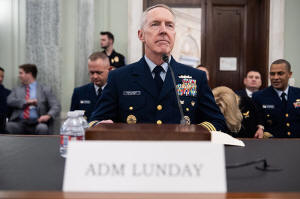
Adm. Kevin Lunday, acting commandant of the U.S. Coast Guard,
arrives to a Senate Commerce, Science and Transportation Committee
hearing on his nomination for Commandant of the Coast Guard,
Wednesday, Nov. 19, 2025, on Capitol Hill in Washington. (AP
Photo/Julia Demaree Nikhinson)

The older policy that was rolled out earlier in November also
explicitly said that “the terminology ‘hate incident’ is no longer
present in policy” and conduct that would have previously been
handled as a potential hate incident will now be treated as “a
report of harassment in cases with an identified aggrieved
individual.”
Commanders, in consultation with lawyers, may order or direct the
removal of “potentially divisive” symbols or flags if they are found
to be affecting the unit's morale or discipline, according to the
policy.
The newest policy is silent on whether Coast Guard personnel will be
able to claim they were victims of hate incidents.
The Coast Guard is under the Department of Homeland Security, but it
is still considered a part of America's armed forces and the new
policy was updated in part to be consistent with similar Pentagon
directives, according to a Coast Guard message announcing the
changes.
It also has historically modeled many of its human resources
policies on other military services.
The policy change comes less than two months after Defense Secretary
Pete Hegseth ordered a review of all the hazing, bullying and
harassment definitions across the military, arguing that the
policies were “overly broad” and they were “jeopardizing combat
readiness, mission accomplishment, and trust in the organization.”
The Pentagon could not offer any details about what the review was
specifically looking at, if it could lead to similar changes as seen
in the Coast Guard policy or when the review would be complete.

Menachem Rosensaft, a law professor at Cornell University and a
Jewish community leader, said in a statement that “the swastika is
the ultimate symbol of virulent hate and bigotry, and even a
consideration by the Coast Guard to no longer classify it as such
would be equivalent to dismissing the Ku Klux Klan’s burning crosses
and hoods as merely ‘potentially divisive.'”
Senate Democratic leader Chuck Schumer called the move “disgusting,
and it’s more encouragement from the Republicans of extremism.”
___
Haigh reported from Norwich, Connecticut.
All contents © copyright 2025 Associated Press. All rights reserved |