Move. Cheer. Dance. Do the wave. How to tap into the collective joy of
'we mode'
[November 24, 2025]
By ALBERT STUMM
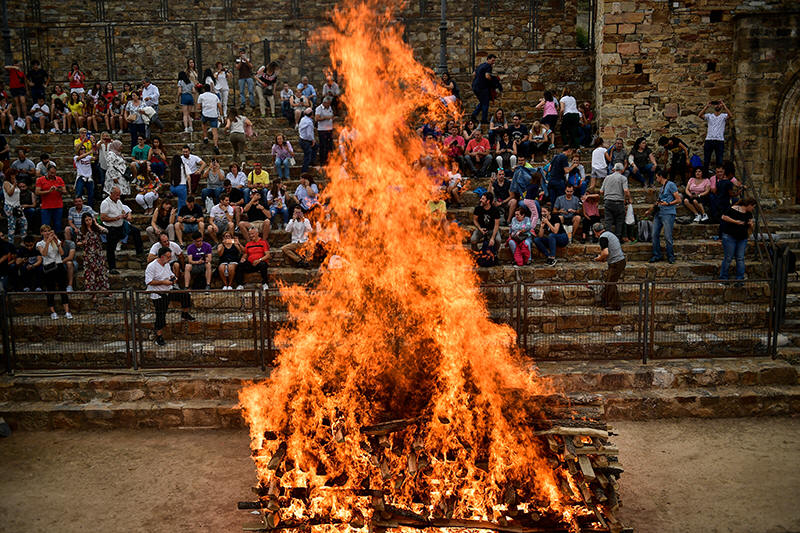
With a runway of smoking-hot coals laid out before them, residents in
San Pedro Manrique, Spain, steel themselves as thousands of onlookers
cheer them on. The crowd roars when they walk across the fire, sometimes
carrying another person on their back.
Although the walkers and the crowd perform very different roles during
the annual June ritual, they report similar feelings: an ineffable
feeling of togetherness, as if the entire group becomes one, said
Dimitris Xygalatas, a cognitive anthropologist at the University of
Connecticut, who witnessed the Spanish ritual years ago as a researcher.
He has experienced similar feelings in a stadium while chanting and
cheering together with 30,000 fans of his hometown soccer team. Both are
instances of collective effervescence, said Xygalatas, author of
“Rituals: How Seemingly Senseless Acts Make Life Worth Living.”
It’s that feeling that happens when people engage together in a
meaningful activity that sparks positive emotions. Such as when you get
goose bumps at a concert, feel the rush of adrenaline in group exercise
classes or get swept up in religious festivals.
Recently, collective effervescence has been referred to as “we mode,”
and it’s something that can be cultivated to improve your life, said
Kelly McGonigal, a Stanford University health psychologist.
“When you are connected through shared positive emotion, expressions
often act as this aerosolized joy, where you catch other people’s
smiles, laughter, their physical expressions,” McGonigal said. “It
becomes contagious.”

When hearts beat as one
“We mode” has also been called physiological synchrony, and McGonigal
calls it “collective joy.” The concept was documented more than a
century ago by French sociologist Emile Durkheim, who described cultural
effervescence after studying aboriginal Australian societies.
Xygalatas’ research has focused on measuring it in various group
activities. To quantify “autonomic responses,” he has fitted people with
heart monitors and electrodes and extracted thousands of stills from
videos to analyze facial expressions.
He found that people’s physiological responses synchronize during
exciting events. The heartbeats of sports fans who attend a game, for
instance, sync up, while those of fans watching the same game on TV
don’t. Fans at the game also have higher levels of endorphins, which
have been linked to bonding, he said.
[to top of second column]
|
People view a fire before walking on the burning embers during the
night of San Juan in San Pedro Manrique, northern Spain, June 23,
2019. (AP Photo/Alvaro Barrientos, File)

On a basic level, collective rituals involve meeting and connecting with
people, which is a key to psychological well-being, Xygalatas noted.
“If we all dress alike and we move alike and we feel alike, we express
the same emotions that trigger mechanisms in our brain,” Xygalatas said.
“There’s a fundamental need for synchrony.”
Activities that create ‘we mode’
What kinds of activities should you look for to tap into “we mode”?
McGonigal, who has studied the science of emotion and wrote “The Joy of
Movement” about the emotional benefits of exercise, named these
criteria:
The activity must be in person. McGonigal noted that during the height
of the COVID-19 pandemic, people who tried to recreate positive
interactions online found it more difficult than in person.
“If you’re not physically present with people, a lot of the signals that
create the shared state, they just aren’t there,” she said.
It also helps to make noise and move your body, whether you cheer,
applaud, move, dance or sing. McGonigal said you’re more likely to feel
this kind of collective joy when you’re dancing with people than when
you’re sitting in a theater watching a dance performance.
Also, try to let go of shame or self-consciousness, and get into the
activity. Passive observers don’t get the same effect, McGonigal said.
“You’ve got to do the wave at the sporting event,” she said. “If you’re
at a group exercise class, and your instructor is like, ‘Can I get a
whoop, whoop?’ You gotta whoop, whoop.”
All contents © copyright 2025 Associated Press. All rights reserved
 |