European Union agrees on new sanctions against Russia targeting its
shadow oil fleet and LNG imports
[October 23, 2025] By
LORNE COOK
BRUSSELS (AP) — The European Union has agreed on a new raft of sanctions
against Russia targeting its shadow fleet of oil tankers and banning its
imports of liquefied natural gas, the Danish EU presidency announced
Thursday.
“Today is a good day for Europe and Ukraine,” Danish Foreign Minister
Lars Løkke Rasmussen said in a statement, as EU leaders were gathering
for a summit in Brussels.
He said that the new sanctions “will introduce new and comprehensive
measures on oil and gas, the shadow fleet and Russia’s financial
sector.” A new system for limiting the movement of Russian diplomats
within the 27-nation EU will also be introduced.
The move comes a day after U.S. President Donald Trump’s administration
announced new sanctions against Russia’s oil industry that are aimed at
moving Russian President Vladimir Putin to the negotiating table and
ending Moscow’s war on Ukraine.
Energy revenue is the linchpin of Russia’s economy, allowing Putin to
pour money into the armed forces without worsening inflation for
everyday people and avoiding a currency collapse.
The new EU measures took almost a month to decide. The 27-nation bloc
has already slapped 18 packages of sanctions against Russia over the
war, but getting final agreement on who and what to target can take
weeks.

The sanctions agreement was sealed at a Thursday morning meeting of EU
ambassadors, just a few hours before Ukrainian President Volodymyr
Zelenskyy joins his European counterparts for the one-day summit, as
they press for a ceasefire to halt almost four years of fighting.
The summit comes after Trump said that his plan for a swift meeting with
Putin was on hold because he didn’t want it to be a “waste of time.” It
was yet another twist in Trump’s stop-and-go effort to end the war.
The leaders are also eager for any progress on Trump’s Gaza peace plan,
and will debate ways to keep the 27-nation bloc involved in proceedings.
The EU is the world’s biggest provider of aid to Palestinians but has
little leverage over Israel – in part because European nations are
divided over how to handle the conflict – and it has struggled to play a
role of consequence.
[to top of second column] |
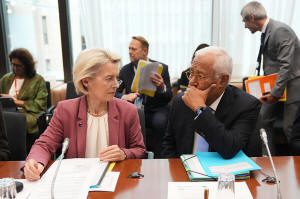
European Commission President Ursula von der Leyen, left, and
European Council President Antonio Costa wait for the start of the
Tripartite Social Summit at the European Council building in
Brussels, Wednesday, Oct. 22, 2025. (AP Photo/Virginia Mayo)
 It’s role in the war in Ukraine is
clearer, and the summit takes place as Russian armed forces strike
at the conflict-torn country’s power grid just as the weather starts
to turn colder.
Earlier this week, Ukraine’s strongest European backers who form
part of the “coalition of the willing” said they opposed any push to
make Ukraine surrender land captured by Russian forces in return for
peace, as Trump most recently has suggested.
The U.K. will host a meeting of the members of that coalition of
more than 30 countries on Friday.
On the EU side, leaders intend to push forward with plans to use
billions of dollars in frozen Russian assets to help fund Ukraine’s
war efforts, despite some misgivings about the consequences of such
a step.
The biggest tranche of frozen assets – some $225 billion worth – are
held in Belgium, and the Belgian government has been reluctant to
take any risks on using the money without firm guarantees from its
European partners.
Ukraine’s budget and military needs for 2026 and 2027 are estimated
to total around $153 billion.
The EU leaders are also likely to sign off on a new “road map” to
prepare Europe to defend itself against a Russian attack by the end
of the decade. Top officials believe that Russian could be ready to
take aim at another European country within 3-5 years.
All contents © copyright 2025 Associated Press. All rights reserved
 |