Immigrant rights group calls for removing pregnant women from detention
[October 23, 2025]
By SARA CLINE and VALERIE GONZALEZ
BATON ROUGE, La. (AP) — Women taken into custody by U.S. immigration
agents while pregnant say they received inadequate care in a letter
Wednesday that calls on the Trump administration to stop holding
expectant mothers in federal detention facilities.
The letter to U.S. Immigration and Customs Enforcement is part of a
broader campaign in recent months by Democrats and immigrant rights
groups to draw attention to what they say is the mistreatment of
pregnant detainees.
The Department of Homeland Security has defended its care, saying
pregnant detainees get regular prenatal visits, mental health services,
nutritional support and accommodations “aligned with community standards
of care.”
In addition, Homeland Security Department Assistant Secretary Tricia
McLaughlin said in a written statement Wednesday that such detentions
are “exceedingly rare” — and that pregnant women currently account for
less than 1% of the total number of ICE detainees in custody. The agency
didn't provide additional figures related to detainees who are pregnant,
postpartum or nursing — data that Democrats have sought for months.
The letter sent by the American Civil Liberties Union cites accounts
from pregnant women who say they were shackled while being transported,
placed in solitary confinement for multiple days and given insufficient
food and water while detained in Louisiana and Georgia.
The ACLU said that over the past five months it has met with more than a
dozen females who were pregnant while in ICE custody -- including some
who had a miscarriage while detained. The women reported “gravely
troubling experiences,” the letter states, including lack of translation
during medical encounters and medical neglect. One suffered a “severe”
infection after her miscarriage.

When asked about the letter, McLaughlin called it “another disgusting
attempt to smear ICE." She argued that the ACLU used “unsubstantiated”
and “unverifiable claims.”
In an interview with The Associated Press, one of the women said she was
kept in handcuffs while being transported to Louisiana — a journey that
lasted five hours and spanned two plane rides. The woman, who has since
been released from custody and given birth, spoke on the condition of
anonymity out of fear of facing retaliation during her ongoing case.
An officer told her he considered taking off the handcuffs but worried
she would escape. “How am I going to escape if I’m pregnant?” the woman
said she responded.
[to top of second column]
|
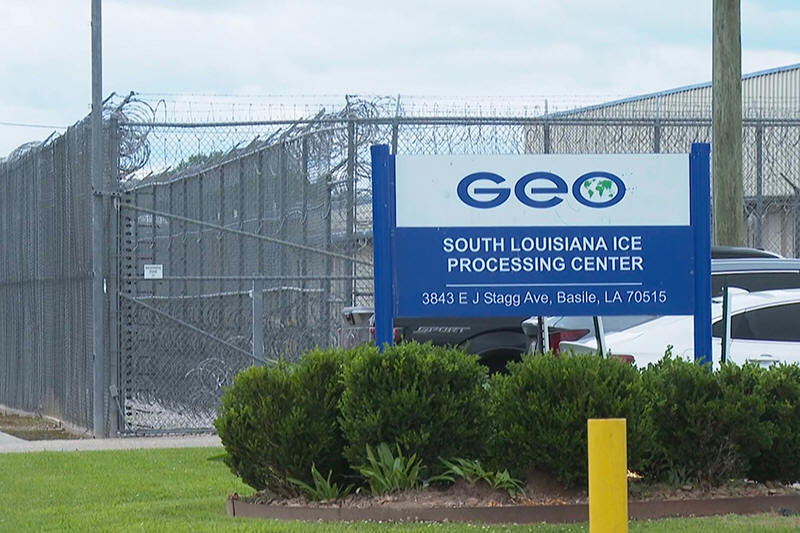
This image taken from video shows the South Louisiana ICE Processing
Center in Basile, La., April 7, 2025. (AP Photo/Stephen Smith)

She said she felt as if she'd been kidnapped and experienced dizziness,
nausea and vaginal bleeding. During her time in detention, she said
pregnant women were not offered special diets and described the food as
horrible. She alleged that detainees had to “beg” for water and toilet
paper.
The ACLU's letter is the latest call for an investigation into the
arrests and treatment of pregnant detainees.
Senate Democrats wrote Homeland Security Secretary Kristi Noem in
September, expressing concerns about the “prevalence and treatment” of
pregnant, postpartum and nursing women in ICE custody. They demanded
that the agency stop detaining such people unless there are “exceptional
circumstances.”
“Proper care for pregnancy is a basic human right, regardless of whether
you are incarcerated or not and regardless of your immigration status,”
said Rep. Sydney Kamlager-Dove, a California Democrat. She signed onto a
Democratic Women's Caucus letter to DHS officials in July sharing
concerns about the “treatment of women” and demanding answers —
including how many have given birth while detained.
Kamlager-Dove said she's working on legislation that would “severely
restrict the use of restraints on pregnant, laboring and postpartum
women who are in federal custody.”
ICE guidelines already say that agents “should not detain, arrest, or
take into custody for an administrative violation of the immigration
laws" people “known to be pregnant, postpartum or nursing," based on a
policy sent to the AP by DHS. But the document does state that such
people may be detained and held in custody under “exceptional
circumstances” or if their release is prohibited by law.
The policy also prohibits using restraints on pregnant detainees, but
here too there are exceptions — including if there is a serious threat
that the detainee will hurt herself or others, or if “an immediate and
credible risk" of escape cannot be “reasonably minimized” through other
methods.
___
Gonzalez reported from McAllen, Texas.
All contents © copyright 2025 Associated Press. All rights reserved |