Plan to sell golf course built on slaves' graves sparks outrage in
Florida's capital city
[October 23, 2025]
By KATE PAYNE
TALLAHASSEE, Fla. (AP) — A dark history long buried under the towering
live oak trees and manicured lawns of a country club in Florida’s
capital city of Tallahassee is reviving painful memories of the
community's segregated past and fueling some residents' calls for a
public reckoning.
Under the rolling hills of the Capital City Country Club in one of
Tallahassee's most sought-after neighborhoods, the evidence of Florida's
slave-holding past lies just beneath the surface, in the form of the
long-lost burial grounds of enslaved people who lived and died on the
plantation that once sprawled with cotton there.
Across the country, many thousands of unmarked and forgotten cemeteries
of enslaved people are at risk of being lost, as descendants and
volunteers fight development and indifference.
Less than a mile from Florida's state Capitol, archaeologists with the
National Park Service have identified what they believe to be 23
unmarked graves and 14 possible graves near the 7th hole of the golf
course, which is semiprivate and currently operates on city-owned land.
“We know they were enslaved. But who were they?" said Tifany Hill, a
Tallahassee resident whose family maintains a historic Black cemetery
that dates to the 1800s.
More than four years after the Tallahassee City Commission approved
plans to create a commemorative site to preserve and protect the
unmarked graves at the golf course, no such memorial has been built.
Now, city officials are considering selling the land to the country
club, which has paid a nominal $1 a year in rent for nearly 70 years.

That lease has been in place since 1956, when the club reverted to
private ownership, allowing it to sidestep a U.S. Supreme Court ruling
that banned the segregation of public parks and recreational facilities.
Among the club's former members was a judge whose nomination to the
nation's highest court failed after he faced questions about whether he
helped privatize the club to avoid integration.
After receiving a recent offer from the country club, the city had
proposed selling the 178-acre (72-hectare) golf course for $1.25 million
to the club — with the legal requirement that it perpetually operate the
property as an 18-hole golf course and that the city be allowed to build
and maintain a commemorative site for the graves, with public access
guaranteed.
After residents opposed to the sale crowded the City Hall chambers on
Wednesday, the commission voted to postpone the issue until its next
meeting.
[to top of second column]
|
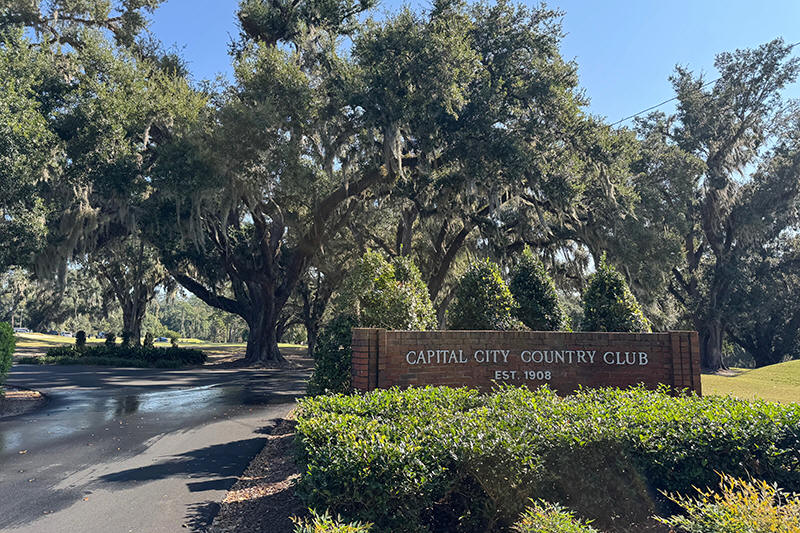
A sign for the Capital City Country Club stands, Oct. 22, 2025 in
Tallahassee, Fla. (AP Photo/Kate Payne)

Prospect of sale angers activists
The prospect of selling the land that includes the burial grounds is
an outrage to Delaitre Hollinger, a local activist whose ancestors
were enslaved in Leon County, where on the eve of the Civil War,
three out of every four residents were human chattel owned by elite
white families. Hollinger helped lead the push to memorialize the
rediscovered graves.
“They were sold on the auction blocks of Leon County, and now we are
willing to sell them again,” Hollinger said at Wednesday's
commission meeting.
In Leon County, there are only a handful of known slave burial sites
— despite the scores of plantations that once dominated the area,
which was the epicenter of Florida's slavery economy.
Now residents and some commissioners are questioning why it has
taken city staff years to act on plans to commemorate the site.
City administrators have attributed the delay to negotiations around
enacting the agreement, as well as damaging tornadoes that hit the
area in 2024.
Calls to identify those interred at the site
Kathleen Powers Conti, a Florida State University history professor
who specializes in the preservation of sites of trauma and contested
history, decried the proposal and urged the city to proactively work
to identify those interred at the site.
“I am frankly shocked that in all of these conversations, no one in
the country club, no one in the city commission is actually looking
to find the descendants of those people buried there,” she said at
Wednesday's meeting.
For Hill and other advocates, the people whose final resting place
is now another Florida golf course have been denied dignity for too
long — in life as well as in death.
“It's our history,” Hill told the commission. “It could be my
ancestor that's in there.”
All contents © copyright 2025 Associated Press. All rights reserved
 |