China's next 5-year plan puts focus on tech and consumers as trade wars
drag on economy
[October 24, 2025] By
CHAN HO-HIM, HUIZHONG WU AND KEN MORITSUGU
HONG KONG (AP) — China's leaders are vowing to reduce its reliance on
foreign advanced technology and spur stronger domestic demand as it
weathers “high winds” amid elevated trade tensions with the U.S.
An outline of the ruling Communist Party's blueprint for the next five
years was laid out in a 5,000-word communique released Thursday after a
four-day top level meeting in Beijing, just days ahead of planned talks
between Chinese leader Xi Jinping and U.S. President Donald Trump.
Five-year plans are a throwback to the days of Soviet-style central
planning. China still relies heavily on them to map out policy
priorities and decide on funding. Party “plenum” meetings like the one
held this week also are used to rally the party rank-and-file around
Xi's leadership.
Thursday's announcement signaled no major policy shifts. Despite
mounting trade tensions, China intends to remain a global manufacturing
power while building stronger economic growth at home.
China gains confidence in the trade war
The communique does not refer directly to the trade war between Beijing
and Washington, but warns of rising “uncertainties and unforeseen
factors.”
Han Wenxiu, a senior party official in financial and economic policy,
told reporters Friday that China is well placed to handle such risks in
an era when great-power competition is becoming more complex and “the
international balance of power is undergoing profound adjustments.”
He predicted China's strength and international status would grow in the
next five years. “There is always opportunity in crisis and crisis can
be turned into opportunity,” Han said.

Chi Lo, an Asia Pacific senior market strategist at BNP Paribas Asset
Management, said an emphasis in the communique on substantial
improvements in scientific and technological self-reliance likely
reflects confidence that China is less vulnerable to pressure from the
trade war.
The party vowed to achieve “markedly stronger” international influence
by 2035 and to safeguard the multilateral trading system, portraying
Beijing as a defender of free trade, noted Leah Fahy, a China economist
at Capital Economics.
Domestic economic challenges remain
A downturn in the property sector that began while China was still in
the midst of disruptions from the COVID-19 pandemic has sapped consumer
confidence, reducing household wealth and leading to widespread layoffs.
China’s communique emphasized the strategic need to expand domestic
demand. The government has already encouraged investment to modernize
factories and paid subsidies to people who replace old appliances and
vehicles with new ones.
“The economies of major countries are all driven by domestic demand and
the market is the most scarce resource in today’s world,” said Zheng
Shanjie, head of the National Development and Reform Commission,
Beijing’s main planning agency.
But manufacturing capacity exceeds demand in many industries. That has
caused damaging price wars and led companies to boost exports, adding to
trade tensions with the U.S., the European Union and others.
Even with strong government support, the economy grew 4.8% in the last
quarter, the slowest pace in a year. Factory activity shrank for the
sixth consecutive month in September, as domestic demand remained
sluggish.
China's leaders have stuck to their goal of attaining the status of a
“mid-level developed country" and doubling the size of the economy in
2020 by 2035.
That implies an average annual growth rate of about 4-5% in the next
decade, said Lynn Song, chief economist for Greater China at ING Bank.
[to top of second column] |
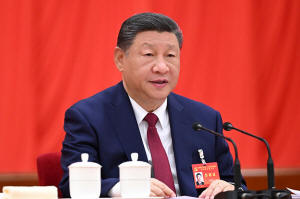
In this photo released by Xinhua News Agency on Thursday, Oct 23,
2025, Chinese President Xi Jinping speaks during the fourth plenary
session of the 20th Communist Party of China (CPC) Central Committee
in Beijing. (Xie Huanchi/Xinhua via AP)

China will remain a manufacturing juggernaut
China is the world’s biggest manufacturer, accounting for roughly 30% of
global production and about a quarter of its overall economy. The new
5-year plan calls for keeping manufacturing at an “appropriate level”
with advanced industries as the backbone.
China’s focus on the manufacturing sector "will remain a top priority,
even in the face of overcapacity (and) price wars,” said Fahy of Capital
Economics.
Over the years, Chinese manufacturing has progressed from
labor-intensive, low-cost production to higher-value products including
electric vehicles, robots and batteries. In coming years, the emphasis
will be on advanced manufacturing, said Robin Xing, chief China
economist at Morgan Stanley.
That includes areas such as quantum technology, biomanufacturing,
hydrogen and nuclear fusion energy, artificial intelligence and
next-generation mobile communications, said Zheng, the planning agency
chief.
“These industries are ready to take off,” he said. “It means that in the
next 10 years we will build another high-tech industry in China and this
will inject continued impetus to our efforts to achieve Chinese
modernization.”
It's unclear if China's commitment to catalyzing more consumer spending
and domestic investment will make much of a dent in its exports.
Chinese companies like BYD and CATL have become global leaders in EV
battery technology and production. China plays a pivotal role in global
supply chains and has shown it can control access to rare earths,
materials used in many products.
“The Chinese government sees manufacturing as a core issue in security
and geopolitical leverage over other countries,” added Gary Ng, a senior
economist at Natixis.
Xi continues to centralize power
The four-day plenum was marked by relatively low attendance.
Out of 205 full members in the elite Communist Party central committee,
only 168 were there, according to the communique. Many have been purged
in anti-corruption campaigns that also enforce loyalty to Xi within the
party.
An "unprecedented proportion of central committee members are in
political trouble," said Neil Thomas, a fellow at the Asia Society
Policy Institute’s Center for China Analysis.

The meeting appointed Gen. Zhang Shengmin as China's second highest
ranking general. He replaced He Weidong, who was ousted from the party
along with eight other senior officials in a recent anti-corruption
drive.
As the party continues to centralize power, “the political position
faced by Xi and his dominance within the party is still relatively
secure” said Xin Sun, a senior lecturer in Chinese and East Asian
business at King’s College London.
___
Wu reported from Bangkok and Moritsugu reported from Beijing. Associated
Press researchers Yu Bing and Shihuan Chen in Beijing contributed.
All contents © copyright 2025 Associated Press. All rights reserved |