Hundreds of thousands of Hungarians attend rival rallies in Budapest as
Orbán faces election test
[October 24, 2025]
By JUSTIN SPIKE
BUDAPEST, Hungary (AP) — Hundreds of thousands of Hungarians filled the
streets of Budapest on Thursday in competing demonstrations as
supporters of the country’s two main political movements staged mutual
shows of strength before next spring’s national election.
The rival rallies were a standoff between nationalist Prime Minister
Viktor Orbán and his main political challenger, Péter Magyar, who looks
set to present the long-serving Hungarian leader with the most
competitive ballot in his 15 years in power.
The election is due in April, but an exact date for the vote hasn't been
set.
Orbán's supporters gathered on a bridge spanning the Danube River on
Thursday morning and began marching toward Hungary's towering neo-Gothic
parliament. The rally, dubbed a “peace march” by organizers, came on
Hungary’s Oct. 23 national holiday, a remembrance of a failed
anti-Soviet uprising in 1956 that was crushed by the Red Army.
Participants shouted slogans backing Orbán, and his message that foreign
powers threaten to push Hungary into direct involvement in Russia's war
in Ukraine. At the front of the march, one large banner read: “We don’t
want to die for Ukraine.”
Addressing the crowd in a speech riddled with hostility for both Ukraine
and the European Union — regular subjects of his ire — Orbán accused
Kyiv's European backers of having brought the EU into the war, and of
being willing “to send others to die.”

Orbán, considered Russian President Vladimir Putin’s closest partner in
the EU, has consistently argued against Western support for neighboring
Ukraine since Moscow launched its full-scale invasion on Feb. 24, 2022,
and has maintained warm relations with the Kremlin while taking a
combative posture toward Kyiv.
The Hungarian leader also has vehemently opposed Ukraine's ambitions to
join the 27-nation EU and has argued for an immediate ceasefire in the
conflict, though he hasn't addressed what that might imply for Ukraine’s
territorial integrity or European security amid continuing Russian
aggression.
During his roughly 40-minute speech, Orbán said that Ukraine “has long
ceased to be sovereign, independent and is absolutely not
self-sufficient.”
He said he would support a strategic partnership between the EU and
Kyiv, but that Ukraine "cannot be members either of our military or
economic alliance. They would bring war, take our money and ruin our
economy.”
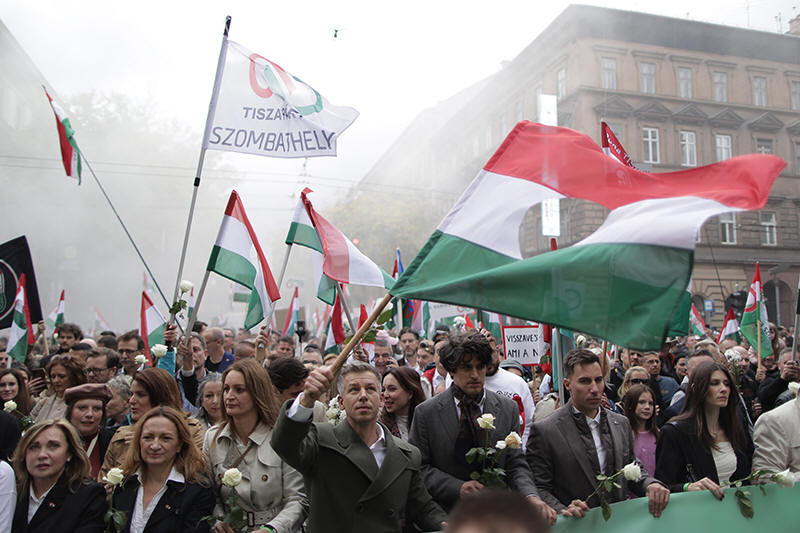
Later in the day, throngs of supporters of opposition leader Magyar
filled one of Budapest's central squares and adjacent avenues for their
own demonstration — both an anti-government protest and a show of
support for Magyar and his center-right Tisza party.
Marchers shouted anti-government slogans, as well as “Russians go home!”
— a refrain from Hungary's 1956 anti-Soviet rebellion and a modern
reference to many people's view that Orbán has drawn the country too
close to Moscow.
One Tisza supporter, Zsanett Kiss, traveled from Pápa in western Hungary
to attend the march. She said she believed Magyar would be able to
improve Hungary's stagnate economy, but also to bring the country back
to a more democratic path.
[to top of second column]
|
The leader of the Hungarian opposition TISZA party, Peter Magyar,
foreground and center, rallies during a demonstration marking the
69th anniversary of the outbreak of Hungary's 1956 revolution
against communist rule and the Soviet Union, in Budapest, Hungary,
Thursday, Oct. 23, 2025. (AP Photo/Rudolf Karancsi)

“I want there to be a change already in this country, and I can say
that I’ve had enough, enough of the last 15 years," she said.
Magyar, a 44-year-old lawyer and former insider within Orbán’s
Fidesz party, burst into political prominence last year, and has
focused his message on bread-and-butter issues affecting the
majority of Hungarians: persistent inflation, poor health care and
increasingly salient allegations of government corruption — all
sources of dissatisfaction that have plagued Orbán’s government.
Magyar has focused his campaign on the rural countryside,
traditionally a reliable voting bloc for Fidesz. He recently ended
an 80-day tour of the country where he held scores of town
hall-style forums, giving speeches and taking questions from
attendees.
Speaking to the crowd of his supporters that filled Budapest's
sprawling Heroes' Square, Magyar accused Orbán of impoverishing the
country by misusing public funds, and of turning Hungarians against
one another.
However, he also struck an inclusionary tone, encouraging his
supporters to embrace their political opponents following next
April's election.
“I call on everyone to stick together and endure these six bitter
months, and then to reach out to those who gathered at another event
today,” Magyar said. He encouraged the crowd to imagine a future in
which, "on October 23 of next year, there are not two contemptuous
crowds facing each other, but a nation united, celebrating and
smiling at each other.”
The dueling marches on Thursday were seen as a barometer of which
politician had more energy behind his campaign as the election
nears. Orbán is lagging in the polls behind Magyar’s Tisza, and with
six months before the ballot, the prime minister has struggled to
reinvigorate his base.
Still, the EU's longest-serving leader remains popular among a
sizable portion of Hungary's voters, and on Thursday was able to
successfully mobilize many thousands to Budapest in his support.

Scores of buses that were used to transport participants from around
Hungary and neighboring countries were parked near the
pro-government march route. One marcher, Sándor Kerekes, said that
he had come to the event from the ethnic Hungarian-majority town of
Fantanele, in Romania’s Transylvania region.
“It’s important for us to feel like we can meet with like-minded
people, that we think the same things and think with unity,” he
said.
All contents © copyright 2025 Associated Press. All rights reserved |