Trump gives disaster declarations to Alaska and others but denies
Illinois, Vermont and Maryland
[October 24, 2025]
By GABRIELA AOUN ANGUEIRA
President Donald Trump approved major disaster declarations for Alaska,
Nebraska, North Dakota and the Leech Lake Band of Ojibwe late Wednesday,
while denying requests from Vermont, Illinois and Maryland and leaving
other states still waiting for answers.
The decisions fell mostly along party lines, with Trump touting on
social media Wednesday that he had “won BIG” in Alaska in the last three
presidential elections and that it was his “honor” to deliver for the
“incredible Patriots" of Missouri, a state he also won three times.
The disaster declarations authorize the Federal Emergency Management
Agency to support recipients with federal financial assistance to repair
public infrastructure damaged by disasters and, in some cases, provide
survivors money for repairs and temporary housing.
While Trump has approved more disaster declarations than he's denied
this year, he has also repeatedly floated the idea of “ phasing out ”
FEMA, saying he wants states to take more responsibility for disaster
response and recovery. States already take the lead in disasters, but
depend on federal assistance when the needs exceed what they can manage
alone.
Trump has also taken longer to approve disaster declaration requests
than in any previous administration, including his first, according to
an Associated Press analysis.
Approvals fell mostly along party lines
The states approved for disaster declarations include Alaska, which
filed an expedited request after experiencing back-to-back storms this
month that wrecked coastal villages, displaced 2,000 residents and
killed at least one person. Trump approved a 100% cost share of
disaster-related expenses for 90 days.

North Dakota and Nebraska will also receive public assistance for August
severe weather, and the Leech Lake Band of Ojibwe in Minnesota was
approved for both public and individual assistance for a June storm that
felled thousands of trees across its tribal lands.
Trump denied four requests, including Maryland's appeal for
reconsideration after the state was denied a disaster declaration for
May flooding that severely impacted the state's two westernmost
counties.
Gov. Wes Moore, a Democrat, denounced the decision in a statement
Thursday, calling the final denial “deeply frustrating.”
“President Trump and his Administration have politicized disaster
relief, and our communities are the ones who will pay the price,” said
Moore. The state has been supporting impacted individuals itself,
deploying over $450,000 for the first time from its State Disaster
Recovery Fund.
Maryland met the conditions necessary to qualify for public assistance,
according to a preliminary damage assessment, but Trump, who has the
final decision on the declarations, denied the state's July request.
Maryland appealed in August with further data showing the counties
experienced $33.7 million in damage, according to the state, more than
three times its threshold for federal assistance.
Trump also denied Vermont a major disaster declaration for July 10
floods after the state waited over nine weeks for a decision. The
damages far exceed what some of the small towns impacted can afford on
their own, said Eric Forand, Vermont's emergency management director.
[to top of second column]
|
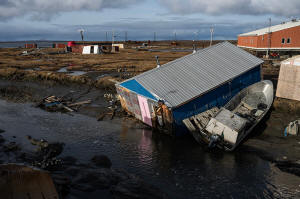
A home is left damaged in Kipnuk, Alaska, on a stream bank after the
remnants of Typhoon Halong caused widespread destruction in the
coastal village in Western Alaska, Friday, Oct. 17, 2025. (Marc
Lester/Anchorage Daily News via AP)

“It’s well over the annual budget or two years’ budget (of some
towns), to fix those roads,” Forand said.
The other denials included an application from Illinois for
individual assistance for three counties impacted in July by severe
storms and flooding, and one from Alaska to rebuild a public safety
building that burned in a July electrical fire.
Asked why the states were denied, White House spokesperson Abigail
Jackson said, “President Trump provides a more thorough review of
disaster declaration requests than any Administration has before
him.” She said Trump was “ensuring American tax dollars are used
appropriately and efficiently by the states to supplement — not
substitute, their obligation to respond to and recover from
disasters.”
Assistance granted after weekslong wait
Several states and one tribe still await decisions on their
requests.
Not knowing whether public assistance is coming can delay crucial
projects, especially for small jurisdictions with tight budgets, and
sometimes leaves survivors without any help to secure temporary
housing or repair homes now too dangerous to live in.
Before its approval Wednesday, the Leech Lake Band of Ojibwe was
straining to cover the costs of clearing thousands of trees felled
across its reservation by a June thunderstorm. As a tribe, it is
entitled to apply for assistance independently of the state where it
is located.
The tribe had spent about $1.5 million of its own funds so far, said
Duane Oothoudt, emergency operations manager for the Leech Lake
Police Department.
The tribe was "doing a lot of juggling, using reserve funding to
operate and continue paying our contractors,” Oothoudt said just
hours before being notified of the disaster declaration, nine weeks
after submitting the request.
With federal funding approved for both public and individual
assistance, Oothoudt said Thursday his one-man emergency management
department would focus on helping survivors first.
“There's a lot of work to do,” he said. “People were hurt by the
storm.”
___
Associated Press writer Brian Witte in Annapolis, Maryland,
contributed.
All contents © copyright 2025 Associated Press. All rights reserved
 |